

We’re now in the final stretch of a rather eventful year for the AI buildout. The market and plenty of outsiders are convinced we’re in the late stages of an AI bubble, yet the largest players in the ecosystem keep using their cash flow and credit to scale their datacenters. Nobody paying attention should be surprised by this (the payback period on 1GW of compute is currently about one year), but it remains a major source of tension between most of the Mag7 and their large, very conservative shareholders.
This week we take the pulse of the industry through the earnings calls of the key players.
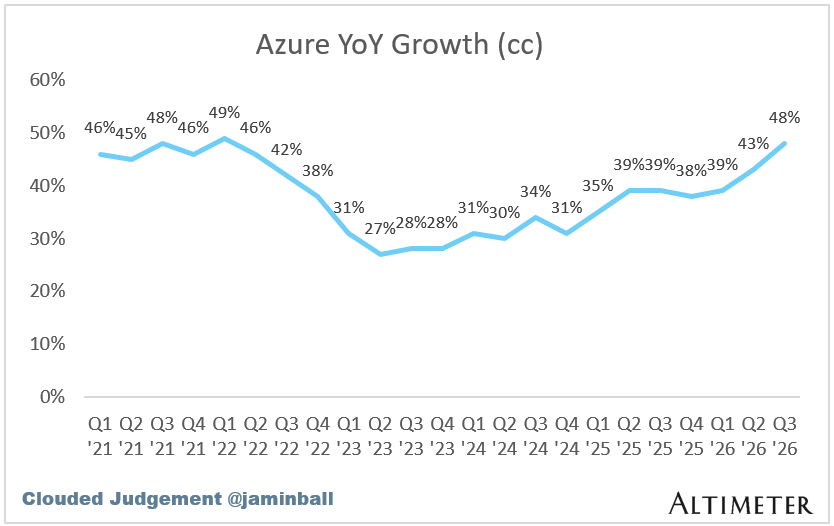
Satya Nadella: Thank you very much, Jonathan. It was a fast start to our fiscal year. Microsoft Cloud revenue surpassed $63 billion with growth accelerating to 30% year-over-year. We are focused on 3 things: designing AI to empower people, ensuring every organization has sovereignty over its own learning and building trust with controls that ensure agent safety and security. Now let’s talk about how we are making progress on those goals as we build a new tech stack, starting with Copilot. We announced our biggest update to Copilot to date this quarter, bringing together Chat, Cowork, Autopilot and Code into one unified experience. It’s one product experience across commercial and consumer and comes with all of Office built in.
We think of Copilot as the new OS for work. Customers are increasingly turning to Copilot to get real work done. Automated tasks have nearly doubled since July. Daily users are up nearly 50% quarter-over-quarter and over 5x year-over-year. User satisfaction improved nearly 20% quarter-over-quarter to another all-time high. And 90% of Copilot queries use Auto mode, which dynamically routes tasks across models optimizing for quality, speed and cost. These improvements are translating into larger purchases. The number of customers with more than 50,000 Copilot seats increased over 8x year-over-year, including Capgemini, HCLTech, Hitachi Group, Truist Financial and U.K. Revenue and Customs Department.
And just last week, Volkswagen announced plans to deploy Copilot to more than 330,000 employees, one of the largest deployments to date in Europe. We’re also seeing strong momentum with E7, which brings together Copilot, E5, Entra and Agent 365. Thousands of customers in every industry have purchased the suite to date, including Amadeus, BlackRock, Fiserv and New South Wales Health Department and ZEISS. Our business model is expanding from per seat subscriptions to include consumption, expanding our TAM and ARPU. The subscription brings increasingly capable everyday intelligence to every user. Typically, IT funds this, consolidating frontier advances for everyone across the organization.
And as agents take on higher-value work, consumption opens up business funded demand with spending tied directly to the value these agents deliver. The number of Copilot customers actively consuming credits through usage-based billing grew over 75% over the quarter. When it comes to software development, all major coding agents have shown up to work on GitHub. Agent-generated PRs have increased 6x over the past 6 months, and agents now open more than 1/3 of all PRs on the platform. We are very hard at work on reliability as agentic activity on GitHub soars. At GitHub Universe this morning, we shared how we are expanding capacity and rebuilding the core Git architecture for the Agentic wave.
Microsoft is in a peculiar transition. It had a real first-mover advantage: it could roll OpenAI’s models out for free to its largest ZIRP-era customers. It threw that away. Copilot became a toxic brand and is now being phased out even on laptops, which have all shipped with a Copilot key for the last few years.
Still, Satya believes distribution matters more than product quality or branding, so he keeps pushing his teams to improve the enterprise customer experience.
Satya Nadella: Also at Universe, we announced broad availability of Copilot Fusion, which is all about bringing multi-model orchestration to software development. It delivers frontier-level quality up to 40% faster and at up to 77% lower cost. Credit consumption from Agentic features on GitHub has more than doubled since usage-based billing went into effect. And we’re also helping developers secure their code and turn AI-generated code into high-quality software. GitHub Advanced Security revenue increased over 50% year-over-year as customers use its AI capabilities to scan entire repos and fix vulnerabilities in real time.
In the business application space, we are extending this vision of Copilot as the new OS for work, bringing the business logic and capabilities of Dynamics 365 directly into Copilot and helping every organization stand up their own infinite SaaS factory. This quarter, we introduced 30 new Copilot skills across Dynamics 365, which enables customers to access CRM and ERP capabilities directly in the flow of work. In recruiting, more than 10 million LinkedIn members use our LinkedIn AI-powered job search daily and 25,000 customers are using our agentic hiring solutions. Recruiters using Hiring Assistant are finding interview quality applicants 33% faster while reviewing 83% fewer profiles to find qualified match.
Most coding inference now happens outside GitHub Copilot, and Microsoft is trying to fill the gap Cursor left after the SpaceXAI acquisition (especially now that OpenAI has pulled its models). With those enterprise customers, it’s playing something close to a “model sovereignty” game. Whether the bluff works, given an inferior harness at a higher price than the alternatives, remains to be seen.
Bringing Dynamics 365 into Copilot is another attempt to counter the shift of agentic work revenue towards Anthropic, and very aggressive plays like Claudeforce.
Brad Reback: Great. Sorry about that. I did not hear my name. On M365 consumption, when you all shifted GitHub from a per seat model to a consumption model, it unlocked a ton of revenue growth for you all. As you think about the tools in place now unlocked on the consumption side for the core M365 customer, do you think the unlocks is fast and without sales effort? Or is it going to take a fair amount of effort to get those meters spinning?
Satya Nadella: Yes. Thanks for the question. I think on the coding side, it will be faster just because I think people are used to paying on this PayGo as the sort of the general market and how it works. And if anything, hopefully, some of the things that we announced even at GitHub Universe today with Fusion are a more attractive way, right? Because you even -- if you think about it, right, you buy a bunch of credits and you want to use those credits most efficiently. That’s the promise of GitHub Copilot Fusion. So we are very optimistic about making progress on that.
And then when it comes to Copilot itself, right, we are trying to make sure that we, in some sense, are driving more and more value into the subscription with every model drop and essentially consolidating the frontier gains for broad deployment. And in many instances, as my remarks said, IT funds this, right? That’s the thing that you want to have standard issue across the board. And at the same time, you have your Pay-As-You-Go or consumption meters for places where you need it. And so -- so both of those options are open. And I think that’s why the -- in the Copilot, Amy referenced, which is we are trying to make sure that customers understand both options.
They’re able to use the 2 options in the optimal way that benefits them. We don’t want them to overbuy one thing and then feel like they’re token maxing because that doesn’t serve anybody’s purpose. We want to make sure that they understand the value of the subscription and how it’s a continually improving value. It’s not even static. And at the same time, you can exercise this consumption meter. And so that’s a little bit of the degree of sophistication in both in our sales motions, even customers’ understanding that’s, I think, coming together. We feel very good about the progress, but a lot more to do.
It’s a bit funny that in the space of 24 months Satya has gone from easily the best CEO in the industry to someone struggling to find the right direction for the company. Microsoft, and the Azure team in particular, absolutely dominated the peak of the ZIRP era, and it’s sitting on many, many large seat contracts with global enterprises. Anthropic’s S-1 showed it is already bringing in tens of billions in revenue from agentic work, yet it barely touches 0.1% of Fortune 500 spend. Microsoft, the company best positioned to monetize this through distribution, is only now moving to a consumption model for agentic work, and has yet to show in any meaningful way that its Copilot “harness” adds value on top of those tokens.
Tal Liani: Just a clarification on something you just said. Did you disclose the Copilot numbers this quarter? But my question is more about the capital commitment or the capital strategy. You said in the prepared remarks that you will approach raising capital if need be in the future. Can you discuss your strategy around it between debt and equity and other sources? How do you intend to raise capital if need be?
Amy Hood: Great. I’ll take that. Look, I think what I said is that if it’s attractive and makes sense, we’re lucky. We have a lot of flexibility in terms of our capacity to raise financing. I’ve talked about this before. There’s a form of financing called leasing, and we’ve been using that one as a vehicle. There’s also -- we’re fortunate to have access in the debt markets given that where our ratings are and sort of we haven’t been able to -- we haven’t yet, I would say, tapped that. And then, of course, there’s other options. But I think the way I see it is we’re feeling good that we’re free cash flow positive.
We feel good that the return on every dollar of CapEx we’re spending, we’re confident in that. And therefore, we feel like we have lots of options to be able to tap the financing markets when they make sense and they’re attractive. And we did not disclose to answer your direct question, an update on the Copilot number this quarter. We talked about momentum in revenue and usage.
Just as Amazon hid its AI revenue for almost 18 months, Microsoft doesn’t want to disclose any hard numbers on Copilot’s agentic consumption. This is probably where “Satya’s flinch”, the slowdown in infrastructure spending, hurt Microsoft the most. I think the most realistic play for Microsoft would have been to dominate infrastructure investment and aggressively poach talent to build the best agentic harness in the industry. Priced below the frontier labs, benchmarking at parity and pushed on top of existing MACC commitments, that product would have been unstoppable.
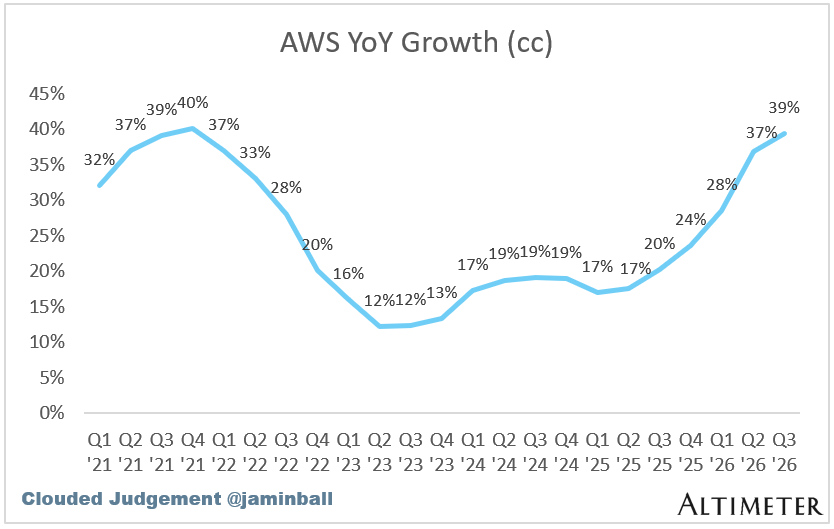
Andy Jassy: Thanks, Dave. We’re reporting $201.9 billion in revenue, up 12% year-over-year. Operating income was $28.1 billion, up 61% year-over-year. Q3 was another strong quarter for Amazon. In AWS, our plan is working. Despite lapping a comparable year-over-year period where we added a lot of capacity, AWS grew 39.3% year-over-year, accelerating for the sixth straight quarter, our fastest growth in nearly five years. Backlog is $578 billion, growing triple digits year-over-year and well-diversified. We’re installing an AI accelerator about every 14 seconds, and almost as fast as we install capacity, customers are gobbling it up. Our core compute and storage revenue grew at their fastest rates in several years.
Our operating margins have long been strong on our core offering, but rapidly improving on the AI side too, well ahead of where they were on core at a similar time of evolution. Even with heightened component costs like memory and significant depreciation from the CapEx we’re investing. We continue to accelerate our CapEx payback and have even more conviction than we already had that the investment we’re making in AWS will yield a much larger revenue and free cash flow-generating business than we would have imagined a couple of years ago, with strong return on invested capital. We have a compelling flywheel spinning in AWS.
Borrowing from Jim Collins’ flywheel definition in “Good to Great,” where if you do A, you almost can’t help but do B, and if you do B, you almost can’t help but do C, and so on. In AWS, having the leading functionality, security, and operational performance can’t help but drive customers to run their apps and store their data in AWS, which can’t help but drive AWS AI demand because customers prefer their production inference to be near the rest of their data and apps, which can’t help but drive core AWS demand because AI uses core for work like reinforcement learning, post-training, and tool usage, which can’t help but drive reinvestment back into our broader AWS functionality.
This is a different model than primarily hosting GPUs or renting short-term data center capacity. This is a long-term platform strategy that broadly helps customers invent and evolve their customer experiences, operate stably, and build a reliable partnership they can grow for many years. It also yields very attractive long-term economics for us, regardless of supply scarcity. There are many examples that illustrate our progress in AWS, but I’ll share a few. On the core side, it’s important to remember that the vast majority of global IT spend, about 85%, is still on premises, and we’re in a 10- to 20-year cycle where that equation will flip to the cloud.
Conventional wisdom has been that linchpin workloads like mainframes or storage area networks would never move to the cloud, but these workloads are moving as AWS has built unique cloud substitutes and AI-driven migration capabilities to make this transition much easier. Enterprises get the benefits of less CapEx, lower operating costs, faster innovation, better developer productivity, and data accessibility to more easily leverage AI. Our core business has attractive margins because we’ve learned to run it very efficiently over the last 20 years. As our core business grows, we keep reinvesting in our core and AI functionality.
For example, as customers generate increasingly more data and seek to get value from it in analytics and AI, the complexity of moving data between data stores and analytics engines is onerous and expensive. With our acquisition of DuckLabs, DuckDB will become the universal SQL dialect of AWS Storage and Analytics, simplifying data processing with a modern analytics engine that is fast, simple to use and ubiquitous, and where customers will be able to write SQL queries once and then execute using any AWS analytics service. For the first time in analytics, customers will have zero migration or portability costs between query engines.
This is a big deal, and you can imagine how it will also help agents do efficient querying as well. On the AI side, we continue to expand the capabilities of our inference service, Amazon Bedrock, and it is leading to remarkable growth, with Fortune 500 companies spending nearly 7x more on Bedrock year-over-year and total Bedrock token volume growing nearly 17x year-over-year. Bedrock is the fastest growing multi-billion dollar service in AWS’s history. We have recently added OpenAI models to Bedrock and usage is growing quickly. We also just added Bedrock-managed versions of Kimi, GLM, and SpaceX models. You cannot have a conversation about AI today without talking about security, and it is another reason customers keep choosing Bedrock.
We have designed Bedrock so customers’ data remains secure and private. Inputs and outputs are never shared with model providers or used to train base models. When customers tune a foundation model, we create a private copy specifically for their use, and data is fully encrypted both in transit and at rest. As frontier models get more powerful, they are surfacing software vulnerabilities previously not found and at unprecedented rates. We built AWS Continuum to discover, prioritize, validate, and remediate code vulnerabilities at machine speed. It is already being used by customers like Capital One, IBM, Infor, Luminate, and Robinhood.
In Q3, we announced that we will integrate it into the tools where code is being written, Anthropic’s Claude Code, OpenAI’s Codex, and AWS’s Kiro. The interest from customers exceeds anything we have ever seen for a new security service. Agents continue to be deployed at accelerating rates, many of which are being built on AgentCore’s building blocks. Tens of thousands of customers currently use AgentCore, deploying 2x more agents with it in Q3 than the prior three quarters combined. In addition to building their own purpose-built agents, most companies will also use turnkey agentic services, and we offer several that customers love. Kiro for coding, Amazon Connect for contact center agents, and AWS Transform for migrations.
They are all iterating quickly and picking up customer momentum. As is Amazon Quick, our intelligent AI work companion, which is growing very rapidly as large enterprises like Mondelez, EchoStar, 3M, Southwest Airlines, and DXC Technology are choosing Quick because it is purpose-built for work with no compromises on customer data. Finally, our chips business continues to grow triple-digit percentages year-over-year, and revenue commitments for Graviton and Trainium have each increased more than 20x year-over-year. AI continues to be a tailwind for Graviton because post-training reinforcement learning and agent tool use is mostly done on CPUs versus AI accelerators, and Graviton is the strongest CPU chip, offering up to 30%-40% better price performance than alternatives.
Unlike Microsoft, Amazon has accepted its role as an infrastructure provider and has focused on scaling compute profitably (it even exited model training earlier this summer).
Andy Jassy: Customers using our custom silicon saved more than $2 billion in Q3 alone, and we just open sourced TorchNeuron so developers can run existing PyTorch code, which most already use on Trainium without rewriting a thing. As we launch new generations of chips, demand for prior generations remains strong. After our launch of Graviton5, backlog for prior generation Graviton instances still more than doubled quarter-over-quarter. Short-term capacity for prior generation Trainium instances sell at a premium compared to the first half of the year. With Trainium demand so strong, customers continue encouraging us to make it available outside of AWS. We intend to do so late in 2027. Overall demand for AWS capacity remains exceptionally strong.
Enterprises are still very early in using inference at scale, and yet inference already accounts for well over half of AWS’s AI revenue and growing, and we have a lot of training revenue as well. We still expect 2026 cash CapEx of approximately $220 billion, the majority for AWS, and expect to spend meaningfully more in 2027 with a clear line of sight to attractive financial returns, as I laid out on our last call. AWS is a $184 billion annualized revenue run rate business, and yet the opportunity remains extraordinary.
With our continued pace of innovation, new core and AI functionality, enterprises wanting to run their core and AI workloads in AWS, and the amount of capacity that we’re adding each year, we believe that AWS can grow north of 40% in each of 2027 and in 2028 and be a trillion-dollar revenue business in the next five to 10 years. We’re in the very early days of this inflection. Our strategy is working, and I expect it will for the foreseeable future. In stores, I think some folks are sleeping a bit on how much progress that business has made and what it’s become the last few years.
While Jassy took a lot of heat for how slowly AWS adapted to this new environment (including in every article in this publication that mentions Amazon), its recent return to high growth has been encouraging to see, especially given the size of its run rate.
Having given up on big hopes of capturing the AI application layer, AWS is in a good position to pivot even more aggressively when underperforming neoclouds start running out of money next year. Strategically, there are several ways for it to play this:
Energized sites, power contracts and grid interconnects. This is the prize, because time-to-power will be a major bottleneck for the foreseeable future.
GPUs. These are less exciting, because in theory they lose value fast and are tied to one Nvidia generation, and AWS’s margin story increasingly runs on Trainium. The catch is that Nvidia remains critical for model training, and older GPU generations have held on to stubbornly high hourly rental prices. In any case, the GPUs mostly secure the asset-backed loans, so the lenders end up owning them, not the shareholders.
Customer contracts. These can be rejected in bankruptcy or follow the customer elsewhere.
So the efficient move is buying assets in court-run sales, or simply leasing distressed capacity at low rates. Leasing also keeps the spend out of capex, which helps the free-cash-flow optics. Buying CoreWeave outright would mean taking on about $50 billion of debt, plus antitrust scrutiny of the #1 cloud buying the #1 neocloud.
Amazon wouldn’t be the only buyer:
Nvidia has every reason to stop chip-building hyperscalers from soaking up its best customers. It has already agreed to buy unsold CoreWeave capacity through April 2032.
Microsoft is the biggest offtaker; one report has it sourcing ~50% of incremental compute from third-party providers. It has the most contracted capacity to protect.
xAI/SpaceX is circling too: Musk has warned that 200+ neocloud firms could collapse, while SpaceX raises $40B in debt for GPUs.
Infrastructure funds would want the powered land.
Consolidation looks likely either way.
Justin Post: Great. Thank you. Andy, continued to see the cloud business accelerate, which is really nice, but the quarter-over-quarter growth slowed. I am just wondering if there is any call-outs there on the customer side or token costs or anything that kind of drove that and how you are thinking about the capacity adds in Q4. Brian, maybe just any impact of fuel costs on your guidance in Q4. Thank you.
Andy Jassy: I will start with the growth question. We are really pleased with the growth. 39.3% on a business that has got a $184 billion annual revenue run rate is quite unusual. Our fastest growth in about five years or six quarters consecutively of acceleration. We are adding quite a bit of capacity. I think if you look at what is driving the growth right now, it is a combination of a few things.First, on the AI side, the unusual top to bottom stack functionality we have, whether you are building your own model with SageMaker AI, which is the easiest way to build your own model, or you want to leverage one of the leading frontier models with high security and very strong price performance, people can use Bedrock. Whether you are building your own agents where we have capabilities like Strands and AgentCore to build and to run those securely and scalably, or you are going to use turnkey agents, which most companies do.
If you just look across, Kiro for coding and Amazon Connect for call center and AWS Transform for migrations and Amazon Quick, which is growing incredibly fast, as an AI companion at work. People are adopting those very quickly. We add a lot of capacity every quarter. The amount that we add every quarter is not equal. We are adding different amounts each quarter. If I look at how much we have added this year and what we have planned over the next, I will call it, eight quarters or so, which is about as far out as we get eight to 10 quarters. We have a lot of capacity coming as well.
Then, I layer on top of that too, just the impact of chips. We’re very well positioned for what’s happening in AI because increasingly, what you’re finding right now is most customers, every customer that uses AI at scale, but particularly enterprises now as they’re starting to deploy more inference into production, they are very eager to save on price performance. Trainium, with the meaningful advantage it has in price performance versus other alternatives, is very compelling to people. Then as more and more people are using AI in a very broad way, it drives a lot of the core in capabilities like reinforcement learning and post-training and tool calling.
We have the leading CPU chip in Graviton, which is about 30%-40% more price performant than the other x86 providers. So those things are really driving very significant growth. The amount of capacity we add each quarter will vary, but at this scale to be projecting growing over 40% year-over-year in each of 2027 and 2028 is pretty significant, and the fact that we believe that this can be a trillion-dollar revenue business in five to 10 years, it’s an extraordinary, unusual opportunity that we’re very excited to be pursuing.
It’s a real sign of the times that an analyst had the balls to get on an earnings call and complain that a $184B business had only accelerated from 37% to 39% YoY growth.
Doug Anmuth: Thanks for taking questions. When you think about the 40%+ AWS revenue growth each of the next two years and then the multi-year path beyond that, can you just talk about the CapEx required to drive that kind of revenue over the next couple of years and beyond? Also, Andy, any updates just to how you are thinking about the duration of returns on both servers and networking and then also data centers? Thanks.
Andy Jassy: Yeah. I’ll take them in reverse order. On the break even on our infrastructure, as I mentioned in my opening comments, we’re continuing to move that left. We’re continuing to make that shorter. There are a lot of cores, a little bit different from AI, it’s a little bit different from how you finance these things. It varies depending on which you’re talking about. But we’re continuing to make progress, as we historically have been pretty good at doing, if you think about AWS, at finding ways to extend useful lives and to make the break even sooner. We’re making good progress there too. On the CapEx involved to grow the way we’re talking about, it’s meaningful.
I think that the way we think about it, Doug, is that this is a once in a lifetime opportunity. I think what we’re seeing with AI, it’s the biggest transformation in our lifetime. If the idea of being able to grow 39% with $184 billion annual run rate and to grow 40% a year on top of that in each of the next two years, and ultimately end up as a trillion-dollar-plus business, we’re going to invest to continue being the leader. We are the leader today in the, I’ll call it the infrastructure and AI space.
Would it be more convenient if this type of acceleration and opportunity happened over 25 years and you could spread the CapEx over 25 years? Yeah, it might be more convenient, but that’s not the world that we live in, and that’s not the opportunity. We can fund this plan. I think it will forever change the size of Amazon. It will forever change our revenue, it will forever change our free cash flow, and we’re going to invest, and we’re going to pursue it to continue to be the significant leader like we are today.
This was a surprisingly good lesson in reframing.
“Oh, we don’t like the capex, it’s too high, please play it safe.”
“I know it’s not convenient for you, but we either become a $1T business or we die. Get used to it.”
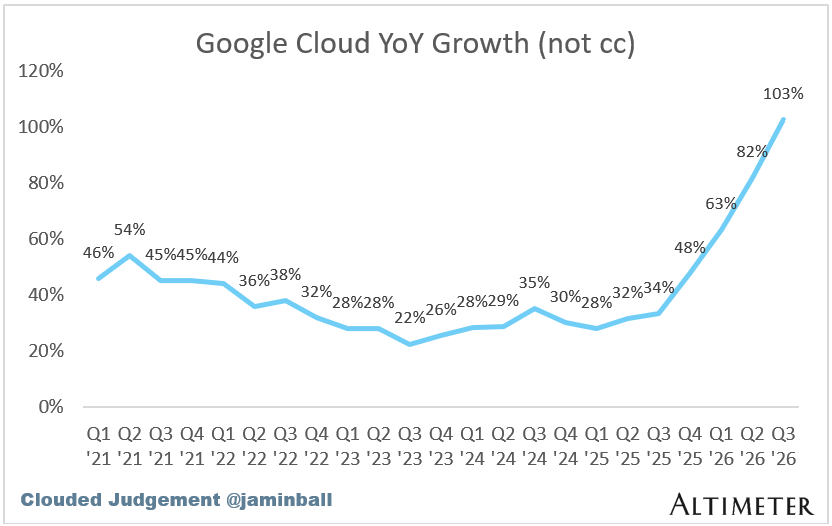
Sundar Pichai: Thanks, Jim, and hello, everyone. Q3 was a strong quarter for Alphabet. Our deep full stack approach is driving momentum across the business with many opportunities ahead. Let me give you a quick snapshot of the quarter. Alphabet revenues grew 25% year-over-year. We are now at $0.5 trillion annual run rate. That’s remarkable growth. Search has strong momentum. Our AI investments are driving increased usage and overall query growth, including commercial queries. In fact, our year-over-year query growth rate is the highest it’s been in the last 5 years. Google Cloud revenues grew 103%. Our AI infrastructure and solutions are the major drivers for Cloud growth and our customers see us as the leading provider here, so there’s huge demand.
We are working hard to bring more capacity online to meet this long-term demand. At the same time, we are seeing strong demand for our TPU systems across a wide range of customers, and we expect that to continue as we scale. I’m excited to welcome Thomas to the call, and he’ll share more about Cloud’s momentum. On our AI models, customers are using our models more than ever. Our first-party model APIs are now processing nearly 32 billion tokens per minute, 40% more than last quarter and more than 4x what we processed a year ago. And with Gemini 4 Argon and now Carbon, which we announced today, we are excited to be leading at the frontier.
The Gemini app is now at 1 billion users and is the fastest-growing product in Google’s history. Lastly, we have surpassed 150 million YouTube Music and Premium subscribers globally, including trials. Today, I’ll talk more about our AI progress, our global consumer platforms led by Search and YouTube, then our long-term bets. Starting with AI, highlighted by our Gemini 4 series of frontier models. We are seeing strong demand and usage for Argon, which we launched 2 weeks ago. In fact, on our developer platforms, usage in the first week ramped up 3.5x faster than Gemini 3, even with capacity constraints. Argon is proving to do really well in areas like finance, legal, cybersecurity and science.
Developers and cloud customers are already using it for things like untangling legacy code bases, accelerating scientific research, robotics, discovering product improvements and domain-specific tasks requiring in-depth reasoning. And at Google, just in the last few weeks, teams across Chrome, Ads and Search have used Argon to write and optimize code much faster, shipping 35% more code with 30% fewer errors. Argon is just the start of the Gemini 4 series. Today, we announced Carbon. It’s our strongest frontier model with state-of-the-art cybersecurity and long horizon capabilities. It ranks #1 on the recently updated artificial analysis intelligence Index at 59. Carbon outperforms Argon across almost every domain like full stack web development, multimodal understanding, complex knowledge work and scientific reasoning.
We are rolling Carbon out first to a subset of trusted cyber defenders before we expand access, and it’s being tested by the U.S. government. Beyond our Gemini 4 series, yesterday, we announced Genie 4, our most advanced world model yet that simulates safe, realistic, interactive worlds with native audio in real time. This is an important building block for training robots and agents. This rapid progress underscores our incredible model momentum. We are at the point where AI is helping us increase our training and launch velocity. I would expect the next 12 months to see continued acceleration because of RSI.
We have more models coming soon, including more efficient versions to help developers optimize for speed and cost and to deploy across our billions of users.
Google Cloud sits in an interesting place.
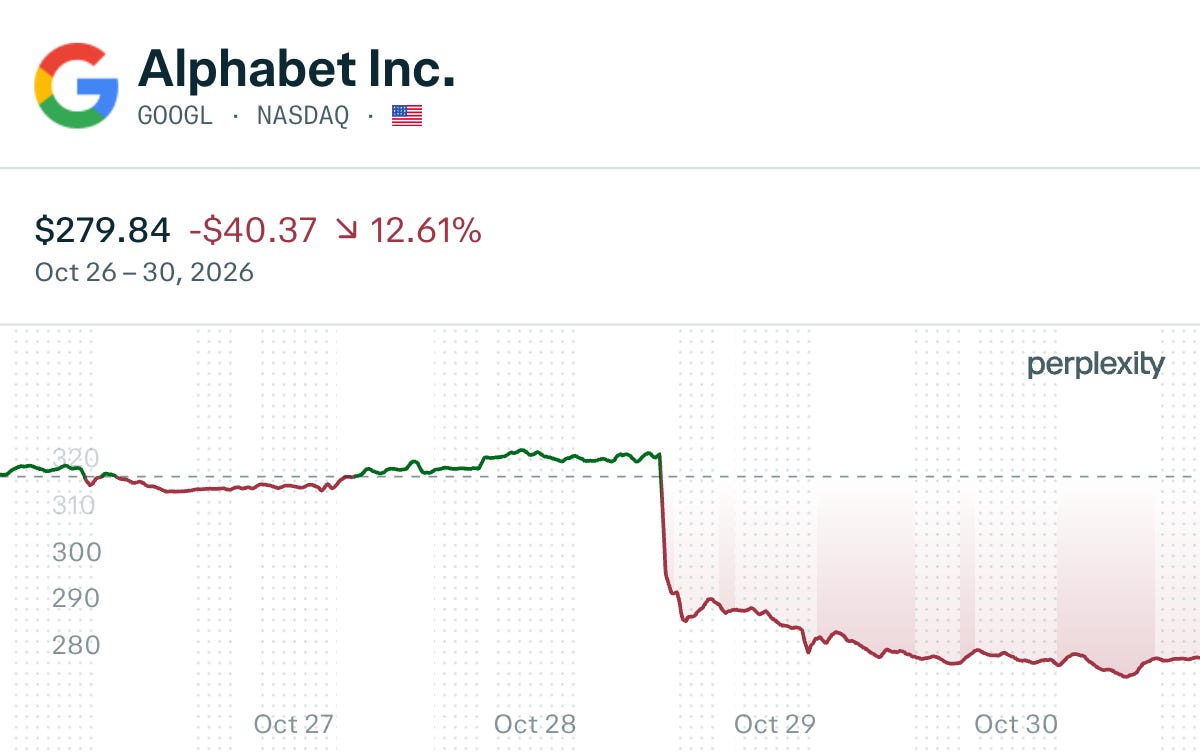
Alphabet had its strongest quarter ever for scaling its infrastructure business, yet the market’s punishment was swift and merciless.
The EPS miss was mostly noise. EPS came in at $2.12 against roughly $3.00 expected, but $0.55 of that was an $8.7 billion paper loss on equity investments.
Capex is now funded with outside money. Capex hit $51.4 billion and free cash flow went negative $9.1 billion. Alphabet raised $28.7 billion in bonds and $12.4 billion in new equity to cover the gap.
2027 is a blank check. Management says capex will “increase significantly” next year and won’t give a number until the Q4 call.
Search is losing monetization. Revenue grew 12% while query volume grew at its fastest pace in five years (each query is earning less).
Cloud got ignored. Revenue grew 103% to $30.7 billion at a 36% margin, on a $561 billion backlog.
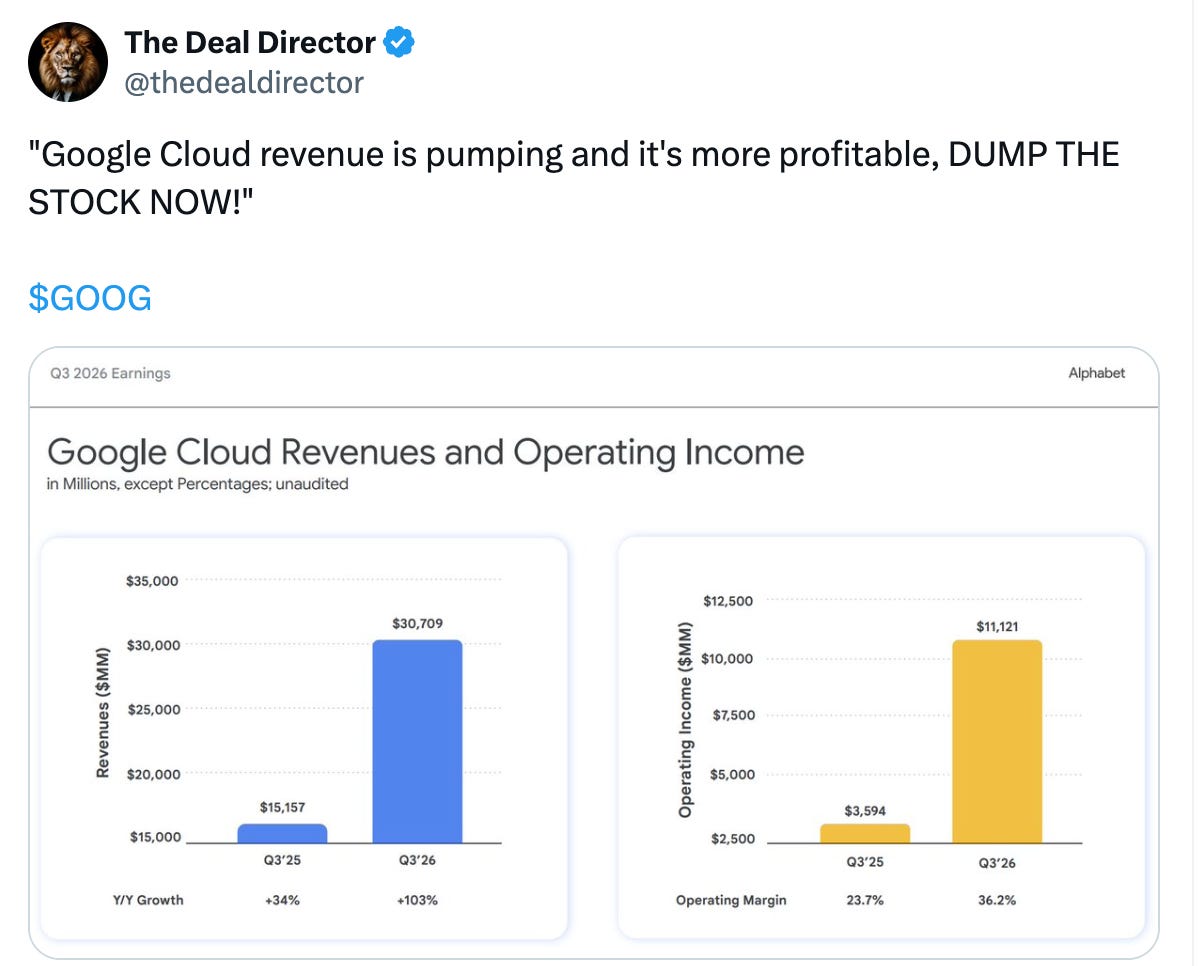
Thomas Kurian: Our strong momentum is driven by our integrated AI portfolio of chips, models, data, security and agent platforms, all designed to work together. We have strong diversification across our product lines, industries and customers. Google Cloud now has 18 product lines with more than $1 billion each in annual revenue. And our growth this quarter was driven by strong growth in Google Cloud Platform with strength in both AI and core GCP. TPU system sales were also a meaningful contributor. Over the past 12 months, more than 2,600 customers have used at least 100 billion tokens and nearly 75 at least 10 trillion tokens on Gemini Enterprise.
Nearly 90% of the Fortune 100 use Gemini Enterprise, and customers who use Gemini Enterprise in Q3 2025 more than quadrupled their spend with us year-over-year. One of the important ways in which customers are using Gemini is for knowledge work. Across all our AI services, we have sold more than 100 million seats for knowledge work. Gemini Enterprise now includes the Gemini agent that is deeply integrated across our entire cloud portfolio. It can research and answer questions, write and run code, and automate process flows with one agent, one API and a single prompt window. It gives companies strong security and cost controls and the widest choice of frontier models.
Customers include BNP Paribas, who is deploying Gemini Enterprise to more than 65,000 employees to streamline workflows while maintaining strict enterprise-grade security and data governance; Tata Steel who deployed more than 300 specialized AI agents in just 9 months to enhance manufacturing safety, optimize supply chains and cut service times for customers by 50%; Ulta Beauty, who built the Ulta AI shopping assistant, resulting in a 3x higher conversion rate than traditional browsing on their site. Gemini is also driving acceleration for our database, analytics and cybersecurity products. Gemini can now help users find, analyze and visualize information from structured and unstructured data.
Gemini uses our knowledge catalog to find the right sources and definitions of information, improving accuracy, lowering token cost and making responses more reliable. Gemini uses our Lakehouse to access information from multiple systems with 0 copy. To respond to agentic analysis, BigQuery improved query speed over 40% year-over-year while reducing query processing cost by over 50% year-over-year. Customers include Deutsche Telekom, which uses BigQuery, Cloud Storage and Knowledge Catalog to build a unified data lakehouse across 40-plus legacy on-premise systems. Etsy, which migrated 3 petabytes of data to unified lakehouse, by using BigQuery and Iceberg, they now perform critical data joins up to 60% faster.
The growing risk of cybersecurity threats is also driving strong demand for our AI-powered security platform. Our Gemini Flash cyber models are frontier models that automate vulnerability discovery across 20 programming languages and patch 2.6x more reliably than other models. And there’s even better performance to come as we roll out Argon and Carbon. Our security platform integrates threat intelligence, cyber response prioritization, automated scanning, code remediation and monitoring. Gemini and Google Threat Intelligence autonomously analyzes millions of external events every day with 98% accuracy. And more than 95% of Wiz customers are adopting AI-powered features, and growth continues. These security tools protect critical infrastructure, including financial institutions like Banorte and Jack Henry and telecommunication providers such as AT&T.
All of this is powered by our leading AI infrastructure, spanning our TPU systems, Axion CPUs, the latest NVIDIA GPUs and our agent compute engine, which is specifically designed for AI agents. TPU systems are specialized systems built for AI, combining hardware, compute storage and networking with systems components and optimized software for training and inference. TPU 8t and 8i offer up to 2.7x better training performance and 80% better inference price performance, respectively, versus our previous generation of TPUs.
To make it easy for developers to port workloads to TPUs, we recently worked closely with Meta to deliver TorchTPU, which allows users to train, serve and deploy PyTorch models on TPUs, using the tools they’re already familiar with and rely on. Nearly 100 customers use TPUs today, and we’re seeing strong and growing demand from many others.
In addition to our work with Anthropic, both directly and via Broadcom and public reference customers like Apple, who are scaling pretraining of their foundation models on the latest generation of TPUs, we’re also working with new frontier model companies, including Mirendil and Physical Intelligence; capital markets firms, including Citadel Securities and Jump Trading; universities like Caltech; and public sector service providers, including Cassava and Cirrascale. Given continued strong and accelerating demand, we’ve recently entered into partnerships to deliver TPU systems with both Crux AI and Oracle, with more in the works. Over to you, Anat.
Having GCP’s CEO deliver prepared remarks shows how much the team wanted to highlight its exceptional infrastructure performance. I think the big difference compared to AWS is that GCP monetizes the application layer of the AI buildout relatively well, but has also ceded any serious attempt at the agentic work layer. The Gemini 4 launch has been deeply unimpressive: the model was benchmaxxed and then failed to gain any real traction in coding.
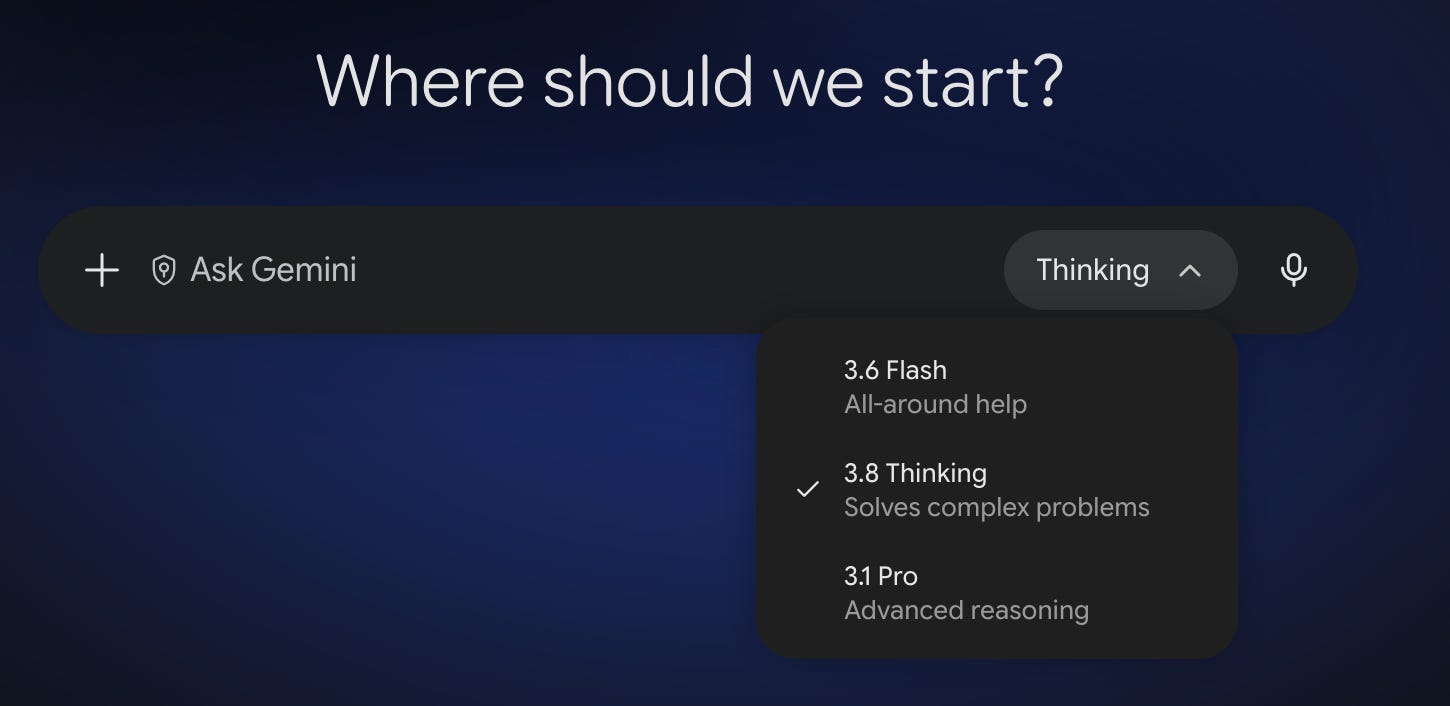
The latest family of Gemini models isn’t available to Workspace customers (the bulk of real-world users), and Google has made no attempt to offer a real agentic coworker application. Its efforts have gone into Antigravity instead, a product with minimal adoption in a market where Google is clearly struggling to compete.
Meta overtaking Google in advertising revenue, while also shipping models that perform well as personal agents (Muse) and in coding (Wonder Full), is a staggering shift in dynamics.
Douglas Anmuth: One for Sundar and one for Philipp. Sundar, on a recent podcast, you said that 2027 could be the golden age of productivity for Google because of the new class of models and how they’ll integrate with your other products. I was hoping you could elaborate on that and just share more, how you think about the opportunity set there ahead. And then, Philipp, just on query growth, the fastest in 5 years but obviously, some deceleration in Search growth. Can you just help us understand the disconnect there? Is it simply that you haven’t been showing as many ads basically in AI Overviews and AI Mode, and that’s now becoming a bigger percentage of the overall queries?
Sundar Pichai: Thanks, Doug. We definitely started seeing a step change, I would say, with 3.8 Flash internally as our models got better at long-horizon tasks, agentic coding, et cetera. But I’m definitely seeing a huge point of inflection once we’ve started deploying Argon internally. It is one of the most meaningful internal productivity levers we have seen on software engineering, directly tracking high-quality code that’s getting checked in, the rate at which it’s getting checked in, reducing the number of rollbacks. But more importantly, people are tackling massive problems as well as we are beginning to see innovation on the product and the consumer experience side from deploying those models. But all this happened only about 4 weeks ago.
We are now deploying Carbon internally, and Carbon is a meaningful step-up from Argon, so as we roll it out and make it all widely available to Googlers with more compute, I expect to -- that's what I was referring to, and I'm even more excited since I said that in the podcast and what I would view as a golden year ahead in terms of us being able to be more productive, and so excited for the innovation ahead.
“Believe me, boys, we’re totally winning on the inside now” is quite the misdirection. Anthropic (Mythos) and OpenAI (Astra) both used the same line to describe the internal jump in performance they saw before releasing those models to the public. The difference is that Anthropic and OpenAI had already shipped critical new products that were adopted aggressively, which is obviously missing at Google.
One of the most brutal realities about Google is how much of the work revolves around the H1 and H2 performance reviews. Key launches end up landing shortly before the self-evaluation period, regardless of whether the product is fully ready or even usable. There’s a lot of bragging about Gemini 4 Carbon for cybersecurity, except that it’s only available to a very limited set of users and almost impossible for open source teams to use (the ones suffering the most and most in need of access to these programs). Launching supposedly flagship models that aren’t available on most surfaces, and aren’t even suitable for the scenarios they’re meant to support, smells more like internal politics than a Google that is suddenly trying to compete properly.
Brian Nowak: I have 2. Maybe let me start with agentic. You rolled out Spark to some of the users throughout the year. I know, Sundar, you’ve talked a lot about shipping more agentic products to the broader base of users. Can you just help us understand a little bit some of the key hurdles you have to overcome technologically to ship out agentic products to the full base of users? Is it model efficiency? Is it capacity? Is it the technology isn’t ready? Like what do we have to do technologically to do that? And then the second one just on to Doug’s question on Search.
Anat, can you help us better understand the search performance comparison factor that you talked about impacting Search? And how do we think about that as we kind of go into 4Q, 1Q just kind of looking at the compares?
Sundar Pichai: Thanks, Brian. First of all, on agents, what an exciting and dynamic area. I think when I look at our new models and we see the capabilities of the kind of complex tasks they can take in an automated way and execute with very, very high quality, it’s clear that the agentic capabilities we’ve all envisioned are going to be real. And so I couldn’t be more excited to bring the next-generation agentic experiences to our users. To your question, I would say a few things. I think the Gemini 4 model cities has been important.
We are working on distilled versions of our Carbon models so that we can deploy it across 1 billion user scale efficiently, both from a compute, from a latency standpoint and from a quality standpoint. So that’s been an important area of investment, definitely making sure you need more than a capable model at scale. You need a robust harness. You need a highly secure run time, and this is where GCP comes in, being able to give each and every one of our users a secure run time at 24/7 availability in the cloud, the right ecosystem of skills and connectors. So all of that is the foundation.
We have been hard at work, and we decided to roll it out to enterprise first, which we announced with our Gemini agent for enterprise, essentially because they have the highest bar for security, governance and controls. And it’s been well received, and we are in the process of expanding that. Later this year, we will bring that same experience to consumers, obviously, starting with the 1 billion users in our Gemini app. We already see people in the app moving beyond chat to what are task and agent-like experiences.
And so the trust users have in our products, the fact that all their context is right there, I think, sets us up well, but we are really focused as a company on delivering that unified experience across our products, and you should expect to see a lot of progress later this year.
“Later this year” means Google will be lucky to make Gemini 4 widely available before Fable 5.5 and Astra 6.1 arrive. And if it does, those models look set to be distilled versions with lower intelligence, competing with Opus and Sol instead. This kind of bait and switch passes in internal politics, but not in the field where AI is actually being adopted.
Eric Sheridan: Based on some of the comments you’ve made recently, Sundar, on compute constraints, can you refresh for us your key priorities for the application of compute as it becomes available across the organization? And the second part, maybe either for you or Thomas, would be within Google Cloud specifically. How does your view continue to evolve with respect to the application of compute to cloud customer needs relative to external TPU?
Sundar Pichai: Thanks, Eric. I’ll start, and then Thomas will answer the second half. Definitely, compute allocation is an area where we are spending a lot of time on because of the forward planning that’s needed. I would start with saying we feel fortunate to have an extraordinary set of opportunities ahead of us. We are operating a scale consumer business that reaches billions of people, a hyperscale cloud business with a lot of momentum and of course, a range of other highly important areas across Google and Alphabet. We always take a long-range planning. And so each of our business areas submit long-range plans with a very disciplined ROIC framework.
And so I would broadly think of all of this as a long-range planning process, not a short-term allocation exercise. Obviously, our AI models underlie everything we do from Search and YouTube to Cloud to Waymo and so on. So it’s the foundation and we view it as a highly leveraged approach, the full stack approach drives a lot of efficiency as well as gives us a lot of optionality across a wide variety of opportunities. So obviously, that is the foundation, and we plan for that for the long term, too. And about that, as I said, we really look at our businesses and really take a disciplined long-range planning approach.
To us, obviously, we are seeing very, very robust demand signals across a wide variety of areas. And so we view it as an extraordinary set of opportunities, and we are investing for that moment. Thomas?
Thomas Kurian: Eric, on the demand in Cloud, we are always managing our portfolio to ensure we have a breadth of customers, and we have different types of customers from digital natives, AI labs, traditional enterprises, financial and capital markets customers. So it’s a broad set of customers. Many of them have either started with using TPU systems, for example, in our cloud. We have over 100 significant TPU customers who start in our cloud. They learn to use TPUs. And remember, a TPU system is a combination of hardware, system software, compilers, the whole thing assembled as a system, including optical networking and other things. We’ve taken a very deliberate approach on how we’re bringing TPUs to customers.
The first one is to build the right silicon. So we have 8t for training, 8i for inference. They both offer substantial price performance and performance improvements relative to prior generations. Second, we’ve optimized the software. The optimization in the software is not just to make the systems run better and to give you great performance but also to see -- make portability seamless. Recently, we introduced, for example, PyTorch, which opens up a much larger market for us by optimizing PyTorch in the TPU. Third, we are broadening distribution. So in the past, you could use TPUs in our cloud.
Now we make for customers who want TPU systems in their data centers, we’re making TPU systems available in their data centers. We’re also broadening availability to other providers. For example, we announced a partnership with Oracle and we’ve launched along with Blackstone an agreement for Crux AI, a joint venture to offer customers TPU systems. We are seeing extraordinary demand and strong growth from both AI labs, capital markets, financial service institutions and enterprises. And if you imagine these 100-plus customers growing to many more and also scaling their use into TPU systems, we see strong demand over the future.
We’ll end the article here, on the cost of indecision when steering a company through the age of AI. On paper, Google is the best-positioned player in the industry (OpenAI was literally created as a counterweight to it). Unfortunately, too many of Google’s current leaders came from the ads business, and the incentives and thinking that work there are simply not compatible with the intense product focus needed to innovate in agentic AI. Still, its many talented engineers and deep pockets make it easier for the company to reposition on the hardware side and finally build Google Cloud into a real competitor (after nearly axing the unit several times in the past). Thomas Kurian now taking an active role on earnings calls says a lot about how much is shifting internally.
Infra Play #157: Laggards and challengers

While Anthropic and OpenAI are currently the undisputed top two AI labs and the leading businesses for enterprise adoption of the technology, third place remains tricky.
In #157, I pointed out that SpaceXSI was then the third-best-performing AI lab in the industry, with Google clearly falling behind (as shown by most of DeepMind’s leadership leaving or “taking a less operational role”). On paper, Gemini 4 should put Google back in the top three, but until the model is actually available, productized and adopted, the comeback remains a mirage. Meanwhile, SpaceXSI fumbled the Grok 4.7 release but still made progress on the product side with Grok Bot. It’s currently being pitched by a GTM team in transition, as the mercenary sales leaders it hired recently are now jumping ship to OpenAI.