

While Anthropic and OpenAI are currently the undisputed top two AI labs and the leading businesses for enterprise adoption of the technology, third place remains tricky.
In my recent mid-year check, I indicated that I consider SpaceXAI (SpaceX+xAI+Cursor) to be the new number three player. This is a controversial opinion, partly because of xAI’s failure to make a meaningful dent in the space, and partly because of the existence of large players that claim benchmark wins and surface-level adoption. The biggest one of those is GCP and the Google AI division that ships new versions of the Gemini family of models. From a purely commercial perspective, while Google does not publish Gemini inference revenue, it is likely in a similar ballpark to the $4.5B to $5B Cursor+xAI run rate.
Let’s take a look at the recent earnings calls and releases from the two players.
Sundar Pichai: Hi, everyone. Thanks for joining us. We have exciting momentum.
Alphabet revenue grew 24% year‑over‑year. Our AI investments are redefining what’s possible across every part of our business.
Our momentum starts with Search, where people are adopting one seamless search experience across AI Overviews and AI Mode. We saw 17% revenue growth in Search & Other, and YouTube Ads grew 13%.
Cloud revenue grew 82%, powered by strong demand for AI infrastructure and AI solutions. And Cloud backlog grew to $514 billion. It’s great to see the wide adoption of Gemini Enterprise, with nearly 90% of the Fortune 100 using it.
Today, I’ll expand on our AI progress, our global product footprint led by Search and YouTube, Google Cloud’s leadership, and our long‑term Bets.
First, AI.
Yesterday we announced new models ‑‑ Gemini 3.6 Flash and Gemini 3.5 Flash‑Lite ‑‑ which are cost effective and highly efficient. We’re seeing tons of demand for our workhorse Gemini Flash series because it hits the sweet spot of performance and cost.
We also launched Gemini 3.5 Flash Cyber, which I’m really excited about. Paired with our CodeMender agent, it finds and fixes vulnerabilities and delivers performance at the frontier, comparable to far bigger cyber models.
Gemini 3.5 Pro is currently in testing, and our team is already building the next generation of models. We have started our most ambitious pre‑training run yet for Gemini 4 and are excited by the progress we are seeing at the frontier.
Demand for our models is translating to strong token usage across developers and enterprise customers, and we continue to be supply constrained, a sign of momentum and rapid adoption.
More than nine million developers are building each month with our models across our APIs and key developer products.
Our model APIs are now processing approximately 22 billion tokens per minute. That’s up from 16 billion just a quarter ago.
Additionally, this quarter, we launched Omni. It allows users to create anything from any input, starting with video. Since launching at I/O in May, there’s been a 40% increase in daily active users creating videos on the Gemini App.
Our Gemma family of open models, small enough to run on local devices, are hugely popular. These models have been downloaded over 900 million times.
And our latest Gemma 4 models have been downloaded over 300 million times since launching in April.
Our agentic development platform Antigravity allows anyone to build in the agent‑first era. It has more than 2.4 million weekly active users. Antigravity is a powerful tool for users and enterprises, and it’s completely accelerated how we build internally. As just one example, a team in Chrome is now on track to accelerate delivery by eight times, compressing a two‑year timeline into three months through model‑driven refactoring.
The misdirection and confusion a laggard introduces is easy to spot by the number of “data points” it throws out, with no acknowledgment that most of them are useless.
Let’s look at the kind of statistics our pencil-pushing friend Sundar considers important:
“Tokens generated,” instead of inference revenue per model family
“Gemini app video creation usage,” instead of revenue for video generation models
“Gemma 4 downloads,” instead of anything tied to money
“Weekly active users of Antigravity,” as in some guy opened the app, submitted one request, and closed it
The only meaningful story here is GCP’s growth rate and backlog.
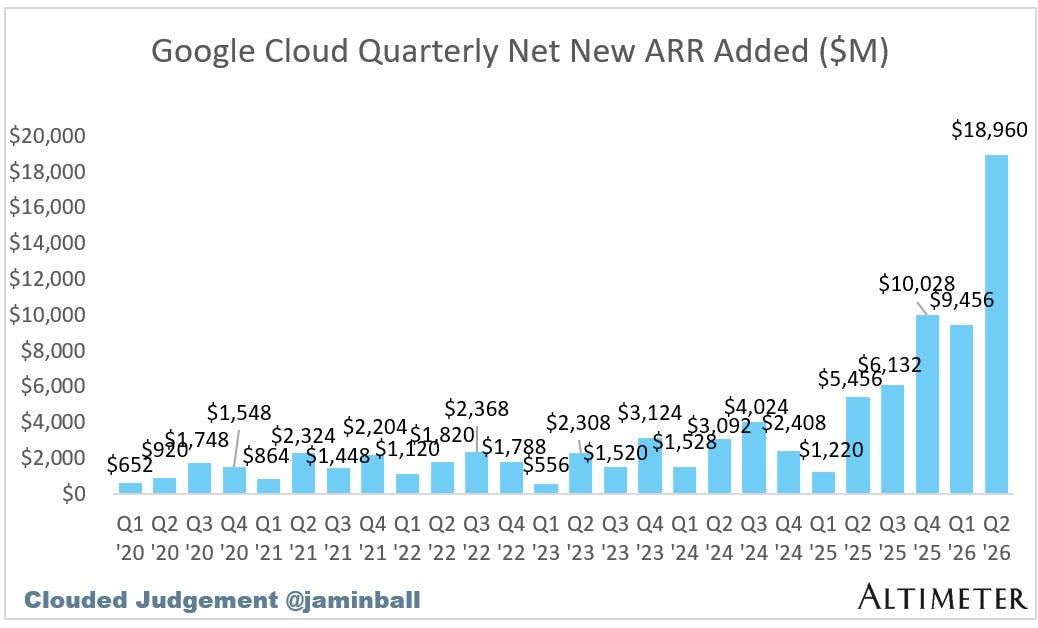
GCP’s overperformance cannot be overstated, but it does need to be calibrated. This is not an explosion of Gemini usage. It is TPU deliveries and new data center installations, combined with aggressive upselling into existing cloud infrastructure and application accounts.
The only real model monetization play for GCP right now is the Gemini Flash story I flagged earlier, which gets leveraged for customer support agents because it is dirt cheap relative to performance.
Elon Musk: Thank you. So, it’s been another milestone year for SpaceX so far. We’re making great progress developing a fully and rapidly reusable, reliable rocket with Starship.
We’re connecting millions more people globally across 170 markets with fast, reliable Starlink Internet, we’re building AI compute capacity at scale faster than anyone else, we believe. And we’re significantly improving our AI models, most notably with the release of Grok 4.5 last month. And now, I’ll dive into each of those topics separately.
So with Starship, we completed two successful flights of Starship V3 in the past 90 days. Flight 13 demonstrated core capabilities necessary to achieve an orbital mission and return to Starbase for catch. On Flight 14 will be our first flight to fly our Version 3 Starlink satellites, our communication satellites, to operational orbit.
We’ll try to actually catch the first and the second stage of Starship V3 this year, and we could possibly catch the ship as soon as the next flight. And it’s difficult to actually explain to most people, just the incredible significance of Starship.
I think perhaps describing it in terms of tonnage to orbit is a good way to appreciate the magnitude of the impact Starship will have on the future of civilization. So right now, we deliver, call it, roughly 2,500 tons a year to orbit via Falcon. This is a big number by normal standards. The rest of the world, I think delivers around 300 tons. So, we deliver 80% to 90% of total earth mass to orbit per year with Falcon. Now with Starship, our aspirations, and I think we will achieve these aspirations, are to deliver well over 1 million tons to orbit per year and probably ultimately 10 million tons per year.
If you had a chart where you plotted things, you would need a very, very big table to put the chart on to even see any of our competitors on that chart and to make it so our next biggest competitor was one pixel high on the bar chart. You would still need a very big bar chart to represent the SpaceX Starship vehicle.
And it’s worth noting that we actually encourage our competitors to copy us. We do nothing to slow them down. We actually launched competing satellite constellations at fair prices, the same price we charge everyone. So, we do encourage our competitors to copy us, but it’s quite difficult to copy something like Starship. But we don’t use patents as sort of a landmine exercise to stop people from copying us. We actively encourage it. When you think about it, we go from 2,500 tons a year to 1 million, potentially 10 million tons per year. It’s really a ridiculously profound difference. But that is our plan, and I think we will achieve that plan.
Regarding Starlink, it’s also worth just noting that the Starlink V3 satellite is about an order of magnitude more capable than the Starlink V2 satellite which was already a very capable satellite. We expect to launch about an order of magnitude more Starlink V3 satellites. That would mean roughly two orders of magnitude increase in the delivered bandwidth. Even if our monetization per bit dropped by a factor of 10, that would still mean a 10x increase in the revenue of Starlink. I think people are really underestimating Starlink here. This is a big deal. It’s kind of hard for people to wrap their minds around this, but it’s not out of the question that at some point, Starlink will deliver a majority of the world’s Internet, at least in countries where we’re allowed to operate, which is the vast majority of countries. This is important to bear in mind, and it’s not in the infinity future. It’s less than 10 years.
With the advent of AI and humanoid robotics and vehicle robotics and just a massive number of robots, the appetite of bandwidth will be much greater than it has been in the past. You think of a human consuming perhaps, or producing perhaps, a few hundred bits per second of output. Actually, the average human is outputting less than one bit per second over the course of a day which is 86,400 seconds. Now computers easily do billions of bits per second continuously over a 24-hour period. So, this is why I would expect the appetite for bandwidth to grow dramatically with the growth of AI and robotics. And really, I think Starlink is the only internet that can actually service that bandwidth.
Regarding AI, we’re making rapid progress on Grok. Grok 4.5 was a huge improvement. We have Grok 4.6 coming out probably next week. Then, Grok 4.7 is about three or four weeks from today. We expect the cadence of AI development to improve dramatically. With Grok 5, which should be out before the end of this year, we will be incorporating the entire corpus of SpaceX data. Basically, all the data that SpaceX has ever produced, which is a tremendous amount over the course of a quarter century, will be incorporated into Grok training. We think this will make Grok by far the best engineer. These are all like very big things.
In addition, of course we are providing compute to others, and we are building and deploying compute, I think faster, or our rate of growth certainly is faster than anyone else. Our efficiency of compute deployment, I think is also the highest. We expect to end this year with over 2 gigawatts of compute. And probably our cumulative compute online by the end of next year will be several times higher. It may, let’s say, be closer to 10 gigawatts of compute than 5 gigawatts of compute. That’s a way to think about it. And going forward, we’ve decided to build exclusively on NVIDIA because we think the Vera Rubin architecture is the best architecture. We think it’s the best AI computer, and we greatly value our close cooperation and partnership on many levels with NVIDIA. So, we’re exclusive to NVIDIA.
This new capacity coming online will obviously further benefit the development of Grok, as well as our Cursor acquisition, which should close quite soon. I think we’re through almost all of the regulatory hurdles.
Then with respect to the Starmind AI satellite, which will be essentially an optimized Vera Rubin NVL72 computer, this is not some sort of far-future, distant thing; we expect to start launching these next year. We think the design of the NVL72 VR computer is a much better design than, say, having a standard rack-style design, and so we expect to actually deploy this on the ground, as well as in orbit because we think it’s going to be a radical simplification of the normal NVL72 rack. It will cost less. It will be more effective. If we’re going to put it in space, why not want to put it on the ground? I think that’s going to be pretty cool.
In conclusion, the SpaceX team is solving some of the hardest engineering problems in the history of humanity. I think the team is succeeding because I think we’ve got in a lot of ways, the smartest, most dedicated team of humans that has ever existed. I’m incredibly proud to work with such a team and I’d like to thank the team for their incredible hard work. And also, thank you to investors who have supported us along the way.
The difference between Elon and Sundar is immediately obvious. One hides behind ad revenue and throws out bullshit adoption metrics. The other makes big bets, even when the practical outcomes are shaky.
The only metric we heard was the 2GW of compute that will be online by the end of the year, which is realistic given recent progress at Colossus, plus a dubious range of “we will do something between 5GW and 10GW next year, but probably closer to 10GW.”
Given that the rough cost of 1GW is around $50B, and that you still need the electricity to run it, hitting 10GW while everyone else is building big will be tricky. The synergies should be obvious: big rockets deliver big payloads of connectivity, and data centers in space keep feeding ever-improving models.
Speaking of improved models and new user surfaces, this week xAI shipped Grok 4.6 and a new competitor to Cowork and Codex called Grok Bot.
The new coworking agent is named “Grok Bot,” but it is clearly a Cursor internal product, and the stylish, coherent launch video makes that obvious. Most of the content we saw from xAI was sleeping bags in a barren office, which is definitely not the vibe here.
More interestingly, focusing on an interface built for non-technical users is a tasteful choice. Those users typically work a single topic in one thread that expands and collapses its context across multiple iterations, so a dedicated “bot” makes sense.
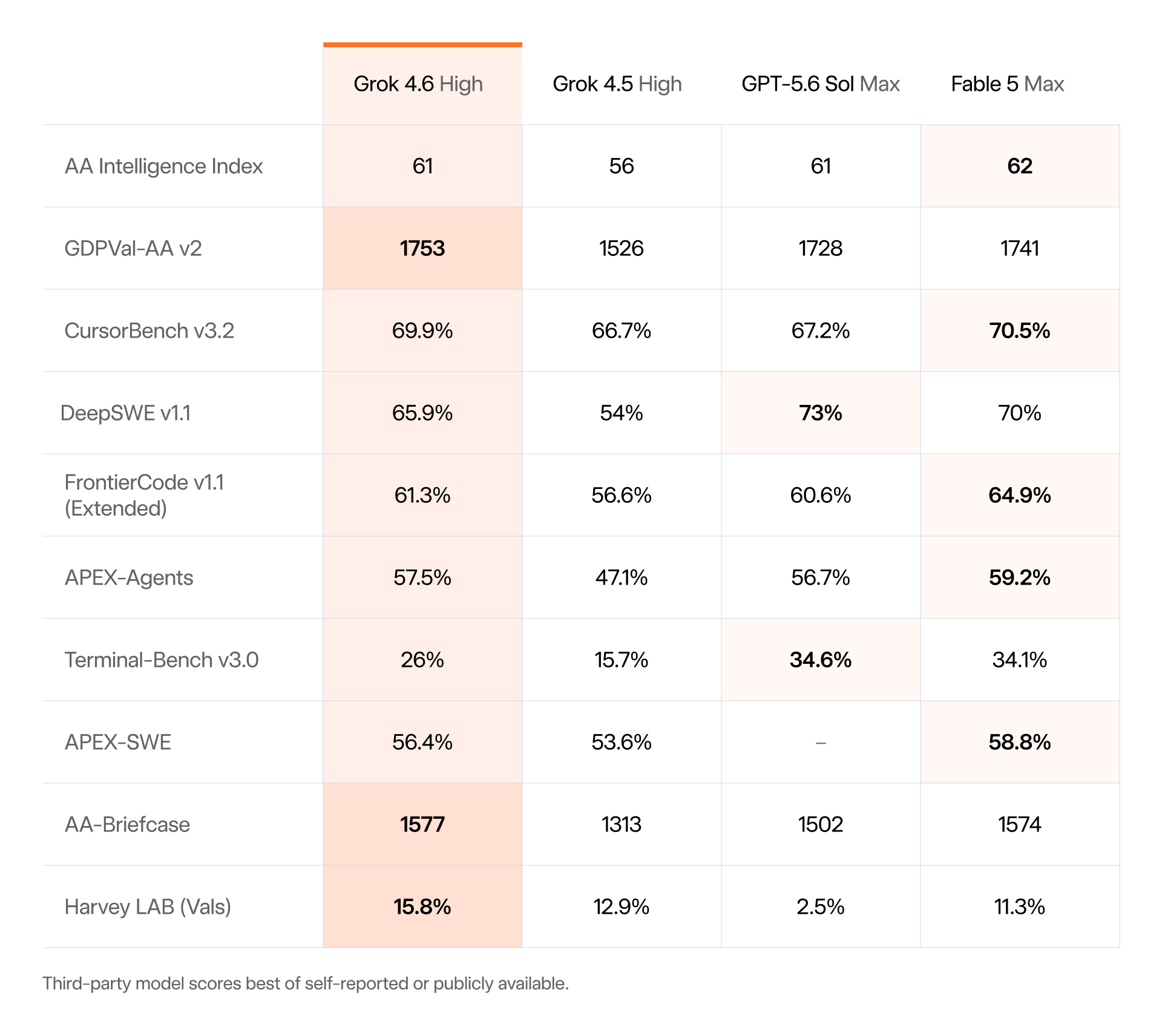
In my mid-year performance check on the key players in AI, I outlined the following game plan for SpaceXAI: