

Pause and consider all this for a lingering moment: the militant engineering culture, the all-consuming work identity, the apostolic sense of devotion to a great cause. The cynics will read statements from Zuckerberg or some other senior exec about creating “a more open and connected world” and think, “Oh, what sentimental drivel.”
The critics will read of a new product tweak or partnership, and think Facebook is doing it only to make more money. They’re wrong. Facebook is full of true believers who really, really, really are not doing it for the money, and really, really will not stop until every man, woman, and child on earth is staring into a blue-framed window with a Facebook logo. Which, if you think about it, is much scarier than simple greed.
The greedy man can always be bought at some price or another, and his behavior is predictable. But the true zealot? He can’t be had at any price, and there’s no telling what his mad visions will have him and his followers do. That’s what we’re talking about with Mark Elliot Zuckerberg and the company he created.
Martinez, Antonio Garcia. Chaos Monkeys: Obscene Fortune and Random Failure in Silicon Valley (pp. 285-286). (Function). Kindle Edition.
It's easy to forget how influential Meta was in tech between 2010 and 2020.
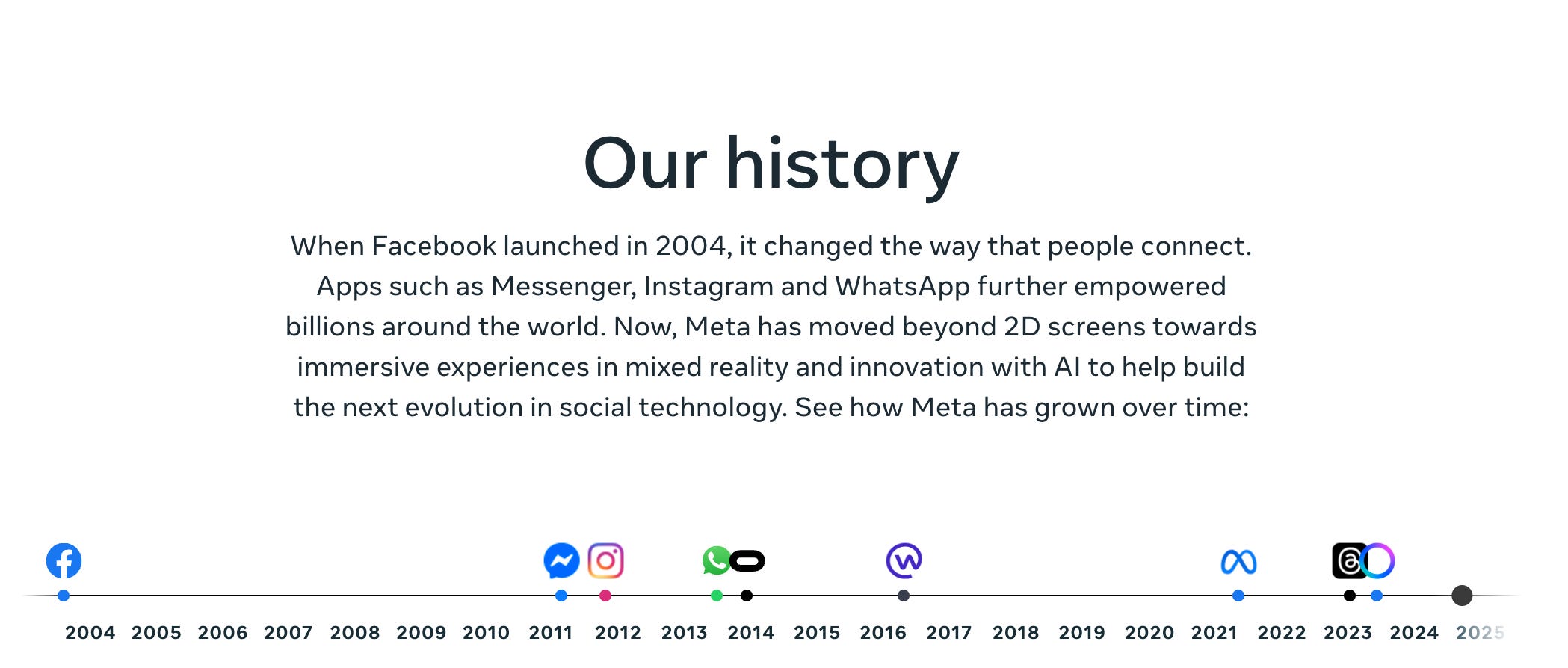
Over that period, the company built what was largely considered the best paid and most competent engineering team in the industry, captured a significant share of the world’s eyeballs (and the ad dollars behind them), and positioned itself to do essentially whatever it wanted in the 2020s.
The first attempt at redefining the company was around virtual reality, hence the rebrand to Meta (short for the metaverse). This was a complete flop, as the timing was off by 10 to 15 years.
The second pivot is toward becoming one of the key players in the AI era. After a strong early start with the release of the open-source model family Llama, the company failed to deliver a meaningful new model release for almost two years, until Spark 1.1.
Infra Play #152: AI Bonanza (Mid-Year Check)

It’s been six months since we’ve had an “AI bonanza” moment. The last time this played out around late December/early January when a lot of developers and operators spent more time with Claude Opus 4.5 and ClawdBot.
While it's easy to write them off, at a time when compute and sheer force of will are critical to succeeding in AI, Zuckerberg is clearly not quitting, and unlike Google, he is redirecting all of his capital and manpower into turning Meta into a meaningful player in the space.
We are fortunate to live at an incredible moment in history. In the next few years, people will be able to use superintelligence beyond human capacity to create and discover extraordinary new things, build new businesses, express our ideas, learn new concepts, and improve our lives, health, relationships and careers.
The defining question of our age isn’t whether superintelligence will exist, but who will have access to it. Will it be centralized and restricted to a few institutions, or will it be a tool that empowers everyone?
I propose a philosophy based on individual empowerment as the source of prosperity, invention as the primary purpose of superintelligence, and balance of power as the foundation of safety.
It's also clear that for him, this pivot means a lot more than simply protecting his bottom line.
The key takeaway
For tech sales and industry operators: Meta stepped into infrastructure software this quarter, and Zuckerberg conceded on the call that selling to enterprises is a muscle his company has yet to build. The goal is to offer agents and coding models to enterprise customers while ideally avoiding having to sell raw compute. Where they can lean on existing distribution, such as selling customer care agents that provide support across Facebook, Instagram, and WhatsApp, they clearly have an advantage. The problem is that making the jump and competing directly against OpenAI and Anthropic in the same accounts will be very difficult, and the existing teams are poorly prepared for a different kind of sales cycle and buying audience. Still, if they build out a new AI enterprise sales team and find meaningful product-market fit, this could be one of the best “new companies” to sell for in years.
For investors and founders: Meta from its late 2022 bottom through 2025 was a legendary contrarian bet, delivering an 8x return, while 2025 into 2026 has been less impressive. Alphabet, its direct competitor, may end up falling behind on ad revenue by the end of the year while remaining absent from agentic coding, yet none of that widening gap shows up in Meta's stock price. The market does not believe the investment Mark has made can realistically be recouped unless Meta pivots toward a neocloud-style business model. The counterargument is that Meta's AI revenue today is ads, full stop, and the ad engine already pays for the buildout, with ranking and targeting advances lifting clicks 8.3% and conversions 15.7% on Facebook this quarter. The capex cycle storyline is tracking the archetype, where cheap capital and mimetic investment precede a shakeout that hands assets to the strongest balance sheets. If we were making a VC-style bet, this would be framed as an underdog going after a massive market opportunity, relying on exceptional motivation and skill. Until the enterprise motion produces revenue, the skill remains unproven.
Subversive hackery
Mark Zuckerberg: We had a strong quarter for our community and business with 3.6 billion people using at least one of our apps each day. We reached several milestones. Instagram reached 2 billion daily actives. Threads crossed 500 million monthly actives, making it the fastest growing conversation app ever. Facebook has reached more than 2 billion daily actives for a while now. WhatsApp just hit an all-time messaging record, peaking at 30 million messages sent per second during the World Cup Final. And also, Kunal Shah just joined as our new head of WhatsApp. He built one of India's most important payment companies and will be a great addition to the team. We also shipped some strong new models from Meta Superintelligence Labs and released new glasses. Overall, the scale and reach of our community across our apps is pretty remarkable, and it gives us a strong platform for delivering new innovations to billions of people.
The opportunity in front of us is massive.
First, we are now at a point where our investments in AI are accelerating every major part of our core business. They're improving the experience for people using our apps, driving better performance for advertisers, and helping our teams build new experiences and ship faster.
Second, we're developing new personal agents that will be the foundation for our next wave of products and revenue lines in the months and years ahead.
Third, we see a large enterprise opportunity to sell to businesses, including APIs, business agents, potentially selling compute directly, and other services that we're building for large customers. I want to spend some time today laying out exactly how our investments are delivering results today and the opportunities that we see over time.
As we take an analytical approach to the Meta business, it's important to understand where they are today and what the actual cloud infrastructure software pivot behind their AI push really is.
Mark Zuckerberg: For accelerating our core business, we're seeing strong and promising results in several areas. In Instagram and Facebook, I'm very optimistic about our work to integrate large language models into our recommendation systems. LLMs add a first-principles understanding of what the content is about and why it is compelling, as well as a deeper understanding of what people are interested in and what their goals are when they're using our apps. This means that we can show more relevant and engaging content that better reflects people's goals and interests.
Our new Muse Image and Muse Video models will also dramatically expand the universe of content that people can discover across our platforms. There are already two large sets of content to draw from -- first from your friends and the people you follow, and second from creators that you don't follow -- but now there is going to be a whole new and nearly infinite universe of personalized content. This is going to make our services a lot more useful and engaging for people.
For ads, we are using LLMs to improve how our systems predict and rank the ads that we show. We've expanded the context that we can take into account around a person's organic and ads activity to determine an ad's relevance, driving significant increases in relevance and conversions on both Facebook and Instagram. On a dollar basis, our ads business is reporting faster year-overyear revenue growth than any other company's reported ad business -- so these AI investments are paying off.
We are also seeing a lot of demand for our new AI-powered creative tools. 9 million small businesses on our platforms are now using at least one of our AI ad creative tools, and we're rolling out new end-to-end creative solutions that help advertisers translate performance data into their creative decisions. Muse Image is going to supercharge this. The model can analyze images, improve its own work, and produce better ad variations based on advertiser input. We're getting great feedback on this so far.
We also just launched Meta One, a new subscription offering that provides more tools and AI features across our apps. As demand grows, we're going to offer a variety of different tiers and pricing options there as well.
I'm also excited about how AI is helping our teams speed up product development. Earlier this year we shipped Instagram Instants. We also just launched Forum, a standalone Groups app, and Seller, a standalone Marketplace app. And I expect it to become a lot easier to ship new apps, so we're planning to build out more ideas and use our recommendation systems to scale them to the people who will find them interesting, as we've done with Threads.
Today, Google and Meta generate a similar amount of revenue from ads. While Alphabet is larger (since we need to account for the extended services business and GCP), when it comes to ads, there is parity. It's not surprising that many of Meta's strategies follow a similar product path to what we've seen from Google.
Mark Zuckerberg: It's been a little more than a year since we launched Meta Superintelligence Labs and our trajectory is strong. In the last month we shipped Muse Spark 1.1 and Muse Image. Since we rebuilt Meta AI and integrated Muse Spark, we've seen a 60% increase in the number of people interacting with the assistant each day and that continues to grow quickly week-over-week.
Muse Spark 1.1 is a strong agentic and coding model that is very efficient and excels at computer use, tool use, and multimodal understanding. It's available through our new public API, and we're ramping up distribution through partner channels and more coding agents over the coming weeks. We're also building out features to make it easier for enterprises to adopt Muse Spark and that is an area that we expect to continue focusing on.
One reason we're so focused on making Muse Spark great at agentic capabilities is that we think there's a very big opportunity to ship a few types of agents that are aligned with our mission and business.
For Zuck, the ads business is there to finance his expansion into AI. The flagship initiative has been Meta Superintelligence Labs, which is doing less superintelligence these days and more "build a competitive model to power personal and business agents."