

This week we will take a look at the recent Stripe annual letter. At a time when both Buffett and Bezos stopped sending out their “influencer” annual shareholder letters, Stripe is one of the few companies keeping the tradition alive.
Last year, businesses running on Stripe generated $1.9 trillion in total volume, up 34% from 2024, and equivalent to roughly 1.6% of global GDP. Our programmable financial services now power more than 5 million businesses directly or via platforms, including all of the top AI companies, many of the largest bluechip companies (90% of the Dow Jones Industrial Average), most of the biggest tech companies (80% of the Nasdaq 100), and a significant fraction of freshly minted startups (25% of all Delaware corporations are now created with Stripe Atlas).
Beyond payments, these businesses are using Stripe to accelerate their growth with billing and subscription management, tax compliance, fraud prevention, embedded finance, global treasury management, and much besides. Link, the easiest way to pay online, is now used by more than 200 million people.
Stripe remained robustly profitable, allowing us to continue investing heavily in product development (with more than 350 product updates last year) as well as acquisitions. Since our last update, we acquired Privy, which powers more than 110 million programmable wallets, and Metronome, which powers the intricate usage-based billing models used by companies like OpenAI, Anthropic, Confluent, and NVIDIA. Metronome joins our Revenue suite, which is on track to hit an annual run rate of $1 billion this year.
All in all, 2025 was a strong year for the internet economy, and we’re delighted to see so many of Stripe’s customers do so well.
I think that the last 18 months have seen a new leg up of what we can call “the internet economy”. AI-native startups have completely skipped the legacy payment ramp, and the Stripe billing page is one of the most consistent experiences you will have when subscribing to an AI product. These days I’m actually surprised when I’m searching for an invoice from a new company and they are not running on Stripe.
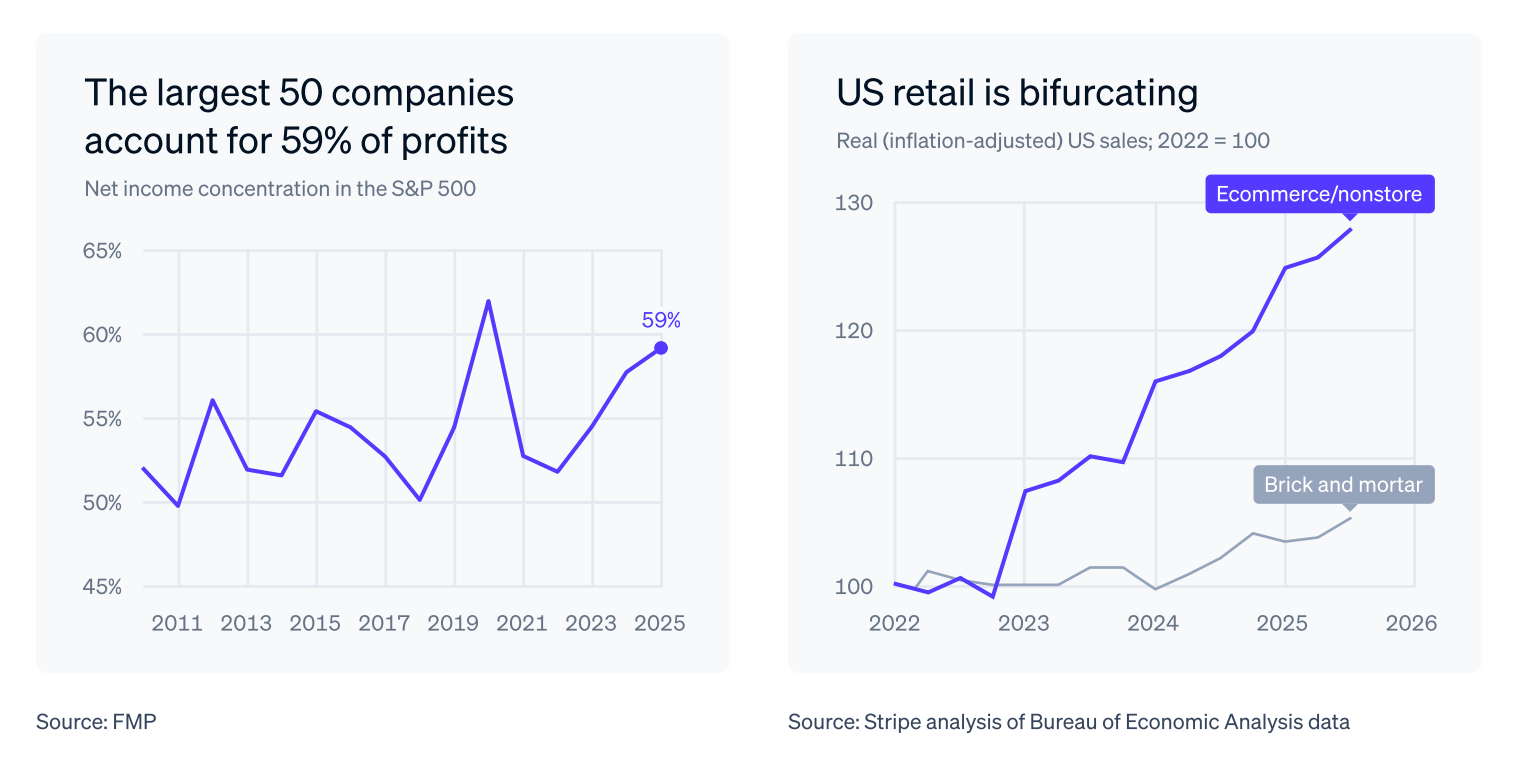
At heart, competitive markets are a sorting machine. They direct profits, capital, and talent to the places of greatest impact, as determined by customers voting with their wallets. Historically, this sorting happened methodically. It typically took decades for a household name to be unseated or for a new entrant to reach meaningful scale. The sorting machine is now whirring faster: winners and losers are being anointed more quickly and more intensely.
The sorting machine is now whirring faster: winners and losers are being anointed more quickly and more intensely. Today, the most profitable third of publicly listed companies in the US account for two-thirds of total market capitalization, the highest share since data began in 1963. And much of this is a story of profit concentration, not just valuations: the top 10% of the S&P 500 by market cap now account for roughly 59% of the index’s total profits, which is elevated relative to recent history.
Much of this is driven by bifurcation within industries. In retail, for example, US brick-and-mortar sales grew just 5% over the past 3 years, whereas ecommerce sales grew 30% over the same period (both in inflationadjusted terms). In air travel, the “big 3” of American, Delta, and United all increased their share of industry revenues and profits over the past decade. (Indeed, Delta and United accounted for nearly all US airline profits in 2025.)
In healthcare, hospital and insurer profit shares have contracted significantly since 2019, but health tech is on track to exceed $110 billion in EBITDA by 2029. Each sector has its own particular dynamics, but the pattern is clear: a cohort of companies is pulling away. Economy-wide, demand for software, computers, and data center investment drove nearly half of all US GDP growth in 2025 and will likely soon be the majority of US growth.
This is an interesting way of looking at the (software) market, particularly the mental model of variance vs concentration. It appears that it's no longer sufficient just to pick the right directional wave (AI coding agent companies), but you also have to hit the most likely concentration winner (Claude Code > Cursor > Replit).
Based on what we can tell from the set of businesses that started on Stripe in 2025—a remarkable cohort—there are no signs of the sorting machine slackening. In 2025, many more new companies joined Stripe than ever before, with more than half of them (57%) based outside the US. This new cohort is by far the highest performing and fastest moving we’ve ever seen, growing around 50% faster than the 2024 cohort. The number of companies reaching $10 million ARR within 3 months of launch was double the 2024 count. This seems to be part of a larger expansion and acceleration in our industry.
After years of relative calm, the number of iOS apps released in December 2025 jumped by 60% year over year. (Someone should check the App Store review team’s sleep scores.) Even code production is accelerating: pushes to GitHub, which grew roughly 10%–12% in prior years, surged 41% between Q3 2024 and Q3 2025. As building gets easier, we’re working on making Stripe even simpler to integrate—including for the agents.
We recently introduced claimable sandboxes, which let you start using Stripe directly from your AI coding tools like Manus, Base44, Replit, and Vercel. When you’re done with v1 and your product is ready to launch, that sandbox converts into a live Stripe account with its configuration intact. More than 100,000 sandboxes have been created this way.
We’re also improving Stripe Atlas, the world’s easiest way to incorporate a business, which saw a 41% increase in company formations last year. Atlas companies are monetizing sooner: in 2025, 20% of Atlas startups charged their first customer within 30 days, up from 8% in 2020.
As we look at these figures, there is an obvious question: is 2025 an anomaly or the beginning of a new regime? Time will adjudicate, but our best guess is that the 2025 acceleration is the start of a larger inflection in entrepreneurship and creativity facilitated by advances in large language models. We have an ambitious roadmap of improvements planned. Stripe will be the best way to build a business in the era of AI.
We are seeing a clear acceleration in the number of new AI-native companies being created, and more importantly, accelerated path to high growth.
For those with aspirations to “go global,” the conventional playbook used to be a steady, sequential progression: win at home, then push abroad. It took Coca-Cola 20 years to bottle its first soda in Cuba, while McDonald’s and Starbucks waited 27 and 16 years, respectively, to serve their first customers in Canada. After the arrival of the World Wide Web, free services tended to launch globally, but their monetization machinery still operated with a time delay.
When Facebook changed from a college-only network to a public platform in 2006, anyone with a browser could create an account, but anyone with money couldn’t necessarily advertise. Support for international currencies didn’t arrive until 2009, five years after the company was founded.
For its part, Google only accepted its first GBP payment from an advertiser in the UK (a live lobster mail order firm!) in 2002, four years after launching its search product globally. Over the last few years, the country-by-country expansion model has melted away. The “domestic market” for a new generation of internet businesses is the internet itself. Nearly every AI product you’ve heard of is all the rage in every country you’ve heard of. ChatGPT, Claude, Replit, Lovable, Base44, Vercel, Cursor, Midjourney, and many more launched globally by default.
This isn’t merely about incremental revenue from a “long tail” of international users. In many cases, the “long tail” is much of the dog. Among Stripe businesses with mostly international revenue, 30% of that revenue comes from countries that are neither their home market nor one of the top 10 global economies.
This is possible largely due to infrastructure that no longer makes foreign demand feel foreign. Last year, we enabled businesses to launch a localized checkout in more than 100 countries simultaneously, complete with localized pricing to maximize conversion, more than 120 payment methods, and local tax compliance supported out of the box. Sometimes improved infrastructure is only felt after decades; other times, pent-up demand reveals itself overnight. Gamma is a California-based AI platform used by 70 million people to create presentations.
When Gamma joined the first cohort of businesses on Stripe to accept UPI payments in India, its Indian revenue leapt 22% that same month.
While the risk of regulations hampering progress has been a constant discussion in the last year, when money talks, cross-border commerce will flow. Stripe has become the backbone of fundamentally an international scaling model for AI-native companies, even if they take their fair share of margin fees.
It may be a crypto winter, but it’s a stablecoin summer. After a decade of stablecoin volumes tracking the undulations of crypto asset prices, last year saw a clear divergence. In 2025, the price of Bitcoin dropped precipitously (and is now down 50% from October), but stablecoin payments volume doubled to around $400 billion, 60% of which is estimated to represent B2B payments. Bridge, the stablecoin orchestration platform we acquired, saw volume more than quadruple. Stablecoin payments are advancing quietly and inexorably as real-world uptake continues apace.
This growth has been catalyzed by a profusion of new capabilities. A Y Combinator founder can now receive funding in stablecoins, hold them in a Stripe financial account, and use them to pay their first engineers, who could be anywhere in the world. SaaS platforms are using stablecoins to collect recurring payments, thanks to a new smart contract that obviates the need for wallet owners to manually sign each transaction. Enterprises leaning on stablecoins to expand internationally now have better tools to embed digital wallets directly into their core products. With Privy, companies like Ramp and Deel have a single API to provision easy-to-use wallets in both custodial and noncustodial models. This makes it possible to build fully global products on day one.
The interoperability between crypto and fiat is also rapidly improving. In April, Bridge partnered with Visa to introduce cards that allow businesses and consumers to spend their stablecoins just like any other card. The payment is deducted from a stablecoin balance and automatically converted to the local currency; the business receives the funds just like any other payment, serenely insulated from the underlying stablecoin mechanics. Phantom, one of the most popular crypto wallets with 20 million monthly active users, is using Bridge to roll out stablecoin-backed cards to its customers.
The more interesting question for Stripe specifically is what fee compression actually does to their business model. Stablecoins are great for commerce broadly, but Stripe’s margin story depends on being the indispensable layer between buyer and seller. If settlement becomes commoditized, Stripe’s bet is clearly that they win on everything built around the payment: billing, tax, fraud, treasury.
Together with the rise of the agentic economy, one of the most “obvious” directional paths that will play out over the next years is even higher percentage of all commerce moving to digital in some form or another. This is what it can potentially look like:
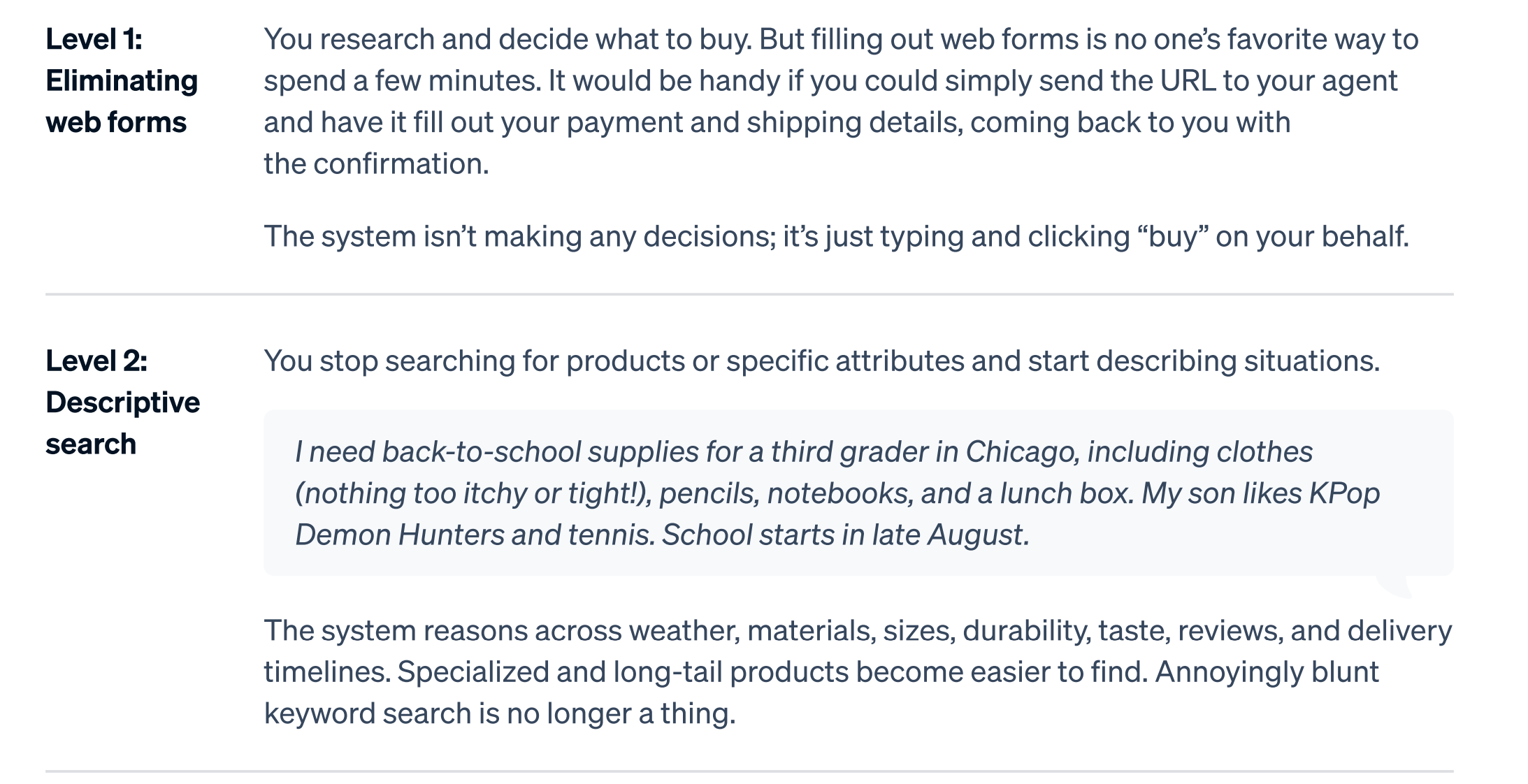
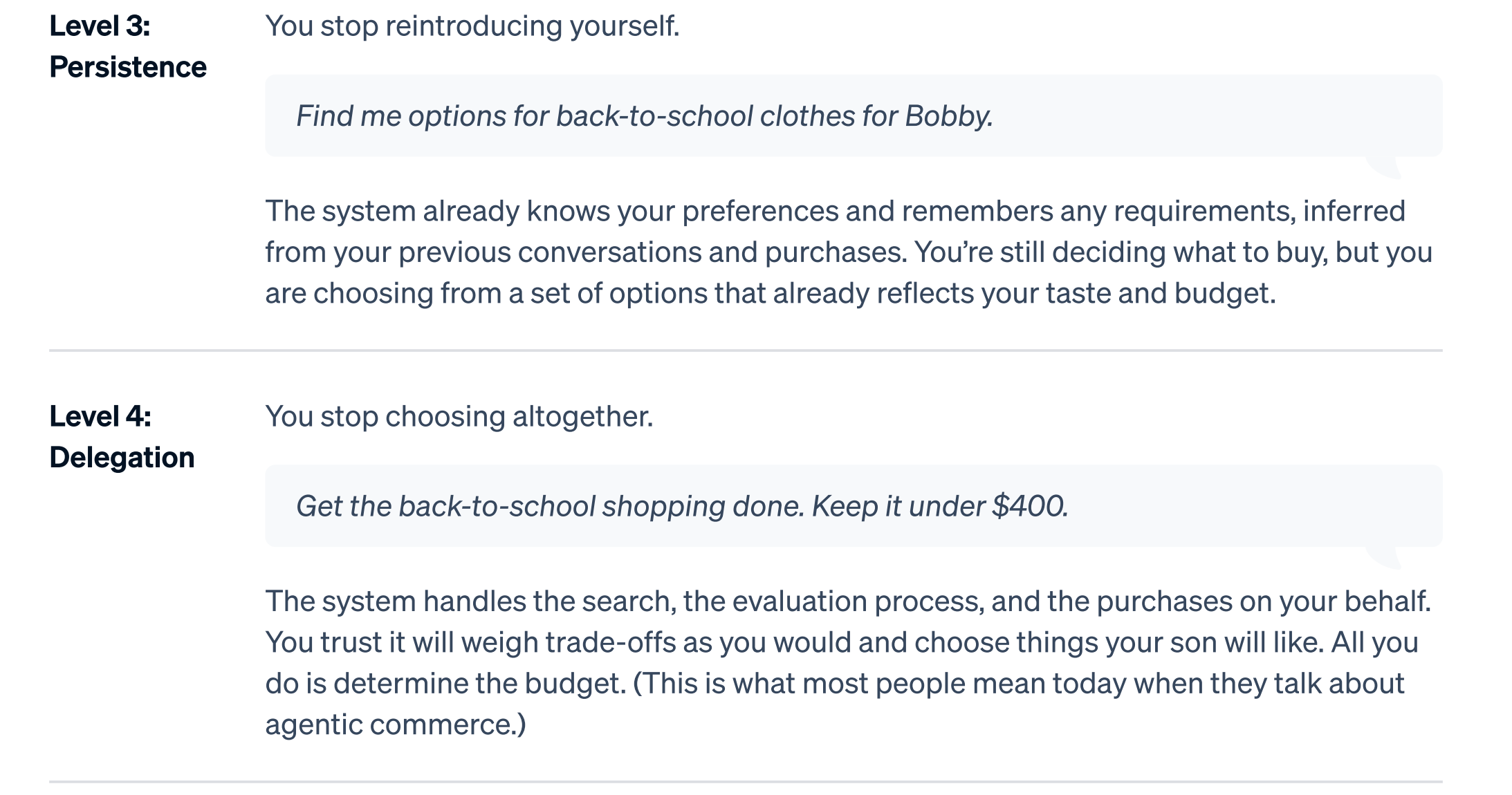

OpenClaw showed a certain appetite for the "personal assistant who is hands-off" application. Essentially just letting AI figure out things on your behalf. While both the technology and the public perception of such a way of living are in its early stages, we've seen how quickly audiences that were used to doing everything themselves (developers), can move to a model where they are comfortably handing off almost everything to AI (agentic coding).
The practical implication for Stripe is that agentic commerce likely means a significant volume of transactions that are never initiated by a human at all. An agent booking a service, spinning up infrastructure, or purchasing an API call on your behalf still routes through a payment layer. Stripe's early moves to make their sandbox natively accessible from within AI coding tools suggests they understand this better than most.
Today’s entrepreneurs and innovators have tools and reach that prior generations of industrialists could not have fathomed. We will hopefully soon witness the combinatorial effect of human ingenuity paying out in the form of productivity gains and improved living standards everywhere.
Last year, Joel Mokyr was awarded the Nobel Prize in Economic Sciences. Mokyr is widely known for emphasizing the importance of culture relative to the traditional economic inputs of capital, labor, and technology. Eighteenth-century industrialists didn’t just have coal or geography on their side. They had a new culture—an “improvement mindset” that saw the status quo as imperfect and correctable.
In The Political Economy of Technological Change, Mokyr also observed that new technologies have in the past often failed, despite their economic superiority, because technological decision-making implicates not only suppliers and customers, but also a broad variety of non-market “aggregators” (regulators, committees, courts) that influence what is adopted. As AI and the internet expand the scope of what’s possible, synthetic impediments to adoption and adaptation will become increasingly costly. Our bifurcating economy shows that growth is contingent on the application of useful knowledge and not some preordained result of its abstract availability.
AI harbors the promise of enormously improving drug discovery… but the potential will only be realized if we make the regulatory process, including clinical trials, faster and cheaper. Entrepreneurs in Europe can boost tepid economies with new tools… but only if well-intentioned yet counterproductive burdens such as the EU AI Act are curtailed.
Next-generation approaches to nuclear energy could usher in energy abundance… but only if we overhaul vetocratic regulatory regimes. Autonomous transport and logistics— from long-haul trucking to drones—could dramatically reduce the cost of physical goods… provided we don’t let a slurry of local ordinances harden into a blockade. Mokyr wrote about the importance of the Republic of Letters in catalyzing the industrial revolution.
Today, we inhabit a Republic of Permissions: a filtering sieve of nonmarket aggregators. While many of our strictures are sensibly motivated, it’s more important than ever to ensure that they carefully balance the benefits achieved with the possibilities foreclosed.
We’re privileged to support many businesses with the tenacity to show what’s possible. Mistral AI and Bending Spoons are proving that world-class European talent can puncture the regulatory permafrost; Zipline and Varda are earning permissions for intricate new hardware inch by inch; while Spring Health and Maven Clinic are stitching together a new software layer for modern healthcare. We continue to believe both in the importance of ideas in fueling economic progress and that many of the best ideas are undervalued.
…
Much of this letter has been dedicated to advances in AI, which can sometimes seem hard to keep up with. The qualitative difference between just-released products and last year’s state of the art is stark. We’re reminded of the phenomenon of falling into a large black hole. If you ever experience that particular misfortune, you won’t actually feel anything special at the moment you cross the event horizon: the path is locally smooth, even though the space of possible futures changes irrevocably upon crossing the threshold.
We write this letter at what may well turn out to be the advent of a different and hopefully much more beneficent singularity. While much around us in 2026 feels similar to prior years, it is also clear that the next decade will look very different to those just gone by. We are as enthusiastic as ever about how vibrant entrepreneurship and wise cultures can contribute to more successful future societies, and we hope that Stripe can play a small role.
So what can we conclude from this annual letter?