

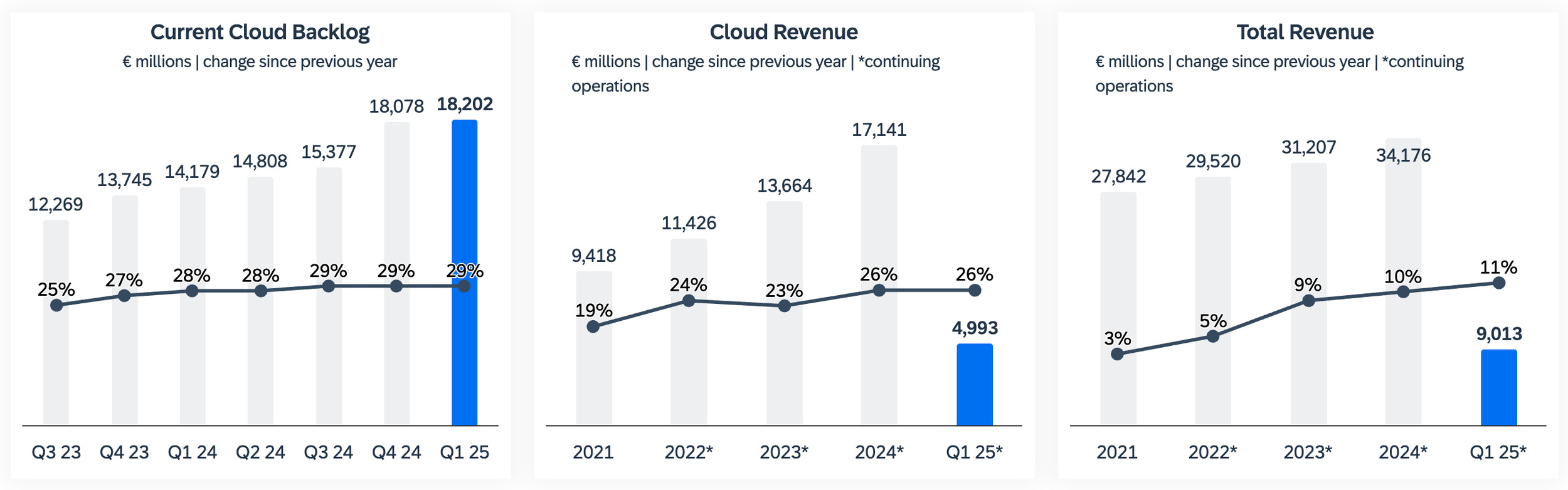
Source: SAP Investor Relations
It’s no secret that the author of this newsletter has a strong preference for the cutting edge in tech—both in terms of capabilities and go-to-market strategies. As such, there has been little coverage of what I consider “legacy” software companies. The funny thing is that they can still be very lucrative and interesting places to work, assuming you land in the right business unit, territory, and under the right local sales leader. It’s just that being part of those organizations would typically reduce your odds of doing something exceptional later because you’d mostly be surrounded by B and C players.
Every now and then, however, an agent of change might be able to climb the ranks of a legacy institution and weaponize it as an extension of their ambition. If Salesforce’s pivot toward AI has been mostly about Marc awakening from his slumber and getting interested in the industry again, for SAP the pivotal player in their journey of scaling into cloud and AI has been Christian Klein.
The key takeaway
For tech sales: SAP is a soft recommend—they have a great install base and a CEO who has pushed hard in the right direction. Quality of life is likely to be low for the next 12 months.
For investors: The stock bottomed at $81.50 in September 2022 and recently passed above $300. While Oracle has doubled in the same period, it’s not difficult to see that markets are starting to pay serious attention to what’s happening, and there is significant payoff potential down the road if they achieve rule of 40 following their GTM revamp. The obvious issue here is that the stock has already run quite aggressively as large players accumulated—they are more likely to dump on you (sorry, I mean “de-risk positions”), which will likely limit upside versus alternatives in cloud infrastructure software.
In his own words
Before we look at SAP’s recent performance and the tech sales opportunity there, let’s first get a measure of the man based on his own point of view. We’ll use a recent interview with Ben Thompson (thank you Kyle for introducing me to his work) at Stratechery:
CK: When I became Chief Operating Officer of SAP, I was responsible for our IT, and obviously we are running SAP solutions, our ERP, our CIM, everything. And I felt, “Oh, I have to transform this company”, and the ERP plays an instrumental part, because in the cloud you sell differently, code differently, you service your customers differently. I had a very homegrown, customized ERP, a very complex system, extremely hard to upgrade. It served our needs very well, but it was not on the latest and I had all of this great new technology, we will definitely talk about AI in a second, but I was eight years behind the latest release and I thought to myself, “Hey, this business model, highly profitable, highly successful, will not lead SAP into a bright future, because there are all these best of breed competitors coming in”.
All of these lessons which I learned, I brought into my role as CEO and said, “Hey, look, wait a second, we are running here a good business, but we have to disrupt ourselves because customers need way more agile systems. They need the latest innovations. They don’t need to spend hundreds of millions of upgrading a system, they need to be on the latest”.
Now what CK is talking about here is a good insider view of how most legacy companies are starting to warm up to “going to the cloud”—by finally understanding that if you want to run the best version of the software you’ve invested in, it’s smartest to let the vendor actually deliver that for you continuously over time. The biggest handicap of most CIOs and CTOs today is thinking that wasting engineering time running outdated on-premises software is some sort of great efficiency play.
CK: Now, AI, Ben, to your question, of course, in 2015, 2016, we already had our first machine learning modules and so on, but what I didn’t like is we played the “me too”. We played the “me too” of other tech companies’ offering on our platform machine learning services. You could build your own modules, but when you are SAP, think about that — you’re running the most mission-critical business processes of the world, you have access to so much business data. So you have a suite, you have mission-critical data, we have to embed AI right into the business processes of our customers so when you do financial planning, you don’t have to code another AI module for that. We are actually infusing the intelligence into your financial planning so that you can simulate right away the impact of tariffs on your financial guidance, or when you then run a supply chain and you demand in supply chain planning, don’t code with Gen AI or traditional AI, another AI app embedded right away into our solution so that end users can use it out of the box. Obviously they can do some fine-tuning, but this is what SAP can do and as we have the business data other than the consumer-driven LLMs, that is what differentiates us.
When everything in a big corporation ends up being an “efficiency and cost control” decision, it becomes very difficult to actually innovate and change your product in a way that remains competitive. SAP had all the resources in the world to try and create whatever the future product play for replacing ERP would be. Instead, they opted to keep milking the install base and offer the most basic functionality that other vendors delivered much earlier (and much better). This is the first time in a while when somebody is in charge and wants to win with better technology, rather than incumbent advantage.
CK: Now in the next step with AI and our new offering, Business Data Cloud (BDC), we are saying suite-first because we have the very mission-critical SAP data. Then Ali Ghodsi, the CEO of Databricks, once reached out to me and said, “Hey Christian, I have so many SAP customers and your data is the most mission-critical in their company, but I have a lot of non-SAP data and I feel we are creating all of this data in big data lakes and then very expensive data scientists are coming to make somehow meaning to this data, but we can do this way smarter”. I said, “Absolutely, Ali, we can do this way smarter, why we are not building this one data layer where we can semantically match SAP structured with non-SAP also unstructured data?”.
The SAP-Databricks partnership is easily one of the most aggressive plays in the industry today. The corporate boilerplate:
CK: SAP Databricks is an SAP-managed version of the Databricks Data Intelligence Platform embedded natively within SAP Business Data Cloud. SAP Databricks brings industry-leading AI/ML, data science, and data engineering capabilities together with semantically rich, business-ready data from SAP applications. Leveraging zero-copy Delta Sharing, companies can seamlessly integrate semi-structured and unstructured data from any source with data products from SAP applications into a single, harmonized data model—eliminating complex data movement with seamless access to high-quality, reliable data.
Now what that really means is that you basically log into your SAP portal, then click on SAP Databricks and it opens a serverless instance of the Databricks Data Intelligence Platform, branded under an OEM. Databricks users now get access to SAP data within their data lakehouse architecture, while SAP users get access to a cutting-edge modern data warehouse without having to contract and implement a new tool.
CK: Yeah, the two companies have a very compelling and a very complementary portfolio in bringing this together. What I actually see coming out of that, and by the way, we are going to see also more partnerships in that space, but what we are going to see is actually a marketplace of data products when, for example, now many customers are coming to us and said, “Okay, great. SAP you make sure, first of all, that in all countries in the world I have a compliant business because you can translate tariffs into all transactions what we are doing. That is a big benefit, but now help me to simulate the impact of tariffs on my business. How should I deal with price changes? How should I deal with inventory change?”.
Then with BDC and Databricks and SAP, you can build data products. You can say, “Okay, let’s use external data, let’s use some SAP data”, bring it together to simulate the impact of tariffs on your production plan, on your financials, on your pricing, etc. So what we will create is a marketplace of data products, this kind of semantical data layer where customers can pick and choose data products to have an immense value either on the steering, on how they run their business, on the decision-making, but first and foremost, and also of course on AI, because the agents will also have access to this data and coming back to my point, you need the business data, it’s not enough to only have non-structural data. You need this business data, you need it combined with the unstructured data and then the agents can become world-class.
The most important thing is that extremely valuable data is now available to data science teams to start running ML jobs against it and ultimately use it to drive advanced AI applications. As CK puts it: