

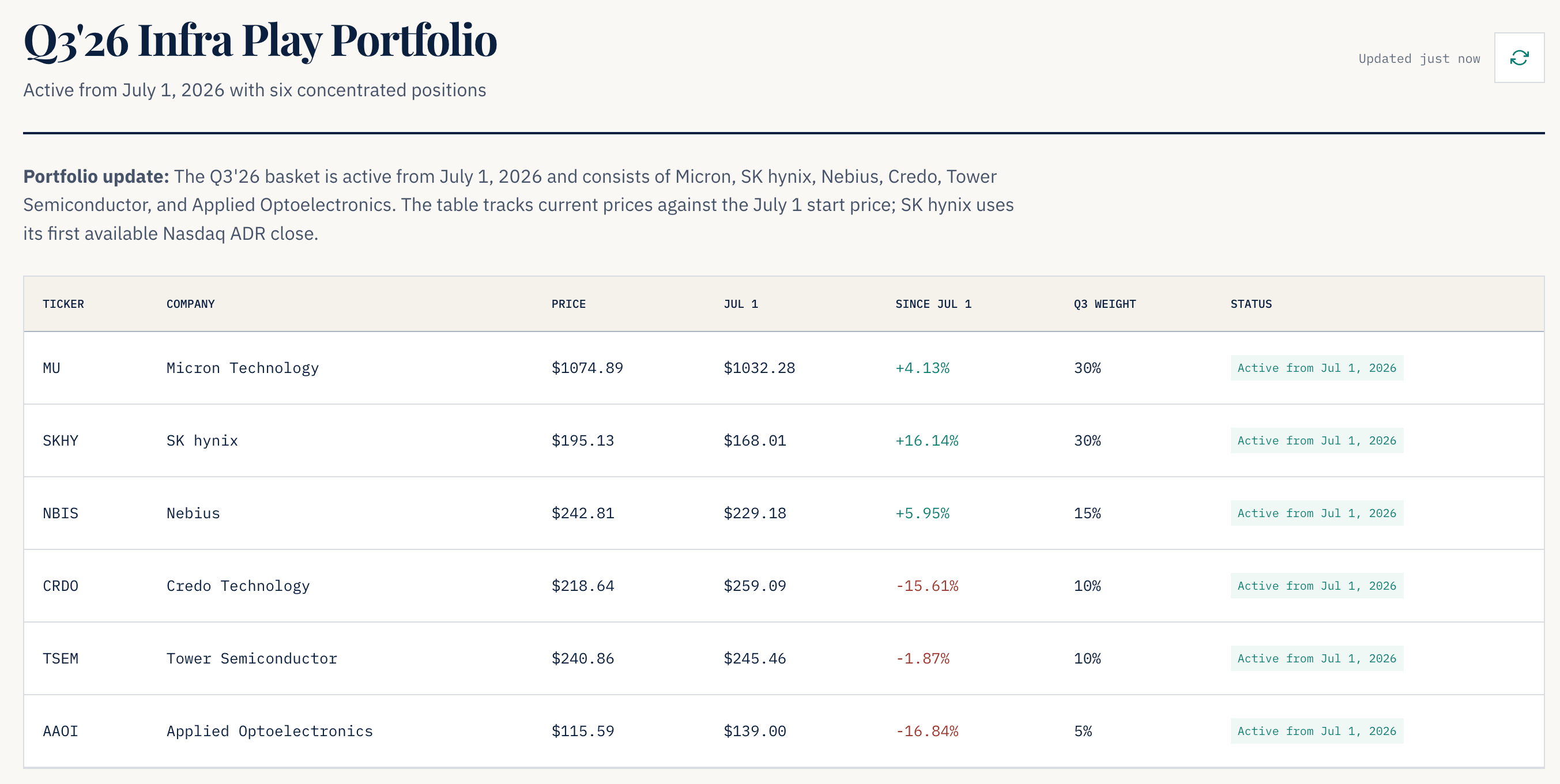
After a crazy run in the first half (Q1: 25.6%; Q2: 87%), Q3 ended up flat (-0.37%). While key companies in the cloud infrastructure buildout reported absolutely outstanding earnings, actual price action was anemic. With the midterms approaching, this raises some interesting challenges, namely: “Even if the directional bet is correct, what happens if it doesn’t pay off?” Most NVIDIA holders who bought in late have experienced this firsthand, although an argument can be made that the lack of price action was driven by the structural and unexpected shift of profit margins toward memory.
The core issue right now is not really proving to the market that the AI buildout is a generational event, but rather convincing it that the macro picture will improve.
What went wrong in Q3:
The war came back. The US and Israel have been at war with Iran since late February. After a stretch of relative calm, fighting resumed in early September, Iran claimed control of the Strait of Hormuz, and Brent went from about $92 in late August to around $101 by September 10. It finished the first week of October at $102.72, and the Wall Street Journal reported that White House advisers have privately raised the prospect of the war running through the rest of the term.
Oil prices rising → higher inflation → rate hikes. Headline CPI held at 3.4% in August, core PCE has run above 3% every month this year, and on September 16 the Fed raised rates by a quarter point to 3.75% to 4%, its first hike since 2023. The vote was 12-0, three members had already wanted to hike in July, and 16 of 19 officials expect at least one more increase this year.
Global bond yields are surging to multi-decade highs. The 10-year Treasury went from about 4.7% in late August to 5.05% on September 23, its highest since 2007, after the composite PMI hit 58.4, a five-year high. It reached 5.28% by September 29, and the 30-year traded at levels last seen in 2002. Long yields have been climbing since July on rising deficits and a wave of debt issuance from AI companies, including NVIDIA’s $25 billion of notes in June.
Tariffs came back into the conversation. On September 2, Commerce Secretary Howard Lutnick said a new round of semiconductor tariffs is under consideration, possibly extending to products containing chips, such as data center servers, with exemptions for companies building in the US. A 25% tariff on certain advanced AI chips has been in place since January.
The economy didn’t actually tip into a recession or a big wave of unemployment. Q2 GDP was revised up to 2.2% from 1.5%, August payrolls rose by 162,000 with unemployment at 4.1%, and the PMI sat at a five-year high. A strong economy is not the bear case for AI capex, but it is probably putting a significant cap on potential multiples.
Leopold got flushed. His fund's collapse wasn't driven by macro, but the deleveraging it triggered across the ecosystem wasn't pretty, even if it was temporary.
What could play out in Q4?
Rates remain a swing factor. Heading into the September payrolls report, futures put the odds of another hike at the October 28 meeting at about 70%.
Oil prices remain closely tied to rate hikes. Goldman expects Brent around $85 by December and sees Middle East shipping disruptions running into 2027, and ANZ doesn’t expect Hormuz to return to pre-war throughput until late Q1 or early Q2 2027. With Brent at $102.72, either the forecasters are early or inflation will still be a problem at the December meeting.
The midterms are a wildcard. Oil prices, the tariff round, and any antitrust waiver for the pacing pact are all political decisions that get easier or harder depending on who controls Congress. There are potentially 5,000 dollarinos for everybody who bets on the current administration.
Tariffs favor builders. The exemption logic rewards companies building in the US, and Lutnick named Micron and TSMC among the companies behind the roughly $1.2 trillion of committed US chip investment.
Does this mean it’s over for the AI infrastructure trade?