

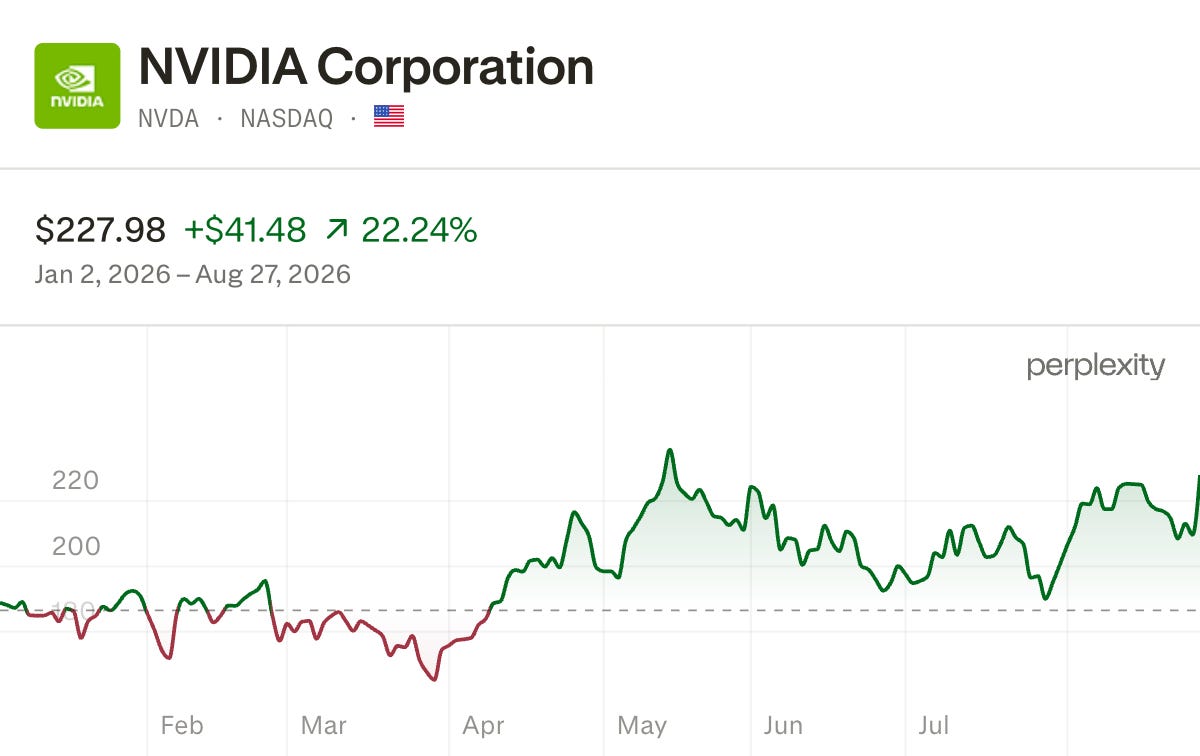
In a year dominated by the semiconductor play and the frontier labs breaking every software revenue record, NVIDIA has been a rather muted player. For the most part the stock has been ranging in the same band since April, even as the company continued to deliver blockbuster earnings quarter after quarter.
This time the gap between the numbers the company is delivering and its “valuation” is becoming a bit comical. We might take this as a signal that the company is simply priced to perfection, but that would be underestimating the sheer capital power that Jensen now commands. Back in January ‘25 I wrote the following:
If AI workflows are going to become the defining way we use computing, then specialized hardware that is the most effective at running those workloads becomes critical. NVIDIA offers essentially the only “complete” package on the market: hardware, software, networking and the capability to execute.
They work with everybody. They supply everybody. They coach, fund, provide feedback and work with everybody.
I think one thing that was underestimated at the time was the “fund” part. As value very clearly accumulates at the bottom of the stack (with NVIDIA and the memory boys being the big winners), the recent desire to move towards the application layer that makes the least money (open source) is a rather contrarian bet by Jensen.
The key takeaway
For tech sales and industry operators: NVIDIA might be back on the menu as a tech sales opportunity for selling tokens. Whether this materializes will depend on whether they continue the self-service model of Hugging Face or plan to push the sovereign AI play with enterprises on top of the HF infrastructure. That would mean the return of a sales team driving that motion, after NVIDIA hired heavily for DGX Cloud and then exited the motion (although, to be fair, they kept everybody on board).
For investors and founders: NVIDIA's most recent financial quarter should push most of the sell side to update their priors. Within the next twelve months the company will become the third largest enterprise in the world, on the back of low-70s margins and a CEO who will very clearly exploit every single angle for expanding his influence and capital muscle.
The demand side of the AI factory
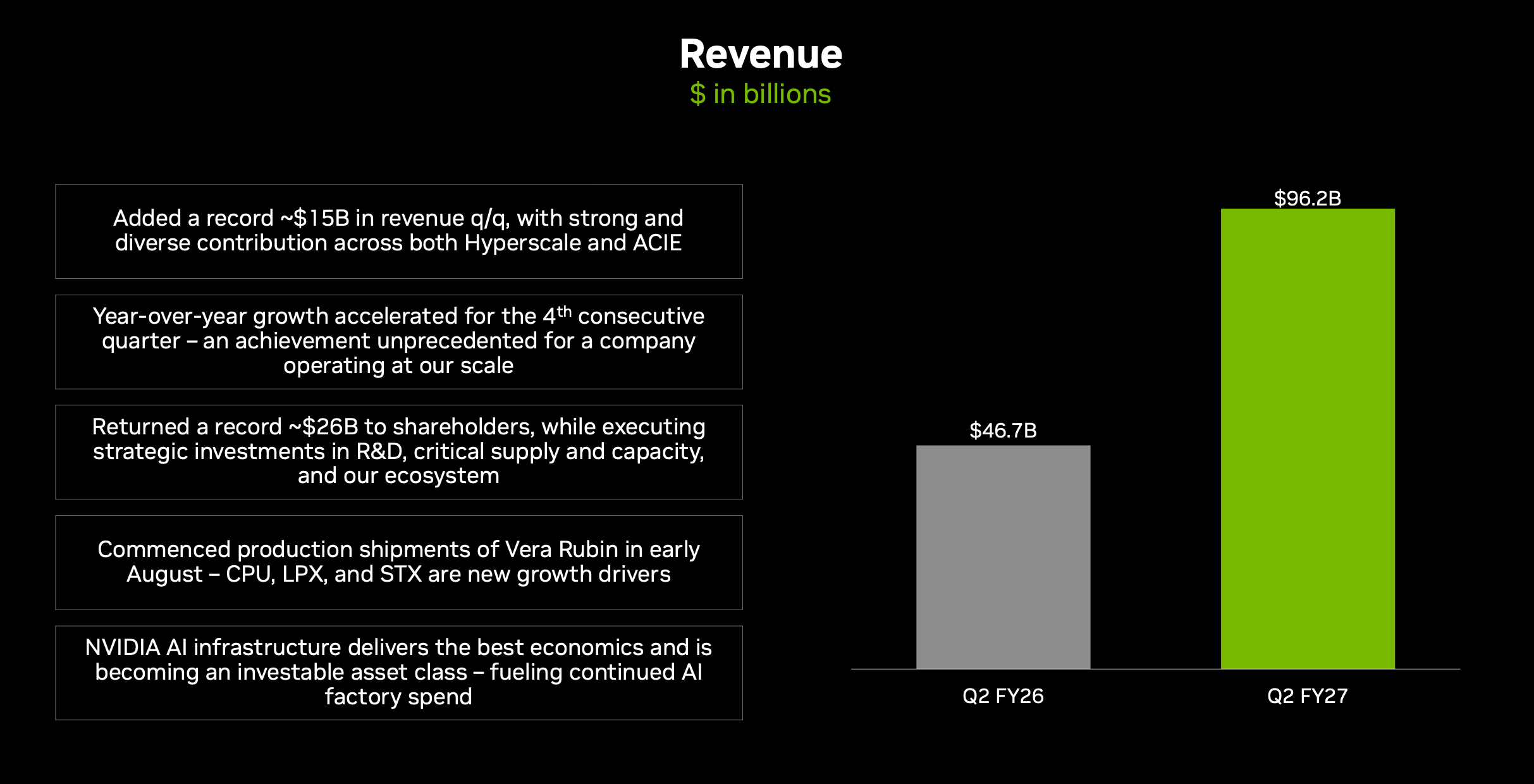
Colette M. Kress, CFO: We delivered another outstanding quarter with record revenue, operating income, and EPS. Total revenue of $96 billion, more than doubled year-over-year as growth accelerated for the fourth consecutive quarter. The surge in AI demand is driving a global infrastructure buildout, supported by an expanding and diverse set of growth opportunities, spanning hyperscalers, AI labs, AI natives, enterprises, and sovereign customers. We expect to grow revenue by approximately 70% in fiscal 2028. This is a supply-constrained outlook.
Q2 data center revenue increased 18% quarter-over-quarter to $89 billion with strong contributions from both subsegments; hyperscale and ACIE, which includes our neocloud, industrial, and enterprise customers. Hyperscale revenue of $49 billion grew 13% sequentially, driven by sustained strength in Blackwell. Reinforcing that more compute drives more revenue as new GPU capacity comes online, our hyperscale customers delivered strong financial results in the quarter, with accelerating revenue growth and expanding margins. With cloud industry backlog now greater than $2 trillion, CapEx by the top-five hyperscalers is expected to reach nearly $800 billion in 2026 and $1.3 trillion in 2027.
Today, we are delighted to announce an expansion of our partnership with AWS. Building on its already vast installed base of NVIDIA Compute, AWS is deploying an additional 2 million GPUs starting this quarter through the second quarter of fiscal 2029. Along with Vera CPUs, some integrated with Rubin, others stand-alone. AWS will serve NVIDIA Nemotron family of open models on Amazon Bedrock and SageMaker. Amazon will also adopt our full physical AI stack; Omniverse, Cosmos, Isaac, and Jetson, to power its fleet of warehouse robots.
ACIE revenue of $40 billion increased 25% sequentially and 138% year-over-year. Growth was driven by neocloud capacity additions to meet the rising demand from enterprises, AI start-ups, and sovereigns, as well as hyperscalers purchasing capacity to supplement their own buildouts. Using NVIDIA DSX reference designs, our neocloud partners are bringing capacity online faster and at lower token cost. They are expected to exit the year with 8 gigawatts in total installed capacity, up from approximately 3 gigawatts at the end of 2025.
Incredibly, we are seeing demand acceleration even at our scale. Customers’ forecasts point to our growth doubling next year. However, as I mentioned earlier, we expect to grow approximately 70% as we are supply-constrained. NVIDIA Compute is fully utilized across every cloud we serve. The economic value it generates for our hyperscale, neocloud, and AI lab partners keeps rising.
To understand the sheer scale of the figures we are talking about here, this is +1,730% growth in four years. For the next fiscal year, they expect close to 70% growth, or $637B in revenue. That would make NVIDIA the third largest company in the world by revenue, slightly behind Amazon and Walmart, which are low-margin retailers for most of their business.