We’re reaching out because we’re announcing that OpenRouter will be joining Stripe, as our largest-ever acquisition. This comes after the recent acquisitions of Bridge, Privy, and Metronome. We thought that it could be useful to take a moment to share how we think about these businesses in the context of Stripe’s strategy.
Stripe aims to grow the GDP of the internet. When we think about a flourishing world, we’re drawn to the underpinnings that make everything possible: mechanics like money, credit, currencies, legal structures, and risk management. We think that the world can, and should, be greater and more prosperous than it is today, and we think that better economic infrastructure can help make it happen.
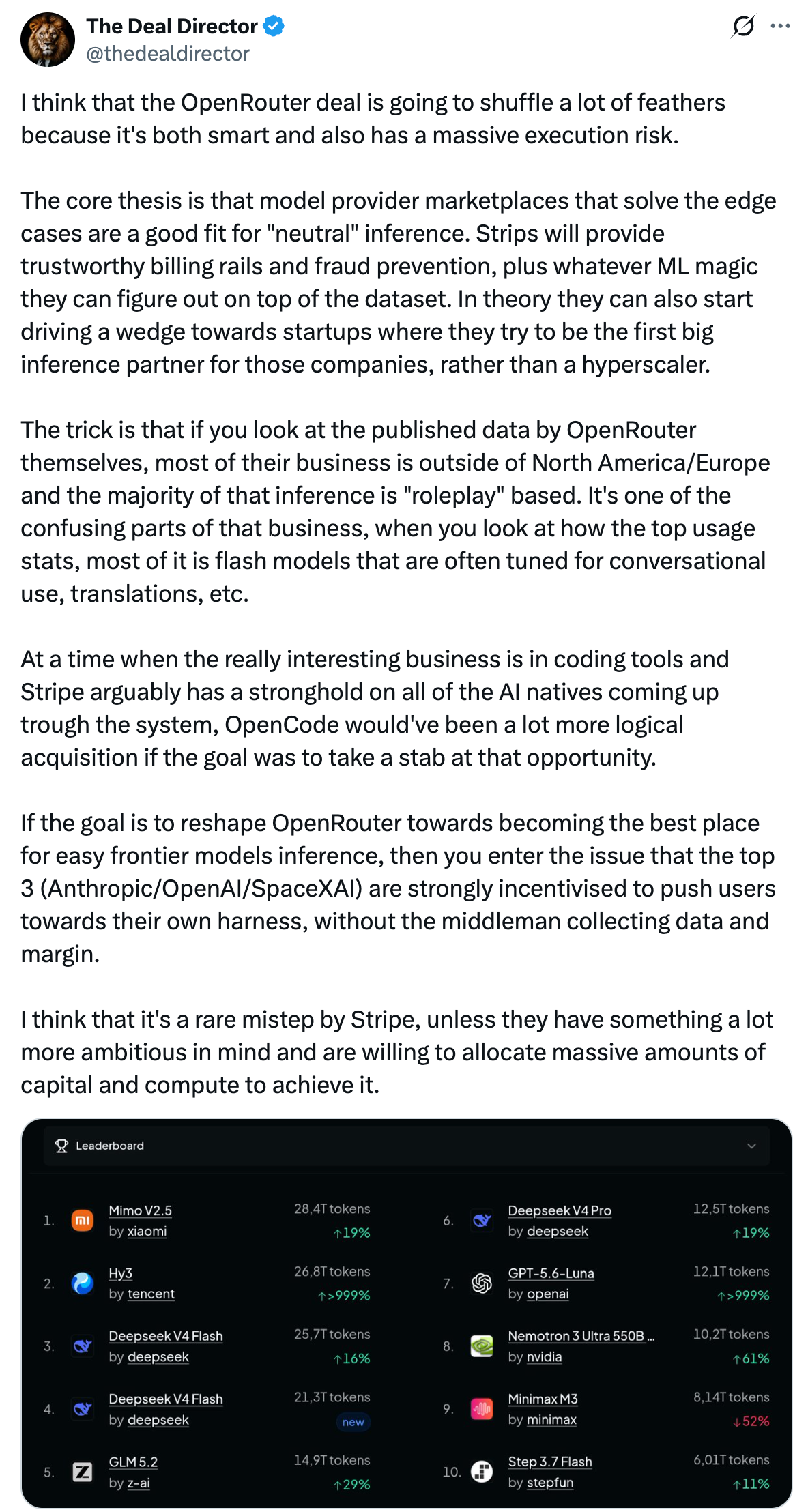
My first reaction to the Stripe acquisition announcement was straightforward:
Source: The Deal Director on X
Since then, we've seen more detail on the deal (including an investor letter sent to Stripe's largest shareholders), and I've had several conversations with industry peers about how they expect this to play out. Has anything changed?
The singularity It’s a fuzzy and perhaps already overworked term, but we decided that January 1st marked the beginning of the singularity, and we have since been operating on that basis. The singularity is often invoked alongside millenarian forecasts, but, in our case, we simply saw a large inflection in long-run trends (for example, a huge increase in the rate of new firm creation), and we decided that we ought to take the phase change seriously.
It turns out that optimizing for developers, as Stripe has from the outset, is in many ways the same thing as optimizing for coding harnesses and for agents, since they too seek programmability and frictionless setup. We’re fortunate that so many of the world’s AI businesses have adopted Stripe as a result, and it’s become evident to us that building economic infrastructure for the internet is mostly the same thing as building the economic infrastructure for AI.
While it’s clear that the changes will be vast, nobody can know with specificity how AI will reshape our world. Many predictions from wise individuals have already been abjectly falsified. With humility about the uncertainty, we have two overarching aims.
First, we want to accelerate the diffusion of AI across the economy. As AI changes what’s possible, we’re seeing a profusion of delightful new products and services (surely just the curtain-raiser relative to the amazing creations to come), which require different and better-suited financial tooling. AI’s rise in the economy is also yielding new challenges, such as new kinds of theft and fraud, which require sophisticated advances to be effectively mitigated. Overall, the promise and collective hope for AI is that it will enable greater material prosperity and abundance, and we want to help make it happen.
Second, there is a fear that AI will yield unemployment or centralization; perhaps both. We think that it is important that deployment of AI enhances human agency, and we hope that Stripe can play a role in protecting economic autonomy as a foundational ingredient of a liberal society. As a result of AI, we hope that there are more companies started, and that those businesses can with greater effectiveness operate alongside and compete with established incumbents. While early data supports this (as we have documented on the Stripe Economics Substack and elsewhere), nothing is foreordained. As partisans of the small, we’ll do our best to keep the road open.
We continue to believe that there is no ceiling on the size of the global economy (somewhat larger than $100T today). Implausible though it might sound on first blush, we think that it’s useful to contemplate the quadrillion-dollar world and to enumerate the relevant bottlenecks to bringing it about. (If global GDP per capita matched that of every Irish person—around $100,000—we’d be 80% of the way there.)
With more than 5 million businesses and flows representing almost 2% of global GDP having adopted Stripe, we’re pleased to be off to a good start, but we think that these figures are microscopic relative to what could be possible in the years ahead.
To understand Stripe as a business, we have to start with the deep influence the Collison brothers have on it. Most tech founders take up “big projects” later in life, or stay private about them. The Collisons are openly interested in how Stripe itself can advance their vision for a better world, and in keeping that grounded in a sustainable business. That sets them apart from the standard tech billionaire profiles: the one who writes large nonprofit checks (Gates, Zuckerberg), the one who raises capital for borderline outlandish ideas meant to push humanity forward (Musk), and the ones somewhere in between (Bezos).
From that perspective, the Collisons sit closer to someone like Dario Amodei in how they think work, purpose, and impact should intertwine, with a lot less effective altruism and a lot more acceleration of scientific, technological, and economic growth. Stripe Press is the public record of those interests, as is Works in Progress, the online magazine that recently moved into print. Full disclosure: I lean closer to the e/acc position myself, but I subscribe to the magazine and regularly give Stripe Press books as gifts.
Source: The Deal Director’s porch
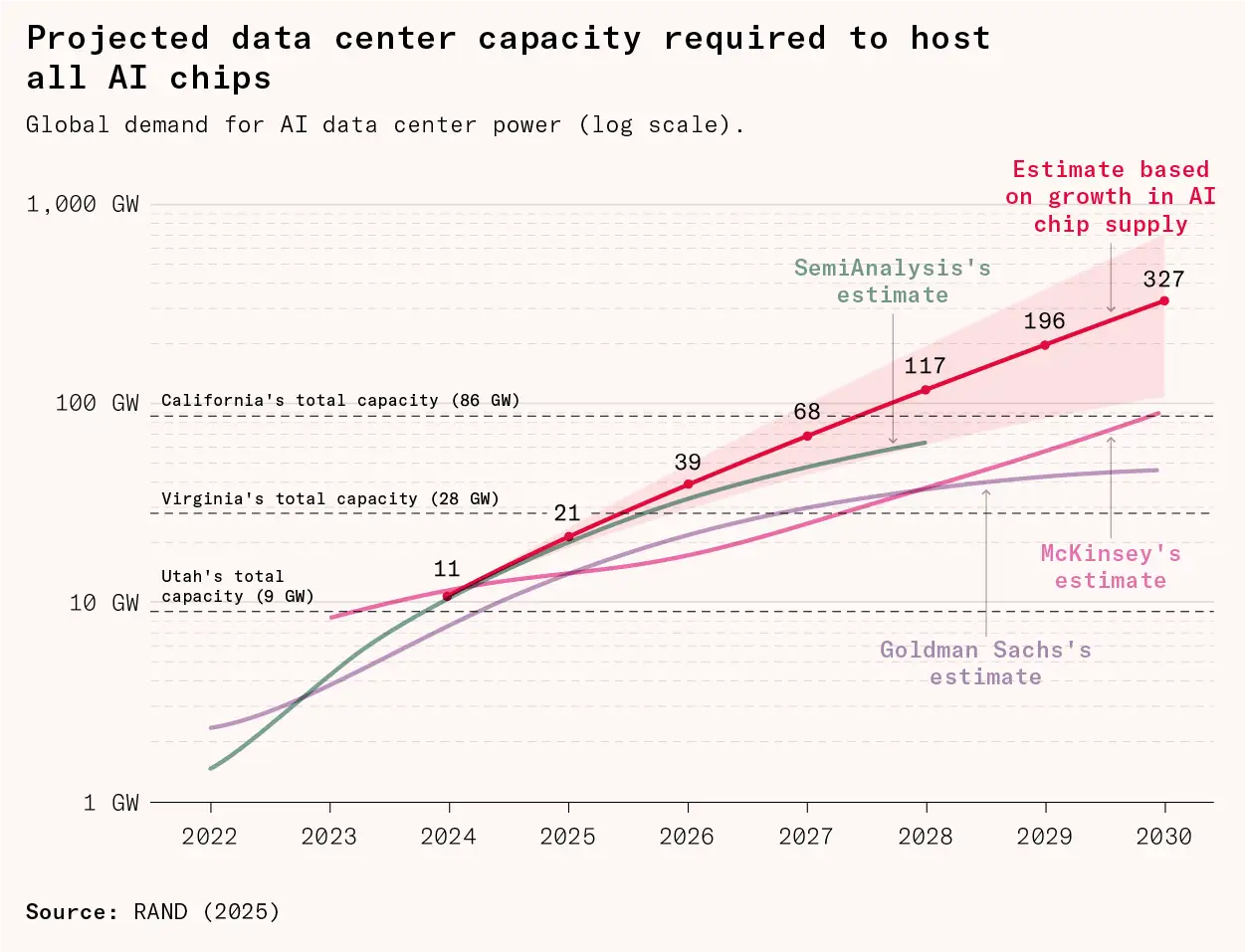
This is an example of the mental models at work, from an article on the AI energy grid problem:
Source: Works in Progress
Tragedy of the commons
In the early 2000s, regulators wanted to level the playing field between new independent producers and incumbents. They worried that utilities might preference their own projects. As there was plenty of spare capacity at the time, the first-come, first-served system seemed both simple and fair.
But today, transmission capacity is a limited resource and independent power producers are thriving. This means there is much less concern around the power of traditional utilities. In response, many grids are proposing mechanisms to allow more valuable projects to jump the queue. MISO, PJM, and SPP, three large grids in the US, have proposed mechanisms to prioritize projects that are most viable or most necessary for the system’s reliability. But these mechanisms are band-aid solutions.
The flood of requests is a typical ‘tragedy of the commons’. Everyone is incentivized to spam the queue with requests. Auctions can fix this.
In the fishing industry, when tradable fishing quotas were introduced worldwide in the 1970s, what had been a mad dash for fish became an orderly and efficient process. Before the quotas, the whole season’s supply was caught in a few days of dangerous, non-stop fishing. Market share went to whoever bagged the fish fastest. Once quotas were introduced, fishers could time their catches with market demand instead of catching everything at the start of the season and then freezing it. And since more efficient fishermen made more money, they were willing to pay more, and quotas went to them rather than the fastest fishers, lowering prices for consumers.
Auctioning new grid capacity could bring similar benefits. The scramble for interconnection would be replaced with an orderly process in which the highest quality projects would get priority. Developers’ bids would reflect both the likelihood that the project will come online and the projected value of the project to the grid if so. Less viable and less valuable projects would be weeded out.
The simplest way to implement an auction would be to create small ‘fast-track clusters’ that receive expedited studies throughout the year. Projects in the regular annual cluster could bid to enter the fast track, and the highest bidders up to some preset number would be admitted. The fast-track proposals recently adopted by some grid operators follow this structure, except that admittance to the fast-track cluster is based on an administrative scoring mechanism, not developer bids. But administrative scoring mechanisms could never capture the subtleties that a developer’s bid would. For example, developers have private knowledge about a project’s chances to get permitted, like whether the site has trees with endangered bird nests or unhappy neighbors generating pushback.
It's no surprise, then, that Stripe Press published the definitive edition of Poor Charlie's Almanack, the collected works of Charlie Munger, available to read digitally here.
John B. Collison: Poor Charlie’s Almanack is a testament to the power of thinking across disciplines. It’s not just a book about investing; it’s a guide to learning how to think for yourself to understand the world around you. Charlie’s philosophy combines insights from nearly every discipline in which he’s ever taken even a passing interest—not only business and finance but also mathematics, physics, history, ethics, and more—delivered with a characteristic irreverence that has persisted for 99 years (and counting). His essays extol the virtues of free enterprise, yes, but also of doing business the right way, with integrity and rigor. Of taking your work very seriously, but never yourself.
We have to approach the OpenRouter acquisition not just as a business decision, but as an expression of the Collison brothers' mental models about the world.
What we’re building In the macro, it is clear that the global economy is going to grow a great deal. In the micro, it is clear that how business works is changing quickly. Existing businesses are adapting their business models (metered billing is rising while many traditional models are in decline) and mobilizing rapidly to launch new products and services (making speed and flexibility the order of the day). Firm formation is accelerating. Agents are on the cusp of becoming economic actors in their own right. Stablecoins are gaining rapid adoption and will likely be further boosted as they become the native currency of the AI economy. Since tokens easily transit borders, global coverage is becoming more important than ever.
We’re working as quickly as we can to build the economic tools this era needs. The combination of native stablecoin support and agentic accessibility is leading to the emergence of a new set of primitives:
Discovery + onboarding: Stripe Projects (which makes it possible for agents to register for third-party services), Stripe Directory (product and service discovery for agents), Provisioning API (embedded registration for agents).
Usage management: Metronome.
Payment: Bridge (stablecoin orchestration), Stripe’s Agentic Commerce Suite, Tempo (blockchain for agents), MPP (machine payments protocol).
Fund storage: Privy (crypto/stablecoin wallets), Open Standard (a new stablecoin).
Over time, we expect a composition shift, as the “AI economy” stack gains share relative to that built for the pre-AI economy. Adoption of these products won’t necessarily look dramatic: we’re integrating them deeply into Stripe’s existing products and platform, ensuring easy adoption for any business.
To ensure that Stripe is as useful as possible in this new phase, we pay close attention to our adoption by the world’s fastest-growing and most important new companies. Today, 88% of the Forbes AI 50 (including OpenAI and Anthropic) are building on Stripe (most of the remaining 12% are pre-monetization), as are 100% of the just-published Brex list of fastest-growing startups. Most of these companies use more than ten Stripe products, and the fraction of Stripe’s revenue derived from both AI companies and from crypto is more than doubling year-over-year. We hope that Stripe will over time track the growth of AI deployment as a whole.
One of the big challenges for fintech incumbents is making their infrastructure ready for agents and for digital payment rails that sit outside today’s guardrails. This is especially true for companies that are public or close to it, since existing regulation strongly disincentivizes the investment needed to rebuild in that direction.
OpenRouter Zooming out, we see capital and intelligence are becoming the two digital flows undergirding every business. Up until now, every developer has needed a straightforward and reliable way to manage their revenue pipeline, and serving this need gave rise to Stripe. Going forward, however, every developer will also need a straightforward and reliable way to manage their intelligence pipeline.
This observation first led us to OpenRouter. OpenRouter has built the world’s largest and most trusted token routing engine, supporting all major models and providers, and beloved by its customers. Thanks to the usefulness of their product, the exceptional ability of the founders and the OpenRouter team, and the panoply of new models being launched every week, their business has grown at a frenetic rate (even by AI standards), with token consumption compounding at 9% per week YTD.
OpenRouter is exceptionally useful for any developer and Stripe is one of the world’s largest developer platforms. As such, we think that there will be many benefits and efficiencies in bringing these two core needs together.
We think that there are deeper reasons to pursue integration besides convenience, however. Our experience in working with our customers has led us to realize that intelligence is special: it is expensive, heterogeneous, and constantly changing. As with financial capital, businesses must reason about cost and return of every unit in a deliberate and granular way. How valuable is this task? With which models can it be best handled? Who will pay, and when, and what is the time-value of that delay?
We have seen the parallels between managing intelligence and managing capital directly in our own products. Radar, for example, was initially designed to prevent financial fraud, but is proving extremely effective at guarding against token fraud at many of the world’s largest AI companies. Metronome (used by Anthropic, Nvidia, and other industry leaders) is showing that metered billing in an AI context is inseparable from token serving and consumption itself.
We expect the deal to close in the coming weeks. We’re excited to extend Stripe’s financial capabilities to this new domain and to help businesses effectively allocate the new currency of intelligence capital.
The explanation here is weak.
“We like developers, developers need money and intelligence, so why not offer both in the same place, amirite?”
Then comes an even shakier proposition: “Well, since this is all moving fast, we might as well own a piece of AI infrastructure, because it could turn into something surprising later.” They are obviously free to do what they want with their capital, but the investor letter exists partly because most of the quoted price is newly issued Stripe stock. Investors got diluted, and the Collison brothers spend much of the letter defending that. Before we get there, a look at the VC apologists.
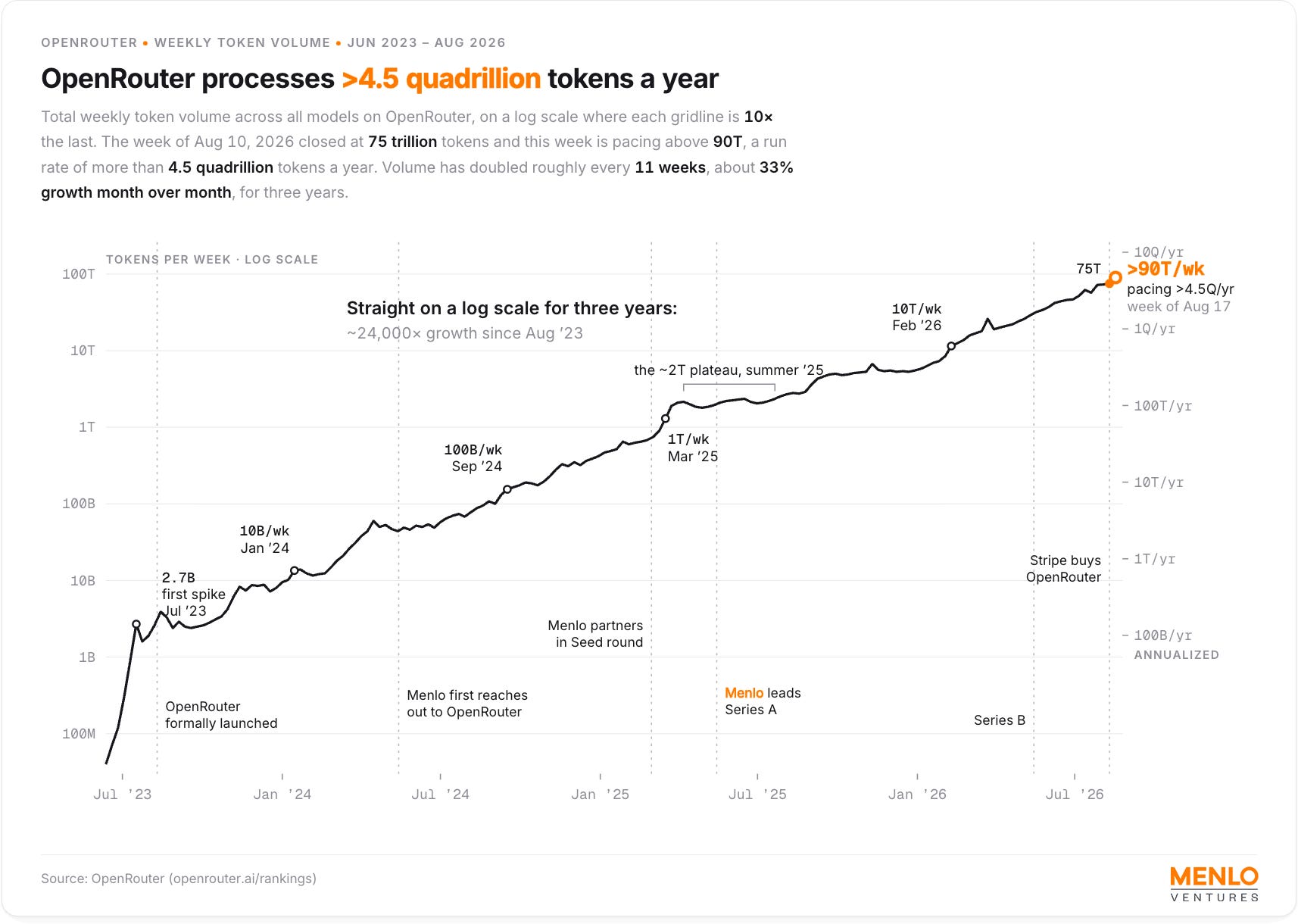
Source: Menlo Ventures
Why We Invested in OpenRouter
OpenRouter was one of the first companies Deedy met after joining Menlo in 2024. The product sat squarely in the center of our AI infrastructure thesis. Menlo’s 2024 Enterprise AI report states two of the core beliefs we held when investing in OpenRouter: that AI spending would rise dramatically and that developers would adopt multiple models.
The first outbound email from Menlo to OpenRouter
It was very clear to us, who ourselves code and use these models, that there are radically different cost, latency, and performance tradeoffs between them. You don’t necessarily need the frontier intelligence of Fable when you’re doing a simple NLP task of identifying entities in text. But it’s also too cumbersome for users to go into each different model company’s website, create an account, figure out how to create a key, make sure they keep the key safe, make sure they align to that model’s slightly different API endpoint spec, and then do model management themselves. A central gateway might seem simple, but it’s actually deceptively difficult infrastructure that few would want to build and maintain.
In venture, we often talk about moats, but purely in the technical sense. OpenRouter had a classic moat of scale—more users, greater ability to predict demand and handle load, easier to scale contracts with labs and have predictable demand for tokens—eventually getting to a place where new model labs want to list on OpenRouter first for distribution. One of the things we’ve observed ever since the acceleration of software startup formation with vibe coding being ubiquitous is that, to break into enterprise, buyers end up choosing the product that has already won the hearts and minds of the developers at their companies. Think about Anthropic, OpenAI, xAI, Cursor, Cognition, ElevenLabs, Lovable, Fireworks—all of them won the developer first! So did OpenRouter.
Since investing:
OpenRouter now processes 30,000x the number of tokens they did at launch, growing 33% MoM for three years and consistently doubling every 11 weeks.
The model landscape exploded with fantastic open-source models from China (DeepSeek, GLM, Kimi), Grok, Meta, and Thinking Machines. OpenRouter supports over 500 models on over 80 providers for 10M users.
Big, new models often launch on OpenRouter first, including OpenAI, X, and Meta. Mark Zuckerberg, who rarely tweets, much less about other products, announced Muse Spark on OpenRouter, as did Elon Musk. OpenAI gives exclusive discounts through OpenRouter, like with Terra and Luna.
Their product-led growth motion converted into one of the fastest sales cycles we’ve seen for their enterprise product, which allows you to provision, control access, and manage AI budgets within your org.
Because OpenRouter could negotiate contracts across providers, it has the highest uptime of even frontier models.
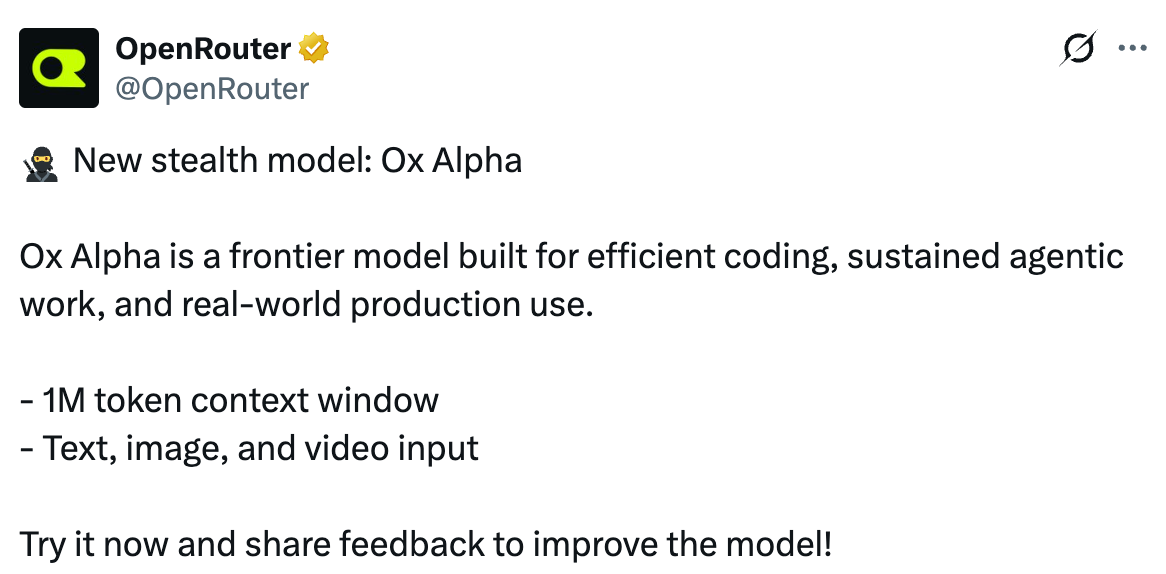
These are generous statements. Yes, new models often land on OpenRouter first, but that is usually a pre-release, offered free to collect telemetry and performance data. This week, for example, there is a stealth model available for free that reportedly scores higher than Fable on DeepSWE:
Source: OpenRouter on X
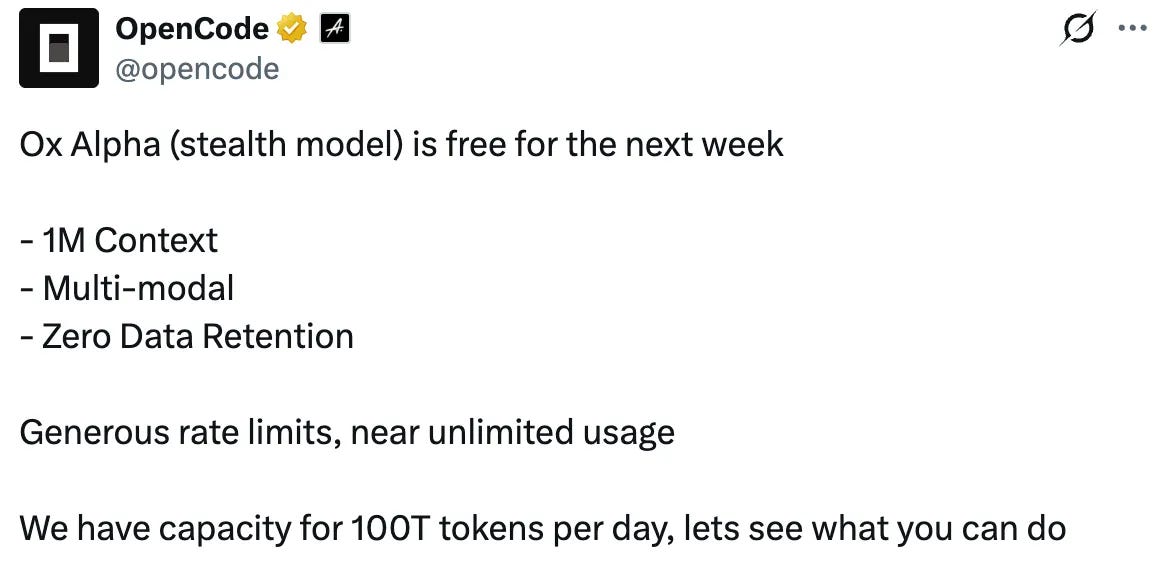
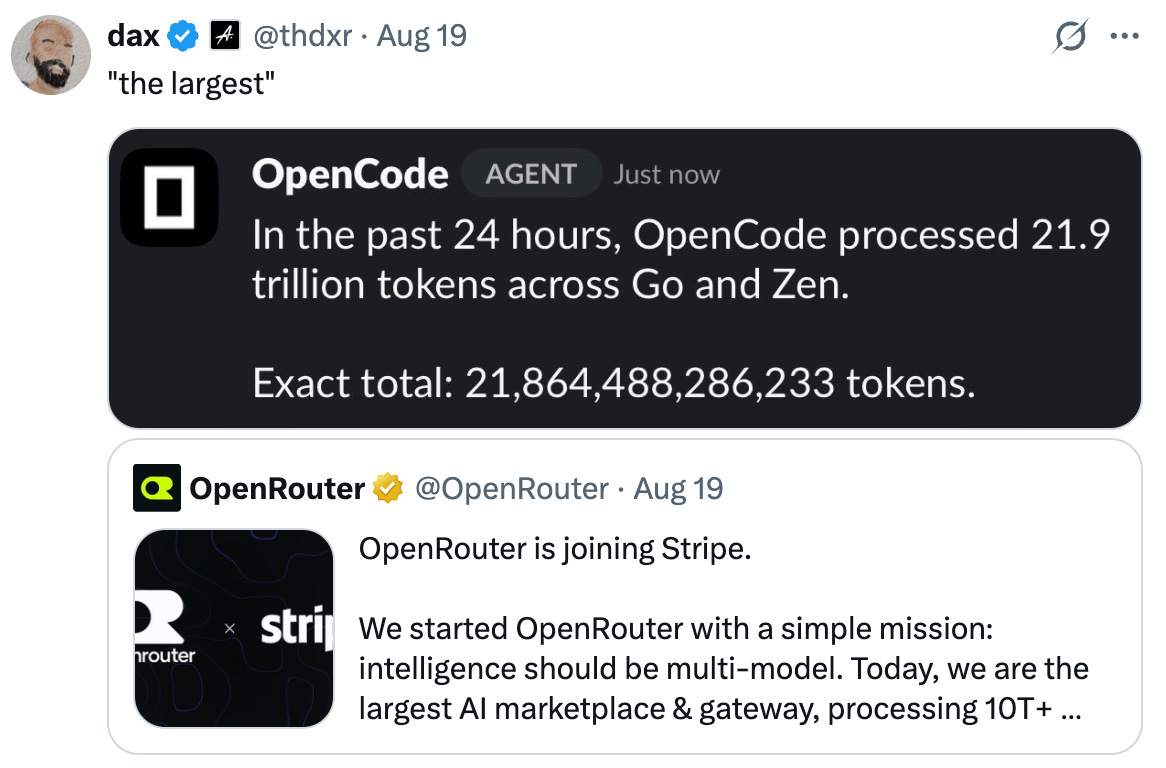
Unfortunately for OpenRouter, the lab behind it is also launching on OpenCode, the biggest alternative model marketplace, which comes with its own harness and agentic workflows.
Source: OpenCode on X
Source: Dax from OpenCode on X
Which brings us back to the core question: who uses OpenRouter, and how much does that overlap with the developer audience Stripe claims it is reaching with this acquisition?
We know that VC-funded early-stage companies are showered with credits and attention from the frontier labs and hyperscalers, so there is little reason for them to start out paying list prices on OpenRouter. We know that OpenCode is taking developer share among people actively trying to avoid OpenAI and Anthropic subscriptions, though only partly, since you can still run your Codex subscription through the OpenCode agent. And we know that corporate buyers reach almost every relevant model through AWS Bedrock, Google Vertex, or Azure AI Foundry.
On the Future of Routers
Contrary to popular belief, OpenRouter’s primary product is not routing tokens; it’s being the best AI gateway. While they do offer an Auto Router, most developers primarily come to OpenRouter to get access to all the different models and make routing decisions themselves. Recently, the burgeoning costs of enterprise LLM spend have become an increasing problem for companies like Uber, Coinbase, and Microsoft. The idea of a router as a panacea to cost is compelling: Why should I use the most expensive model for every subtask of my agent run when I can just route easier tasks to cheaper models? In the last few weeks, the industry has seemingly woken up to this idea simultaneously. Over 10 different companies launched their own routers, from Ramp to Cursor and more.
However, routing based solely on the prompt is actually a bit of a fool’s errand. In the world of agents, when you’re doing a long-running task, you need a lot of context to make sure the prompt goes to the right model. “Find this file in the codebase” could be a task for a cheap, simple LLM or a frontier one depending on the size of the codebase and what the original context is. In a multi-step agentic task, the cost of a router doing the wrong thing compounds downstream, leading to much worse-quality results. The fundamental basis of a differentiated router product is a great unified API with a lot of users already. These users have allowed OpenRouter to silently pick up one of the most expansive datasets of prompts, models for those prompts, contexts around those tasks, and the final results. When used in real production settings, OpenRouter now serves as the best way to mitigate costs by doing routing while genuinely preserving quality. You won’t have to hack around messy evals or continuously update your prompts. You can log in to a dashboard and all it says is, “You can save $100K a year by switching to Muse Spark over GPT 5.6 Sol in this part of your codebase where you use it primarily for summarization. We’ve run the eval for you automatically already!” That is the future of routers.
Stripe + OpenRouter
Stripe and OpenRouter share a similar heritage. Both companies started by winning the developer before moving upmarket. Both companies share a simple, bold design language. Andrej Karpathy called OpenRouter the “transfer switch” of AI, just as Stripe became the switch for payment processing.
The acquisition also marks one of the first large infrastructure outcomes of the AI era. It won’t be the last. The building blocks for managing models, cost, and compute now exist, and they’re letting generational companies form faster than ever. Congratulations to Alex, Chris, Louis and the entire team for building the definitive marketplace for AI models. Stripe set out to grow the GDP of the internet. As of today, that includes intelligence.
There is a lot of storytelling here and not many practical figures. Which is interesting, since the pitch for OpenRouter itself was full of usage and growth metrics.
The reality is that OpenRouter was running at $12M MRR and hiring aggressively for enterprise talent to help large users adopt the platform. This was the moment to choose between scaling distribution alone or riding someone else’s sales muscle, with a healthy dose of founder liquidity on the side.
The Stripe business Over the past few hours, just like every morning, thousands of new businesses have launched on Stripe. From structured data platforms for governments to landscape management systems for gardeners, today’s new businesses span pretty much every sector of the economy. The frontier is a thriving place.
The singularity appears to be accelerating our core business. Stripe’s H1 net revenue increased 41% Y/Y and H1 free cash flow grew 43% Y/Y. By the end of this year, more than ten of our products will generate more than $100M of net revenue, and many of these are growing quickly at scale. In H1, Stripe Billing grew 71% Y/Y, we incorporated our 100,000th business with Atlas (which now accounts for over a quarter of all Delaware incorporations), and Stripe Capital reached more than 100,000 active loans (up 49% Y/Y). Via Stripe Connect, new platforms are activating on Stripe at more than twice the rate of a year ago. Overall, businesses on Stripe are growing significantly faster than the economy as a whole, owing to a combination of selection effects (innovative businesses are likelier to choose Stripe), as well as the cumulative impact of the thousands of small improvements we make each year to accelerate revenue growth for our customers.
We are investing aggressively to grow many new product lines. Stripe Treasury, for example, is one of the fastest-growing products we’ve ever launched, and it will gain a lot of new functionality and global coverage over the coming year. Link, the easiest way to pay online, just passed 300 million users, and has a roadmap chockablock with pending improvements. It’s a rewarding time to be building at Stripe.
We’re pursuing this expansion while paying close attention to shareholder returns. The profitability of Stripe’s core payments engine allows us to make acquisitions like these without significantly diluting existing stockholders. Even while undertaking significant organizational investment and M&A, Stripe’s share count is lower today than three years ago. Stripe’s share price has compounded at 31% since our Series D fundraise 10 years ago, versus 14% for the S&P 500 and 18% for the Nasdaq over that same period. We are more enthusiastic than ever about the prospects of the business from here.
Stripe is, of course, a private company today. We view this as a growing advantage as we venture into the vicissitudes of the singularity. The world is becoming harder to predict and we expect that deft helmsmanship will be required of every company. We’re fortunate to have a corporate structure that helps us steer the right long-term course.
We are grateful for your investment. We will apply ourselves with intensity to ensure that Stripe lives up to its potential.
—Patrick, John, and Will
The era of vicissitudes of the singularity, indeed. The dynamics of this acquisition are quite different from, say, Cursor becoming part of SpaceX.
Technically, OpenRouter was already a heavy Stripe customer for billing, tax, and fraud. Stripe already had Token Billing and Metronome. This completes the intelligence pipeline alongside the money pipeline with almost (on paper) no integration friction.
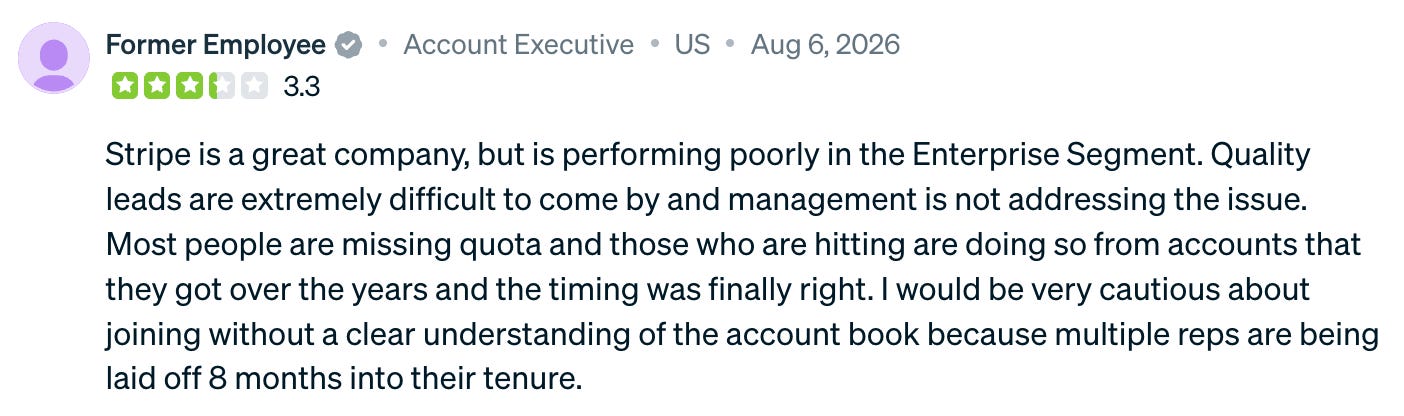
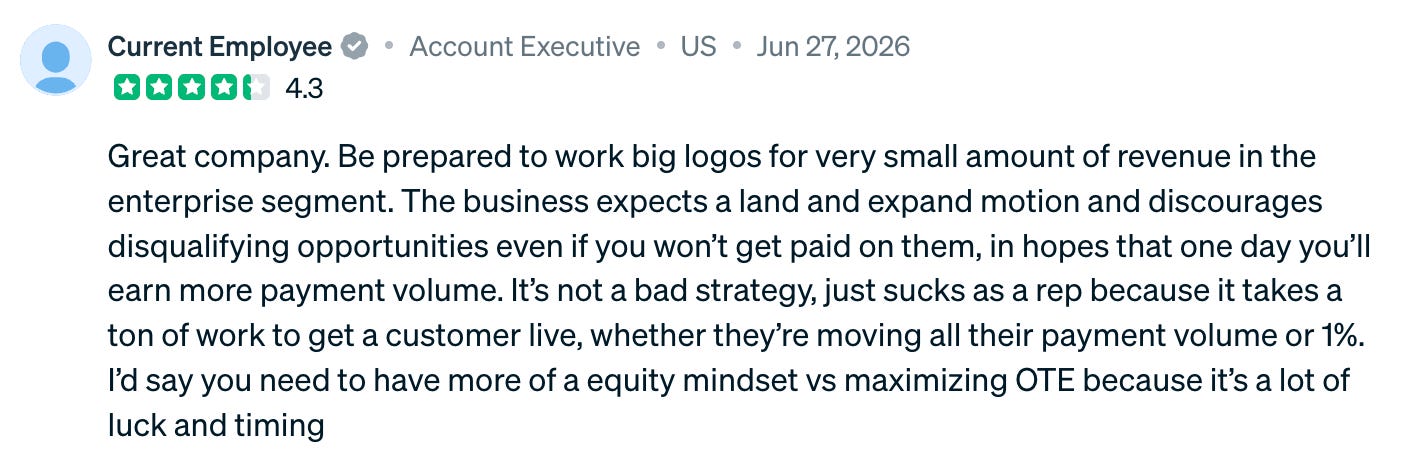
On GTM, Stripe will have to supply the distribution. Since the real money in AI sits in enterprise workloads, that is a problem.
Source: RepVue
Source: RepVue
Source: RepVue
Worth noting that after compensation changes late last year, close to 20% of the GTM team left, on top of already high attrition to the frontier labs and to AI startups. The team that remains has been struggling to gain real enterprise traction, and is now expected to make a fast leap in understanding a sale with a very different audience than the one it knows.
On paper Stripe has a strong developer motion and a bottom-up approach, but that came mostly from being one of the very few companies with any real interest in, or capability for, building programmable payment infrastructure that a technical audience could actually integrate.
Becoming the preferred intelligence platform for those same developers means facing far more competition, from teams of dramatically different size and skill than the payments incumbents. On a single account you might see the hyperscaler of choice fielding up to fifty people, a frontier lab expanding with FDEs building custom integrations, Databricks working the chief AI officer to consolidate usage on their platform, and ServiceNow reps escalating to the CTO that deploying, monitoring, and governing agents obviously belongs to IT.
In strolls Stripe, with one rep who missed quota last year and an OpenRouter sales engineer who has never presented to a large enterprise, pitching a magical 5% cost optimization on the strength of their deep, no pun intended, experience serving the DeepSeek API.
I am being harsh, but the point stands: Stripe is already struggling in enterprise, and the investor letter shows no real understanding of the distribution challenge. Buying OpenRouter and rethinking GTM would have made more sense. Instead there is an overfocus on product synergies and usage metrics, which, as Stripe leadership will find out soon enough, mean very little in the trenches where frontier intelligence actually gets sold.