
Infra Play #150: The big moment for Micron
The ticker is $MU

Micron’s advantage starts with a number most of the coverage skips: the trade ratio. Every bit of high bandwidth memory requires roughly three times as much wafer as a standard DRAM bit, and that ratio climbs with each generation. When Micron pours a wafer into HBM, it pulls that silicon out of the regular DRAM pool, so the product that carries the highest price also starves the supply of everything else Micron sells, and the whole portfolio prices up behind it.
“What does this mean???”
Okay, let’s start more slowly. Micron sells memory, the chips that hold the data a computer is working on right now. Two kinds matter here. DRAM is the short-term working memory inside every server, phone, and laptop, the place data sits while the processor uses it. NAND flash is the cheaper storage that keeps your data when the power goes off, the stuff inside an SSD. Micron’s flagship is a special, high-end version of DRAM called HBM, or high bandwidth memory: dozens of memory chips stacked into a tower and bonded directly onto an AI chip’s package, sitting inches from the processor instead of across the board. Picture a shelf at your desk versus a warehouse across town. HBM is the shelf, and a modern AI chip starves without it.
The fastest GPU on Earth is useless if it sits idle waiting for data, and that is exactly the wall the AI race hit. You can buy all the computing power you want, but without enough memory feeding it, the chip just waits. HBM is what feeds it. Only three companies on the planet can make the stuff, and it takes months of testing to qualify a new supplier for a specific chip. So memory stopped being something you grab off the spot market at whatever price the week sets. It became the thing standing between “we have an idea for an AI model” and “we can actually build it.”
On the chip side are Nvidia and AMD, with Micron’s HBM bonded onto Nvidia’s Blackwell and Vera Rubin platforms and AMD’s Instinct accelerators. Behind them sit the hyperscalers, the handful of giants like Microsoft, Google, Amazon, and Meta spending hundreds of billions on AI, with one of them alone making up 17% of a single recent quarter. And this week the list added a name worth noting for this audience: Anthropic signed a multi-year deal for HBM, DRAM, and SSDs, co-designed memory around how its models run, and sold Micron a piece of itself in the same round. A 47-year-old commodity chipmaker out of Boise, Idaho, written off by Wall Street for decades as a boom-and-bust cycle stock, is now one of the most fought-over names in the entire AI supply chain. The big question, of course, is how long this will last?
SANJAY MEHROTRA, CHAIRMAN, PRESIDENT AND CHIEF EXECUTIVE OFFICER
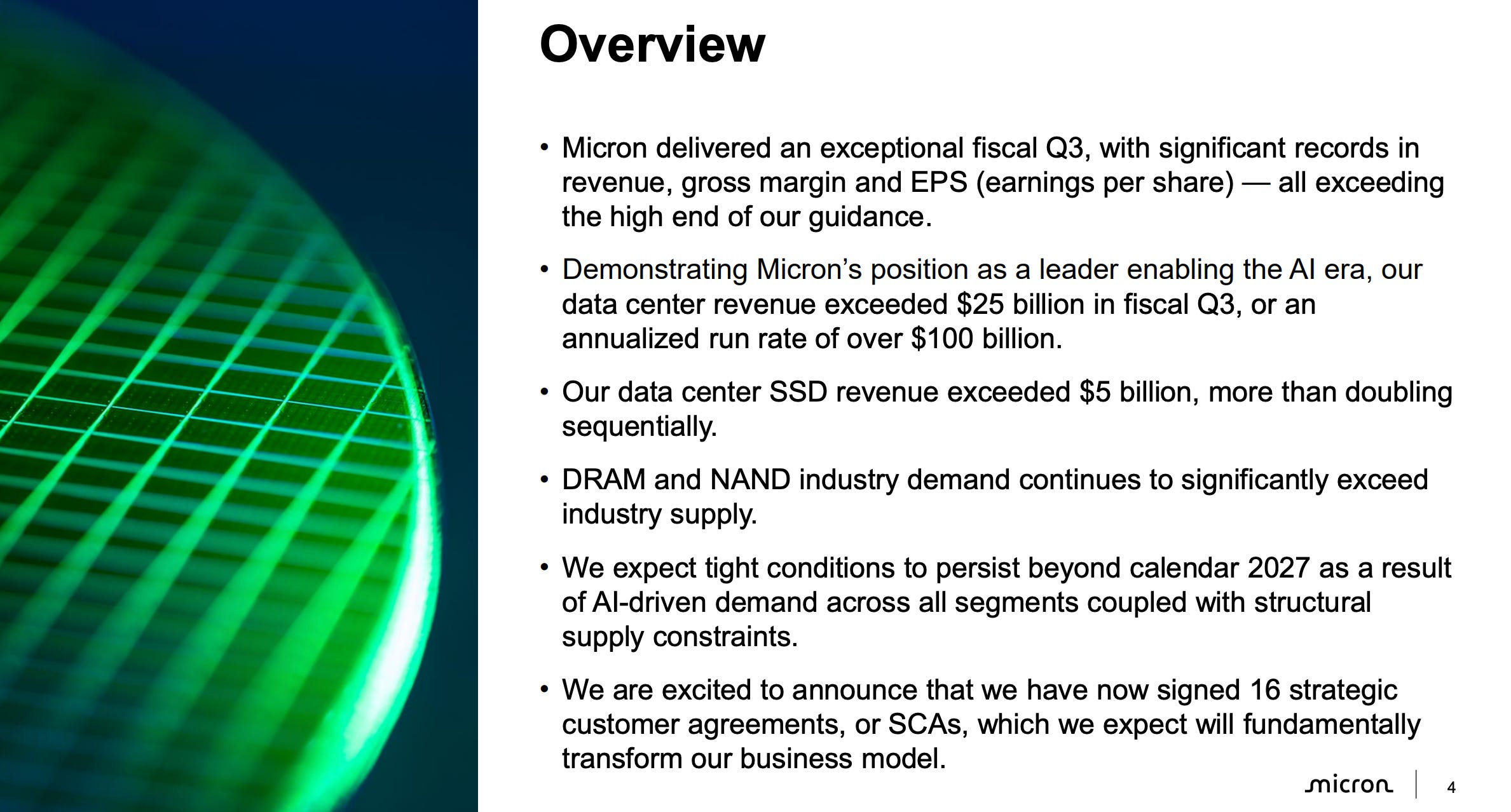
Micron delivered an exceptional fiscal Q3, with significant records in revenue, gross margin and EPS (earnings per share) — all exceeding the high end of our guidance. Demonstrating Micron’s position as a leader enabling the AI era, our data center revenue exceeded $25 billion in fiscal Q3, or an annualized run rate of over $100 billion. Our data center SSD revenue exceeded $5 billion, more than doubling sequentially. DRAM and NAND industry demand continues to significantly exceed industry supply. We expect tight conditions to persist beyond calendar 2027 as a result of AI-driven demand across all segments coupled with structural supply constraints. We are excited to announce that we have now signed 16 strategic customer agreements, or SCAs, which we expect will fundamentally transform our business model.
Industry trends
The memory industry has been structurally transformed by the proliferation of AI. We are only in the early innings of the significant innovation and productivity that can be unleashed in every part of the global economy over time. Data center-driven growth will be increasingly complemented by AI-enabled features in smartphones, high-end PCs and new consumer devices, as well as in automotive, industrial applications and robotics. Exciting possibilities enabled by robotics and humanoids, as well as fully autonomous vehicles, portend a robust long-term demand environment for memory and storage.
With respect to supply, our customers are recognizing that supply shortages in memory and storage will take considerable time to improve. Even as we expect industry supply to improve gradually in 2028, we currently do not have line of sight as to when memory supply will be able to catch up with increasing demand. Memory industry supply growth is dependent on significant greenfield fab expansions. These greenfield projects are large, complex and time consuming. Further, the pace is constrained by several factors, including long lead time for fab construction across the world, shortage of workers with critical trade skills, complex regulations including permitting, and the need for enhanced energy infrastructure. Meanwhile, memory process technology, which is among the most advanced to develop and manufacture in semiconductors, is getting more complex with every new node. Technology transitions are driving slower bit growth over time, wafer growth needs are significantly increasing cleanroom space and greenfield fab requirements, and HBM’s growth and increasing trade ratio with every new generation further pressures non-HBM supply. In NAND, industry suppliers redirecting cleanroom space from NAND to DRAM and overall limited cleanroom space constrain NAND bit supply growth. These factors taken together mean supply is structurally constrained in its growth and ability to meet industry demand, despite our comprehensive efforts to increase supply.
AI systems are powered by GPU, ASIC and CPU designs from an increasingly broad set of suppliers. However, they all share one important characteristic — AI system performance is architecturally dependent on memory subsystem performance and capacity. This has given rise to a more complex memory hierarchy that is providing greater differentiation opportunities for Micron than at any time in our history. It has also elevated the role of memory in the AI world to a strategic asset.
The top ten companies by market cap today are NVIDIA, Alphabet, Apple, Microsoft, Amazon, SpaceX, Broadcom, Tesla, Meta and Berkshire Hathaway Micron.