

As we gear up for the SpaceX IPO (likely ticker SPXQ; 6/12 launch), it's important to understand what the actual story is that Musk is trying to tell the market, and if executed well, how it would reflect on the rest of the industry.
Most IPOs are exits. This one is a funding round dressed as an exit, and depending on how things go, a significant benefit to retail investors. SpaceX is one of the very few public market entrants in the last decade with a genuine monopoly in its core business, a credible thesis on the future of compute, and a founder with a track record of doing the impossible repeatedly.
Vertically integrated innovation engine
“You want to wake up in the morning and think the future is going to be great—and that’s what being a space-faring civilization is all about. It’s about believing in the future and thinking that the future will be better than the past. And I can’t think of anything more exciting than going out there and being among the stars.”
—Elon Musk
Our Mission
Our mission is to build the systems and technologies necessary to make life multi-planetary, to understand the true nature of the universe, and to extend the light of consciousness to the stars. To do this, we have formed the most ambitious, vertically integrated innovation engine on (and off) Earth with unmatched capabilities to rapidly manufacture and launch space-based communications that connect the world, to harness the Sun to power a truth- seeking artificial intelligence that advances scientific discovery, and ultimately to build a base on the Moon and cities on other planets.
The interesting thing about the SpaceX IPO is that the execution here can be considered very boilerplate and favorable for the original investors and the liquidity providers. One of the biggest reasons for Musk's effectiveness and longevity in the game is that he is laser-focused on getting a good deal for his investors and supporters. Still, the actual proceeds of the IPO will go directly to funding AI compute infrastructure, launch infrastructure, satellite constellation buildout, and general corporate purposes.
This is particularly important when the mission that is supposed to be funded here is nothing short of staggering. The goal is very straightforward, SpaceX(AI) intends to compound on its unique manufacturing and hardware execution capability to bring significant amounts of compute to space, that will be both an economic engine for the company and used to build a lead in model training over time.
It's important to note that the successful execution of this IPO will not only provide Musk with significant liquidity to scale his operations, but will also cement him as the unfireable CEO of the organization. He gets to have his cake and eat it too, giving him probably his best shot at going hard after his vision of a multiplanetary species.
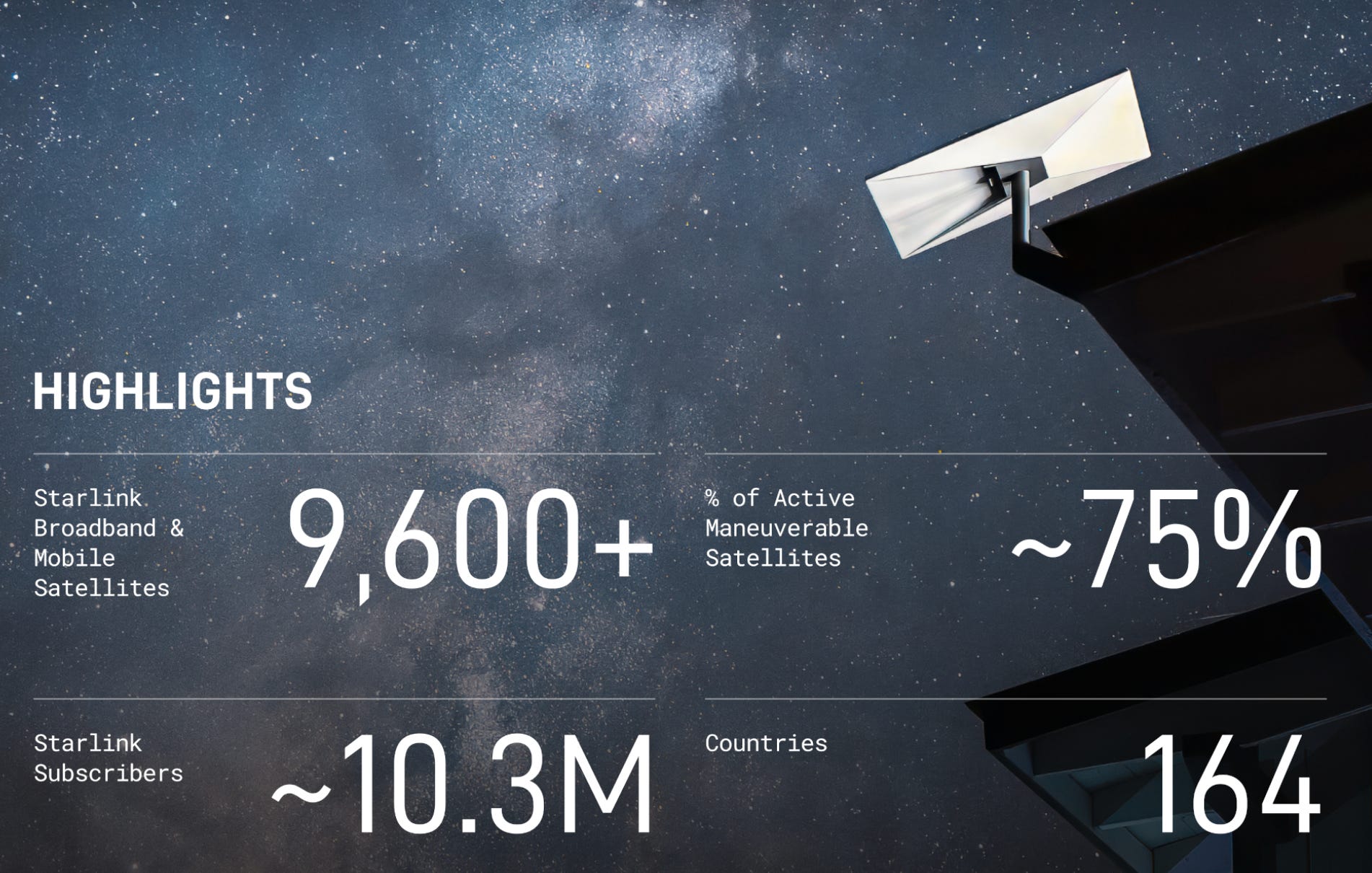
Founded in 2002, SpaceX is the only company building the integrated hardware and software infrastructure of the future across space, connectivity, and AI. At our core, we are builders. We design, manufacture, launch, and operate products and services built on cutting-edge technologies, including the world’s most advanced rockets and spacecraft. We safely and reliably transport astronauts, satellites, and other payloads on missions that benefit life on Earth. Since 2023, we have launched more than 80% of mass to orbit for the world each year with an over 99% mission success rate with Falcon rockets. We also operate a high-speed, low-latency global broadband data and communications network powered by approximately 9,600 Starlink broadband and mobile satellites in Low-Earth Orbit, delivering connectivity to millions of consumer, enterprise, and government customers across 164 countries, territories, and other markets, as of March 31, 2026. Using our dedicated satellite-to-mobile constellation, we offer connectivity services, supplementing terrestrial networks and substantially reducing mobile “dead zones” across approximately 30 countries.
With the potential to improve both space exploration and life on Earth, AI accelerates SpaceX’s mission to make life multiplanetary, to understand the true nature of the universe, and to extend the light of consciousness to the stars. xAI, which was founded in 2023 and acquired by SpaceX in early 2026, is now an integral pillar of our vertically integrated company. We are rapidly constructing AI compute infrastructure—starting on Earth with the goal of extending to space—at industry-leading pace and cost efficiency. Our infrastructure supports training and inference for Grok, which has emerged as one of the world’s most advanced frontier models. Grok is designed as a truth-seeking AI model, built on our founder Elon Musk’s mission to enable humanity to understand the universe. We believe that accomplishing this mission requires a truth-seeking approach to AI.
We define truth seeking as the active, relentless pursuit of what is objectively true about reality, and grounded in evidence, logic, empirical data, and first principles thinking. Our goal is to understand and explain what the universe appears to be doing, as accurately as current knowledge allows. Within two years of its initial model release, Grok achieved frontier-level performance in scientific reasoning, as measured by its GPQA Diamond score, an industry benchmark that evaluates AI models on a standardized set of questions written and validated by experts, on a faster timeline than reported by other leading model providers. Grok also benefits from integration with X, our real-time information, entertainment, and free speech platform, which serves as a foundational distribution and data engine for our AI ecosystem and further enhances Grok’s truth-seeking objective.
The story is not without its weaknesses, namely trying to position Grok as a success, at a time when the majority of the team has left. A lot of their ability to sell the vision will have to rely on more than just "Musk will figure it out," hence why they included the potential Cursor deal as an important part of the investor information.
Our innovations and technological advancements are redefining industries on Earth, while we aim to create new ones on the Moon, Mars, and beyond. We are truly building the infrastructure of the future.
• Space. SpaceX is the only company that has cracked the code on accessing space at scale, revolutionizing an industry characterized by decades of stagnation, risk aversion, and economically perverse cost structures. SpaceX upended this paradigm through the application of first-principles thinking, which rejects industry assumptions and builds solutions based on the fundamental laws of physics. Our intense, mission-driven, engineering-first culture and focus on extreme vertical integration have propelled us to achieve what many deemed impossible. We pioneered high-cadence, reliable, and affordable access to space with our Falcon family of rockets. In 2015, we established at least a 10-year lead over the industry by successfully landing our first Falcon 9 booster back from space before anyone else. Space flight that historically cost billions per launch now costs in the tens of millions, fundamentally reducing the cost of space access and providing the opportunity to build new enterprises in space.
• Connectivity. Since activating service for customers in 2020, Starlink has rapidly expanded global access to high-speed internet, prioritizing underserved rural and remote communities worldwide. While building terrestrial networks in such communities can be prohibitively expensive, Starlink is capable of delivering broadband connectivity anywhere on Earth with just a Starlink Kit. As of March 31, 2026, we had approximately 9,600 Starlink broadband and mobile satellites in Low-Earth Orbit, operating the world’s most advanced broadband constellation providing internet connectivity to approximately 10.3 million Starlink Subscribers across 164 countries, territories, and other markets. In January 2024, we also began deploying our Starlink Mobile constellation that utilizes separate Starlink satellites with satellite-to-mobile capabilities, substantially reducing mobile “dead zones” around the world. As of March 31, 2026, our dedicated satellite-to mobile constellation of approximately 650 V1 Mobile satellites provides satellite-to-mobile data, over-the-top voice, and messaging services to approximately 7.4 million monthly unique devices across approximately 30 countries.
• AI. We were the first company to deploy a coherent gigawatt-scale AI training cluster. For complex reasoning and agentic workloads, compute is directly correlated with the quality of intelligence and task completion speed. In under two years, we have established a dual advantage in both cost efficiency and deployment speed at scale. By owning the compute infrastructure and vertically integrating across the full AI stack, we can train and iterate our frontier models at lower cost and higher velocity and accelerate development cycles. This eliminates external bottlenecks and drives rapid, continuous improvements in model performance. We believe this combination of our state-of-the-art AI compute infrastructure, our truth-seeking frontier model, and our access to real-time data on X creates a significant strategic advantage. Our integrated AI platforms across Grok and X have over 1.3 billion supported accounts active in the last twelve months ended March 31, 2026, including approximately 550 million MAUs and generating approximately 350 million daily posts. Of our MAUs, we had approximately 117 million MAUs that used Grok’s AI features as of March 31, 2026. Grok’s deep integration with X enables freshness, relevance, and contextual awareness that we believe is a competitive differentiator. This direct, real-time access to the information and human discourse on X enhances Grok’s truth-seeking capabilities by grounding outputs in up-to-date knowledge and diverse viewpoints. As a result, we believe Grok can deliver the most objective and relevant insights and best serve high-frequency, high-value use cases across consumer and enterprise AI applications.
If AI is a weakness, connectivity is arguably the single biggest reason why we can “believe” in a potential successful outcome here. The team has done an outstanding job in providing a genuinely great service with Starlink and breaking almost every rule of the telco scaling framework. It’s not difficult to see that if somebody can get inference from space done in the next years, it’s most likely to be SpaceX.