

It appears that we live in the age of abundance of software. This was driven by the expansion of computing power and our ways of making use of it. As a reminder, the core thesis behind this newsletter:
My strong conviction bet is that computing power is the most important resource, alongside oil. Everything that we build in the worlds of atoms and bits depends on it. What are the most important attributes of computing power?
Obtaining it (The art of turning sand into endless racks of deployed compute)
Utilising it (Building applications powered by AI)
Keeping it running (Orchestrating and observing resilient systems)
Protecting it (Securing computing power through software, people, and processes)
The most underappreciated and underreported part of these is how we keep all of this software running on a daily basis.
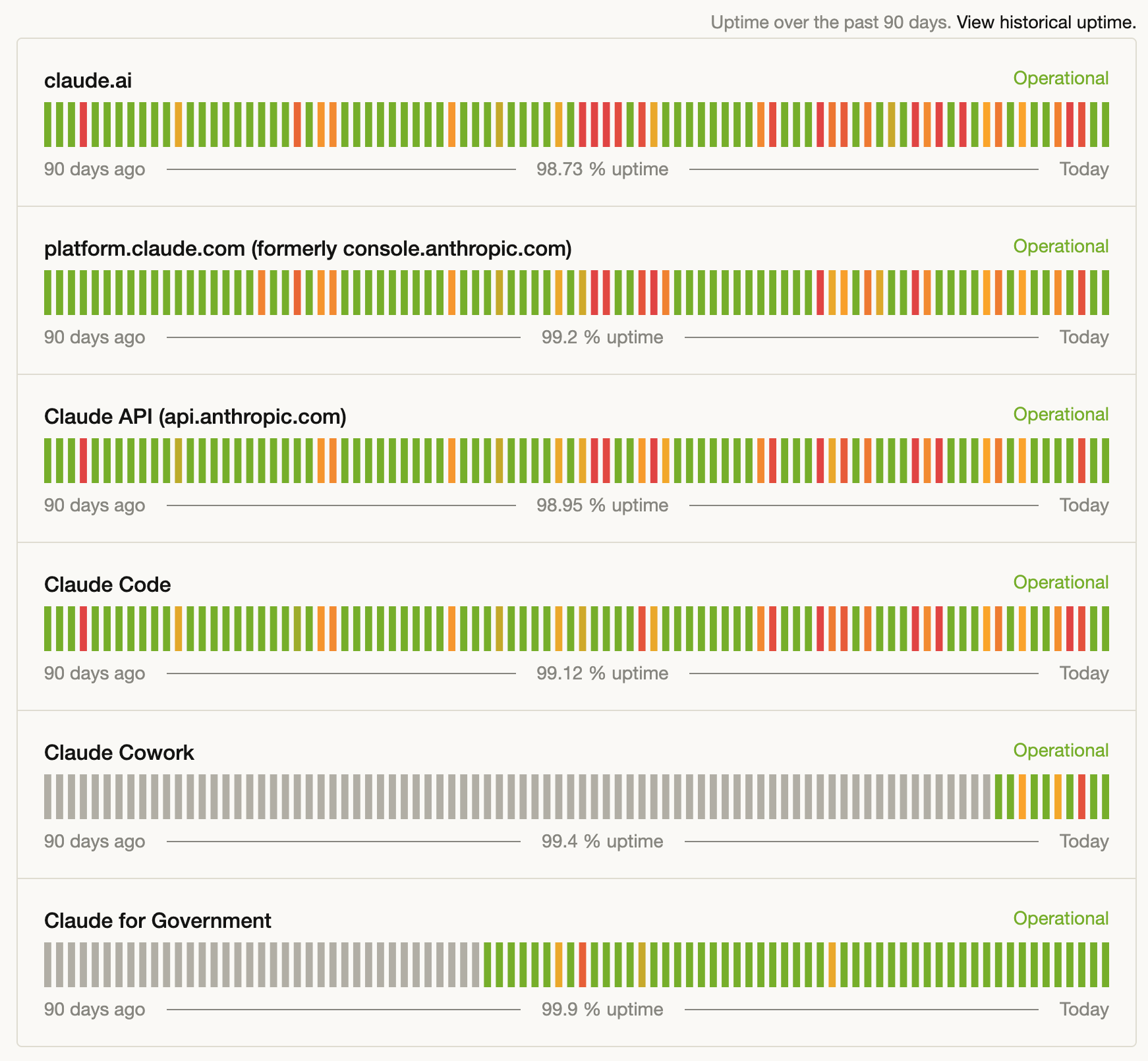
There was a time in the industry, when top performing engineering teams would talk about five, six or even seven 9s of uptime. Today, arguably the most important software company in 2026 is barely able to keep a 99%-ile uptime. To put it into perspective, this means that the main Claude website and the Enterprise API will on average be down for four to five full days every year.
This is a serious and difficult problem to solve. The market opportunity for this has been considered one of the most interesting TAMs in software, with the investor darling Datadog becoming the standard bearer of the industry in the public's consciousness.
Keeping systems running however is not something you just quickly abstract behind a SaaS layer. It's a bona fide engineering job, requiring cross-team collaboration, adaptability, domain knowledge and nerves to keep searching for a needle in a haystack while under immense pressure.
Grafana Labs is one of the most trusted tools in the industry to get the job done. Does this mean it's the next $10B IPO?
The key takeaway
For tech sales and industry operators: The Grafana Labs sales motion works because the company created a category and then built the commercial layer on top of it, which is the correct sequencing. The problem is that the category advantage is being arbitraged away faster than the sales org can convert it. What Grafana actually sells, at its most honest, is faster time to value when things go wrong rather than preventative control, something that is omitted in your usual pitch deck about an unlimited TAM. The open-source-to-cloud conversion path assumed that familiarity with the visualization layer would eventually pull users toward the managed stack. That assumption held when the core buyer had an emotional relationship with the open-source project. It does not hold for developers under 30, who never had that relationship to begin with and are querying logs with AI, setting up automated alerting, and expecting the system to surface the anomaly rather than expecting a human to notice it on a dashboard. In observability the biggest revenue is tied to the workloads that generate the most telemetry, something that makes AI-natives the most interesting greenfield segment in the industry. Unfortunately for Grafana Labs, the majority of business is coming from displacing alternative managed solutions, a business that will look a lot shakier in two years if they remain limited to competing as an efficient option for observability workloads.
For investors and founders: Grafana Labs is at peak success and peak strategic vulnerability simultaneously. The important question to ask is whether the core product premise, specifically that engineers need a sophisticated visualization layer to understand their systems, survives the next wave of AI development. I think it does not, at least not in its current form. The companies building the best AI agents today will eventually turn those agents on their own infrastructure, and the output of that process will be a ticket, not a dashboard. Grafana's real asset is the data access and the distribution network, not the interface sitting on top of it. The trick is that while being widely adopted as an open-source tool has given them a lot of distribution, capturing value without data gravity or workflow control is much more difficult. Data platforms, hyperscalers, cybersecurity companies and other observability vendors are all trying to compete for the same underlying telemetry. A standalone IPO at $1B ARR in the next 24 months would require the company to convince public market investors that dashboards are the future of observability at exactly the moment when agentic systems and data platforms are making that case hardest to defend. The founders did almost everything right. The next decision is the one that determines whether this is remembered as a great infrastructure software company or as a cautionary tale about what happens when a category leader waits too long to expand its category.
The grafanista way
NEW YORK CITY — February 3 — Grafana Labs, the company behind the open observability cloud, today announced a year of strong momentum across customer adoption, product innovation, and market recognition. Over the company’s past fiscal year, which ended Jan. 31, Grafana Labs continued to scale its business while helping thousands of organizations turn signals into action across increasingly complex, AI-driven systems.
Sustained Business Growth and Market Leadership
Grafana Labs entered 2026 with accelerating growth across every dimension of the business:
Annual recurring revenue: Surpassed $400M, driven by continued expansion of Grafana Cloud and growing adoption among large, software-led enterprises.
Customer growth: Now supports 7,000+ organizations worldwide, including 70% of the Fortune 50.
Global expansion: The company added 100+ employees and established a new subsidiary in Japan to accelerate local market growth.
Industry recognition:
Named a Leader in the 2025 Gartner® Magic Quadrant™ for Observability Platforms, positioned furthest for Completeness of Vision
Ranked #13 on Forbes’ Cloud 100, marking the fifth consecutive year on the list
Named a Leader in GigaOm’s Cloud Performance Testing Radar Report
Recognized as Best Observability Solution for Grafana Cloud in the 2025 DevOps Dozen Awards
This momentum reflects a clear trend: as software systems become increasingly distributed, AI-driven, and business-critical, teams are opting for open observability – built on open source, open standards, and open ecosystems – to avoid lock-in and move faster with confidence.
The challenge with doing deep dive articles on companies that are not yet public is that there is typically limited information to understand what direction the company is going towards. Let's start with this bland, but unusual press release, trying to communicate the progress made in their last fiscal year.
From a purely commercial perspective, the company is growing aggressively. Since the announcement of their secondaries sale back in October '25, the company added another $100M ARR in run-rate, something we will see reflected positively in the mood across the go-to-market org.
Powering the Next Generation of AI Companies
As AI-native companies push infrastructure to its limits, observability has become foundational. Over the past year, Grafana Labs deepened its role as critical infrastructure for teams building the next era of AI.
“The pace of innovation in software and AI is only accelerating, and our customers are feeling that complexity every day,” said Anthony Woods, co-founder of Grafana Labs. “This past year showed that open observability isn’t just a philosophy, it’s a practical advantage. From AI-native startups to the world’s largest enterprises, teams are choosing Grafana Cloud so they can understand their systems, control costs, and move at the speed their businesses demand.”
AI leaders, including Anthropic, Lovable, and OutSystems, rely on Grafana Cloud to operate complex, fast-moving systems in production. These teams use Grafana to:
Monitor rapidly evolving AI workloads across metrics, logs, traces, and profiles
Debug distributed systems where model inference, data pipelines, and user experience intersect
Control telemetry cost while maintaining deep visibility as usage scales unpredictably
From training pipelines to real-time inference, Grafana Labs is helping AI builders keep their systems reliable, efficient, and understandable as complexity explodes.


The reality of the observability market today is that AI-natives are not really going towards Grafana Labs. The press release tries to tackle this immediately, claiming Anthropic and Lovable as important customers, but the reality is a bit more complicated than that, with a significant amount of workloads going to new players that are much more focused on the efficiency and speed angle of storing and accessing logs for these dynamic systems.
In observability for AI-natives today, what you’ll commonly see is that Datadog is leading in adoption (with an OpenAI consumption contract into the hundreds of millions), Sentry for the smaller startups without significant complexity and Clickhouse for companies that have significant telemetry and technical challenges.
Grafana Labs, Dynatrace, Elastic and Splunk have mostly struggled with that segment, partly because of complexity of the products and partly because of a curious aspect of software engineering, which we will simplify into “culture”.
Often the tools that software engineers choose, are driven more by trends, external influences and age of the user, rather than some perfect benchmark and a PoC experience.