

As I write this article, missiles are flying over multiple countries in the Middle East. The United States military and its regional allies are attempting to finish the job they started last year: neutralizing the leadership of Iran. Iran has struck back, hitting multiple countries, including the UAE, where one of the largest AI compute datacenters in the world is being built.
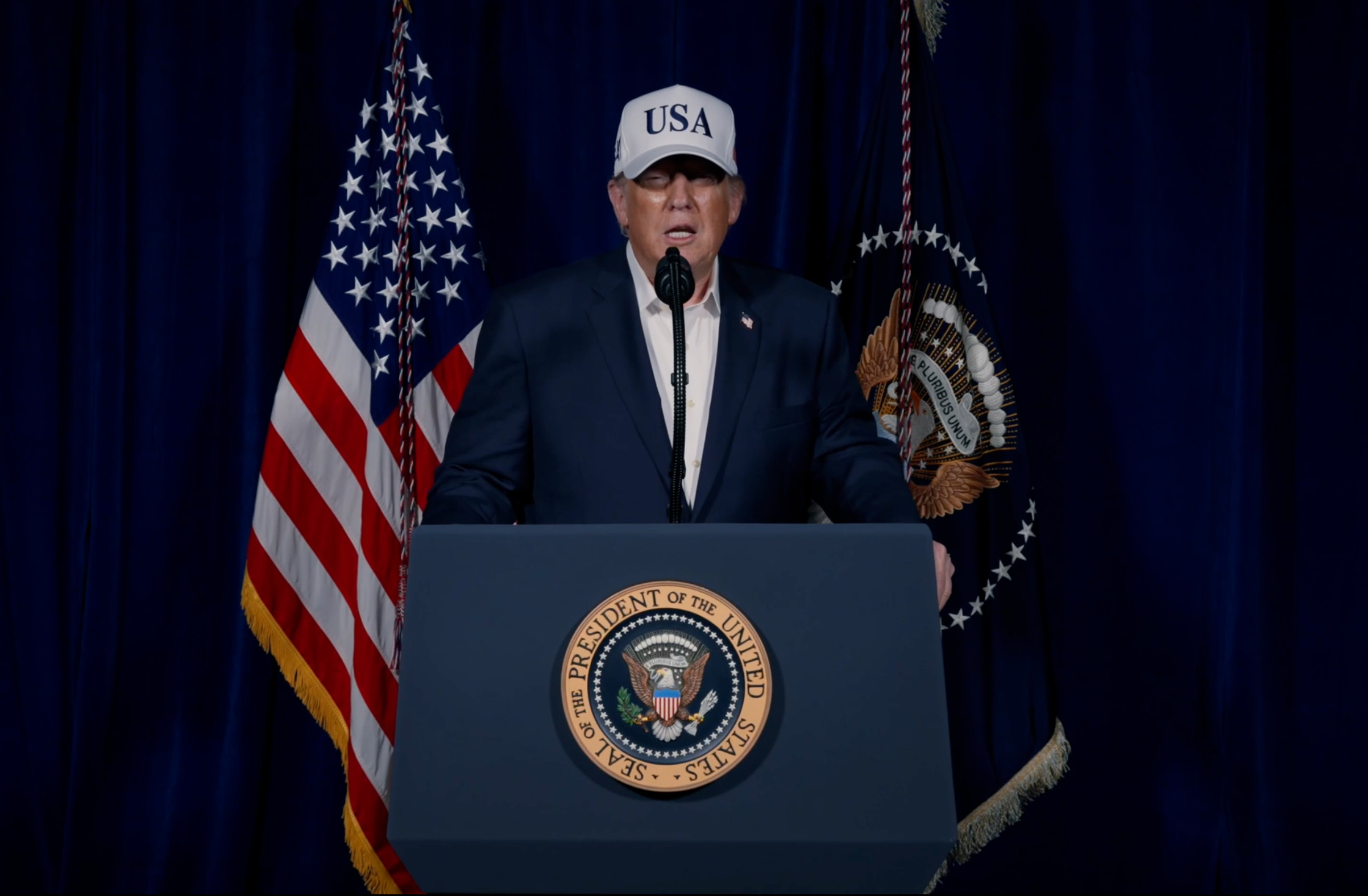
In the background to this event, the Department of War and Anthropic ended up in a high stakes conflict, which at least currently, has led to the designation of the company as a supply chain risk. This played out literally in the hours before President Trump made his announcement regarding the opening salvo of the war.
To call this unprecedented would be significantly understating the impact. The leadership of Anthropic had decided to play a very high stakes game, in relative disregard for the usual way that governments procure technology for defense purposes. During my time in tech, I’ve had the privilege of negotiating software contracts used by governments for national security, and the dynamic has been quite clear from day one. During one of those conversations, a procurement officer flat out told me “look, these renewal clauses that would limit how we use the product are useless, since if it’s part of an operation, we are not going to bother talking to you about it.”
Most of the time, companies would not even have a basic idea of how their products are being used. Access to the teams working with the products typically require government clearances, and the companies that apply to acquire those on behalf of their employees, also sign up to very specific protocols with severe impact clauses. The outcome of violating those goes way beyond “contract got cancelled and we had to refund them”, which has served as a clear deterrent towards software companies acting in what can be perceived as bad faith. Since it is typically very rare for a company to be winning this type of business and still be only founder led (i.e. headcount below 5), by definition a negative outcome would impact the lives of regular employees who have very little incentive to risk going to prison.
Now, let’s try to untangle what has just played out.
Statement from Dario Amodei on our discussions with the Department of War
I believe deeply in the existential importance of using AI to defend the United States and other democracies, and to defeat our autocratic adversaries.
Anthropic has therefore worked proactively to deploy our models to the Department of War and the intelligence community. We were the first frontier AI company to deploy our models in the US government’s classified networks, the first to deploy them at the National Laboratories, and the first to provide custom models for national security customers. Claude is extensively deployed across the Department of War and other national security agencies for mission-critical applications, such as intelligence analysis, modeling and simulation, operational planning, cyber operations, and more.
Anthropic has also acted to defend America’s lead in AI, even when it is against the company’s short-term interest. We chose to forgo several hundred million dollars in revenue to cut off the use of Claude by firms linked to the Chinese Communist Party (some of whom have been designated by the Department of War as Chinese Military Companies), shut down CCP-sponsored cyberattacks that attempted to abuse Claude, and have advocated for strong export controls on chips to ensure a democratic advantage.
Anthropic understands that the Department of War, not private companies, makes military decisions. We have never raised objections to particular military operations nor attempted to limit use of our technology in an ad hoc manner.
However, in a narrow set of cases, we believe AI can undermine, rather than defend, democratic values. Some uses are also simply outside the bounds of what today’s technology can safely and reliably do. Two such use cases have never been included in our contracts with the Department of War, and we believe they should not be included now:
Mass domestic surveillance. We support the use of AI for lawful foreign intelligence and counterintelligence missions. But using these systems for mass domestic surveillance is incompatible with democratic values. AI-driven mass surveillance presents serious, novel risks to our fundamental liberties. To the extent that such surveillance is currently legal, this is only because the law has not yet caught up with the rapidly growing capabilities of AI. For example, under current law, the government can purchase detailed records of Americans’ movements, web browsing, and associations from public sources without obtaining a warrant, a practice the Intelligence Community has acknowledged raises privacy concerns and that has generated bipartisan opposition in Congress. Powerful AI makes it possible to assemble this scattered, individually innocuous data into a comprehensive picture of any person’s life—automatically and at massive scale.
Fully autonomous weapons. Partially autonomous weapons, like those used today in Ukraine, are vital to the defense of democracy. Even fully autonomous weapons (those that take humans out of the loop entirely and automate selecting and engaging targets) may prove critical for our national defense. But today, frontier AI systems are simply not reliable enough to power fully autonomous weapons. We will not knowingly provide a product that puts America’s warfighters and civilians at risk. We have offered to work directly with the Department of War on R&D to improve the reliability of these systems, but they have not accepted this offer. In addition, without proper oversight, fully autonomous weapons cannot be relied upon to exercise the critical judgment that our highly trained, professional troops exhibit every day. They need to be deployed with proper guardrails, which don’t exist today.
To our knowledge, these two exceptions have not been a barrier to accelerating the adoption and use of our models within our armed forces to date.
The Department of War has stated they will only contract with AI companies who accede to “any lawful use” and remove safeguards in the cases mentioned above. They have threatened to remove us from their systems if we maintain these safeguards; they have also threatened to designate us a “supply chain risk”—a label reserved for US adversaries, never before applied to an American company—and to invoke the Defense Production Act to force the safeguards’ removal. These latter two threats are inherently contradictory: one labels us a security risk; the other labels Claude as essential to national security.
Regardless, these threats do not change our position: we cannot in good conscience accede to their request.
It is the Department’s prerogative to select contractors most aligned with their vision. But given the substantial value that Anthropic’s technology provides to our armed forces, we hope they reconsider. Our strong preference is to continue to serve the Department and our warfighters—with our two requested safeguards in place. Should the Department choose to offboard Anthropic, we will work to enable a smooth transition to another provider, avoiding any disruption to ongoing military planning, operations, or other critical missions. Our models will be available on the expansive terms we have proposed for as long as required.
We remain ready to continue our work to support the national security of the United States.
The core two issues that Anthropic leadership claims are at the root of the discussions are domestic surveillance and autonomous weapons, with the important distinction here that they see the latter as an issue because of the maturity of the technology.
The thing is that, according to the government, they’ve been very clear that they want language around “usage for all lawful purposes”.
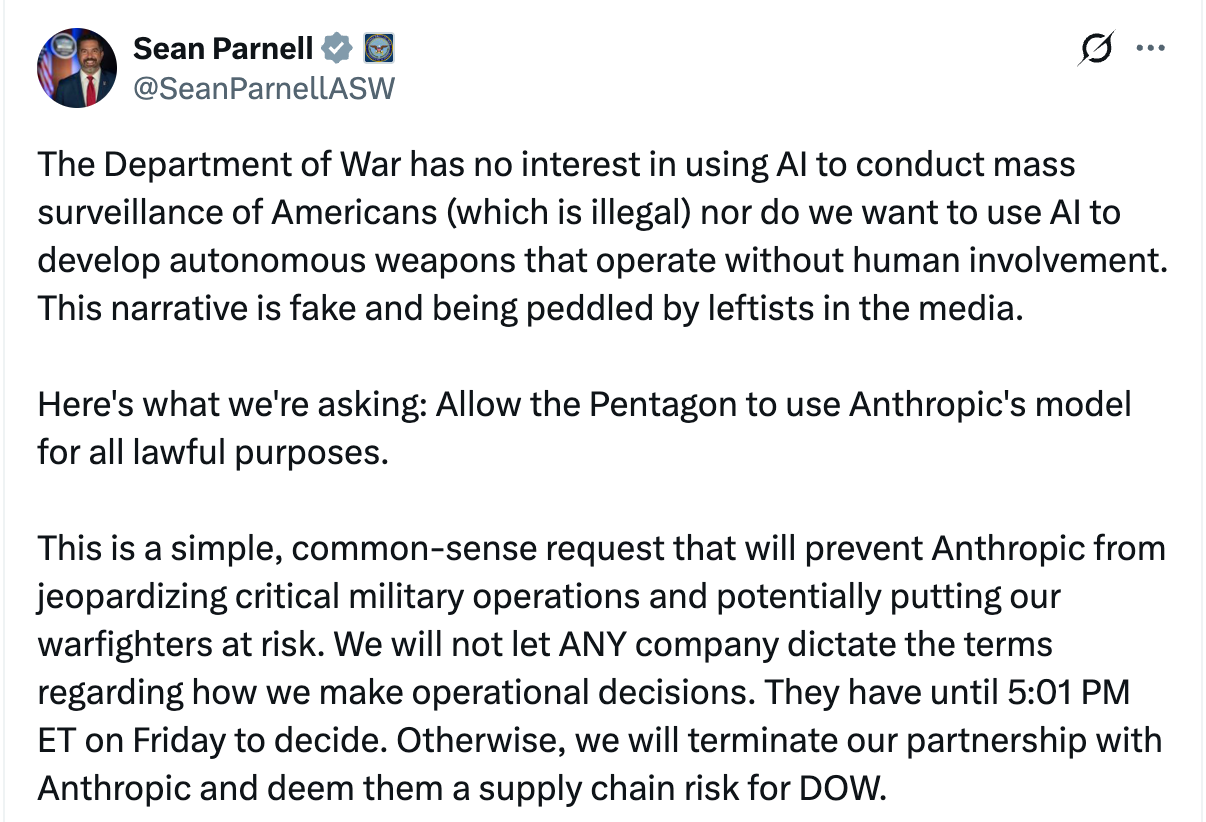
This is not something that is from this week, but is actually tied to a Memorandum on AI use from 1/9/26:
SECRETARY OF WAR 1000 DEFENSE PENTAGON WASHINGTON, DC 20301-1000
JAN 9 2026
MEMORANDUM FOR SENIOR PENTAGON LEADERSHIP COMMANDERS OF THE COMBATANT COMMANDS DEFENSE AGENCY AND DOW FIELD ACTIVITY DIRECTORS
SUBJECT: Artificial Intelligence Strategy for the Department of War
Accelerating America’s Military AI Dominance
President Trump makes clear in Executive Order 14179, “It is the policy of the United States to sustain and enhance America’s global Artificial Intelligence (AI) dominance in order to promote human flourishing, economic competitiveness, and national security.” In the national security domain, AI-enabled warfare and AI-enabled capability development will re-define the character of military affairs over the next decade. This transformation is a race — fueled by the accelerating pace of commercial AI innovation coming out of America’s private sector. The United States Military must build on its lead over our adversaries in integrating this technology, established during President Trump’s first term, to make our Warfighters more lethal and efficient. To this end, aligned with America’s AI Action Plan, I direct the Department of War to accelerate America’s Military AI Dominance by becoming an “AI-first” warfighting force across all components, from front to back.
The Department will achieve this objective by:
Unleashing experimentation with America’s leading AI models Department-wide, and rewarding AI-first re-conceptions of legacy approaches;
Aggressively identifying and eliminating bureaucratic barriers to deeper integration, which are vestiges of legacy information technology and modes of warfare;
Focusing our investment to leverage America’s core asymmetric advantages in AI computing, model innovation, entrepreneurial dynamism, capital markets, and combat-proven operational data from two decades of military and intelligence operations that no other military can replicate; and
Executing a set of “Pace-Setting Projects” (PSPs) that will demonstrate the accelerated pace of execution, focus, and ethos we need to stay ahead. The PSPs will also serve as tangible, outcome-oriented vehicles for rapidly completing our buildout of the foundational AI enablers (infrastructure, data, models, policies, and talent) needed to accelerate AI integration across the entire Department.
The seven initial PSPs outlined below establish the new execution standard: single accountable leaders, aggressive timelines, measurable outcomes, and rapid iteration where failure accelerates learning and improvement.
Acceleration Approach
The means we will employ to pursue this strategy will continue to encompass our substantial program funding and workforce focused on AI across the Services and Components. We will also use the timely financial resources provided by Congress in the form of One Big Beautiful Bill, along with expanded budget withhold (Joint Acceleration Reserve) flexibility, to catalyze our accelerated pace of Military AI integration in the immediate term. And we will leverage the access, capabilities, investments, and insights of America’s allies and partners to support our shared objectives, consistent with the President Trump’s AI Action Plan to “Lead in International AI Diplomacy and Security”.
We will re-focus the Chief Digital and AI Office (CDAO) and these enhanced resources to unlock critical foundational enablers needed to accelerate war-winning efforts across the Department, starting with enabling the set of seven PSPs listed below in fiscal year 2026. These PSPs will address key opportunities for enhanced military AI advantage across Warfighting, Intelligence, and Enterprise mission areas:
Warfighting:
Swarm Forge: Competitive mechanism to iteratively discover, test, and scale novel ways of fighting with and against AI-enabled capabilities — combining America’s elite Warfighting units with elite technology innovators.
Agent Network: Unleashing AI agent development and experimentation for AI-enabled battle management and decision support, from campaign planning to kill chain execution.
Ender’s Foundry: Accelerating AI-enabled simulation capabilities — and sim-dev and sim-ops feedback loops — to ensure we stay ahead of AI-enabled adversaries.
Intelligence:
Open Arsenal: Accelerating the TechINT-to-capability development pipeline, turning intel into weapons in hours not years.
Project Grant: Enabling transformation of deterrence from static postures and speculation to dynamic pressure with interpretable results.
Enterprise:
GenAI.mil: Democratizing AI experimentation and transformation across the Department by putting America’s world-leading AI models directly in the hands of our three million civilian and military personnel, at all classification levels.
Enterprise Agents: Building the playbook for rapid and secure AI agent development and deployment to transform enterprise workflows.
The PSPs will each be led by an exemplary program leader in partnership with a sponsoring organization. Progress will be demonstrated monthly to the Deputy Secretary of War (Deputy Secretary) and Under Secretary of War for Research and Engineering (USW(R&E)), with initial demonstration by transition-partner user(s) to occur within six months from the date of this memorandum.
The CDAO will also ensure all foundational enablers unlocked by these projects are made available to programs Department-wide in real-time, so accelerated execution by PSPs will enable projects across the Department to accelerate their pace along with them. Therefore, I direct each Military Department, combatant command, and defense agency and field activity to identify within 30 days at least three projects they will prioritize to fast-follow these PSPs. Efforts under the Department’s six Critical Technology Areas – including autonomy, C-C5ISRT, and advanced manufacturing — must continue to push the pace for the Department of War (DoW). And the special initiatives outlined in classified annexes, including those in the Classified Annex provided by separate cover to this memorandum, will also be accelerated. CDAO will track and rank this extended pack of AI efforts by speed and impact, and progress will be reported monthly to the Deputy Secretary and USW(R&E).
AI Compute. As part of our AI and Autonomy acceleration investments, the Department will invest substantial resources in the expansion of our access to AI compute infrastructure, from datacenters to the edge. We will leverage the hundreds of billions in private sector capital investment being made in America’s AI sector through our growing array of creative partnerships with America’s world-leading companies. We will work with interagency partners to establish technical standards for new secure datacenters. And we will support and leverage the American Science and Security Platform being developed by President Trump’s Genesis Mission for science and technology innovation, so our warfighters and capability developers have the full benefit of America’s AI compute resources and latest innovations.
Data Access. I direct the CDAO to enforce, and all DoW Components to comply with, the ‘DoD Data Decrees’ to further unlock our data for AI exploitation and mission advantage. Military Departments and Components will establish, maintain, and update federated data catalogs exposing their system interfaces, data assets, and access mechanisms across all classification levels, as mandated by the Department’s May 2021 memorandum, “Creating Data Advantage.” They will deliver their current catalogs — with all available updates — to the CDAO within 30 days of the date of this memorandum. The Under Secretary of War for Intelligence and Security will ensure intelligence data receives parallel treatment, with exploitation pathways established within the same timeframe. The CDAO is authorized to direct release of any DoW data to cleared users with valid purpose, consistent with security guidelines. Effective immediately, denials of CDAO data requests must be justified to the USW(R&E) within seven (7) days, who will remediate or escalate to the Deputy Secretary. Our data advantage is meaningless if our developers and operators cannot exploit it.
Talent. Finally, I believe the best American talent will see this accelerated posture of AI capability development and adoption at the DoW, and I expect each Service and Component to attract and retain this talent. To that end, I direct use of special hiring and pay authorities Department-wide, as well as novel talent programs from the Office of Personnel and Management and other partners, to accelerate our pace of technical talent hiring into AI roles. And I direct each Component to provide AI hiring and talent development plans to the Under Secretary of War for Personnel and Readiness within 60 days of this memo for approval, denial or modification within 30 days thereafter.
Acceleration Expectations
This strategy will accelerate our advantage, and we must implement it with the Warrior Ethos. Consistent with the refocusing of the Department onto a wartime footing, I expect the following approaches to become internalized as essential elements of our execution in this race to maintain Military AI Dominance:
Speed Wins. We must internalize that Military AI is going to be a race for the foreseeable future, and therefore speed wins. We must weaponize learning speed, and measure and manage cycle time and adoption rates as decisive variables in the AI era. We must accept that the risks of not moving fast enough outweigh the risks of imperfect alignment. I direct CDAO to establish deployment velocity and operational cycle-time metrics for all PSPs, to be a focus of their monthly reporting to the Deputy Secretary and USW(R&E).
AI Model Parity. We are seeing unprecedented velocity in the evolution of the frontier AI models. These models are becoming smarter and more robust every day. The Department cannot be working off models that are months or years old. We must have the latest and greatest AI models deployed for our warfighters. Deploying these capabilities across all echelons is simply not enough, we must be able to support and sustain rapid model updates across all echelons. I direct CDAO to establish a delivery and integration cadence with AI vendors that enables the latest models to be deployed within 30 days of public release. This shall be a primary procurement criterion for future model acquisition.
Wartime Approach to Blockers. We must eliminate blockers to data sharing, Authorizations to Operate (ATOs), test and evaluation and certification, contracting, hiring and talent management, and other policies that inhibit rapid experimentation and fielding. We must approach risk tradeoffs, “equities”, and other subjective questions as if we were at war. To this end, I expect our CDAO to act as a Wartime CDAO and work with the Chief Information Officer to fully leverage statutory and delegated authorities to accelerate AI capability delivery, including cross-domain data access and rapid ATO reciprocity on behalf of pace-pushing leaders across the Department. The USW(R&E) will establish a monthly “Barrier Removal Board” with authority to waive non-statutory requirements and escalate blockers for immediate resolution.
Competition > Centralized Planning. As America’s AI ecosystem demonstrates, robust competition by small teams, with transparent metrics for results, is the engine of commercial AI leadership. We must bring this model into the Department and encourage robust competition to spur faster military AI integration. Small, accountable teams will win over process in a race characterized by dynamic and unpredictable innovation. We will measure success through continuous field experimentation: putting AI capabilities in operators’ hands, gathering feedback within days not years, and pushing updates faster than the enemy can adapt. I direct CDAO to establish AI system usage and mission impact metrics for evaluating the success of these AI acceleration efforts. To enable market dynamics to drive resourcing, decisions about future resourcing and deprecation of associated capabilities will principally be made on the basis of these metrics.
AI-Native Warfighting. Together with capability innovation, we must more fully incorporate AI and Autonomy into military planning; tactics, techniques and procedures (TTP) development; and experimentation processes. I direct each Service Chief and Combatant Commander to designate an AI Integration Lead within 30 days, who will work with the CDAO and be responsible for the co-evolution of AI-enabled capabilities with warfighting concepts and experimentation. I direct CDAO to establish criteria for robust experimentation with AI capabilities. And I direct the Joint Staff to designate a senior official to monitor Service AI warfighting concept development and workflow optimization, and provide me with progress reports on a quarterly basis. We must put aside legacy approaches to combat and ensure we use this disruptive technology to compound the lethality of our military. Exercises and experiments that do not meaningfully incorporate AI and autonomous capabilities will be reviewed by the Director of Cost Assessment and Program Evaluation for resourcing adjustment.
Modular Open Architectures. In the AI arms race, system architectures must enable component replacement at commercial velocity to maintain overmatch. I direct Military Department and Component Program Managers acquiring AI capabilities to enforce Modular Open System Architectures (MOSA) along with the “DoD Data Decrees,” exposing modular interfaces and associated documentation sufficient for third-party integration without prime contractor support.
Clarifying “Responsible AI” at the DoW — Out with Utopian Idealism, In with Hard-Nosed Realism. Diversity, Equity, and Inclusion and social ideology have no place in the DoW, so we must not employ AI models which incorporate ideological “tuning” that interferes with their ability to provide objectively truthful responses to user prompts. The Department must also utilize models free from usage policy constraints that may limit lawful military applications. Therefore, I direct the CDAO to establish benchmarks for model objectivity as a primary procurement criterion within 90 days, and I direct the Under Secretary of War for Acquisition and Sustainment to incorporate standard “any lawful use” language into any DoW contract through which AI services are procured within 180 days. I also direct the CDAO to ensure all existing AI policy guidance at the Department aligns with the directives laid out in this memorandum.
Becoming An AI-First Department
The time is now to accelerate AI integration, and we will put the full weight of the Department’s leadership, resources, and expanding corps of private sector partners into accelerating America’s Military AI Dominance.
Becoming an “AI-First” warfighting force requires more than integrating AI into existing workflows. It requires re-imagining how existing workflows, processes, TTPs, and operational concepts would be designed if current AI technology existed when they were created — and then re-inventing them accordingly.
We must drive this transformation across every aspect of the Department. The expectations outlined above must become technological “AI fitness standards” for our Joint Force. 2026 will be the year we emphatically raise the bar for Military AI Dominance.
I've included the full memo since it outlines quite obviously a significant shift in how the US government is adopting AI, particularly when it comes to the work of the DoW. It's incredibly bullish for the frontier labs, as it basically guarantees wide adoption (including of the latest models as they get released). There is one "but" here, that Anthropic took offense at: