

One of the insights I personally find interesting about people is what choices they make when there is actual skin in the game.
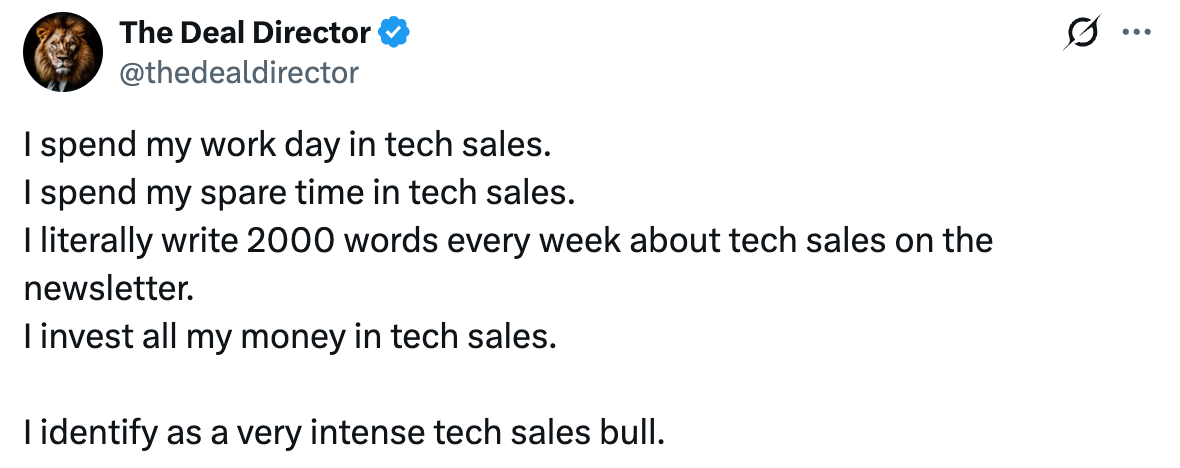
Two years ago I wrote this statement and funnily enough, it still remains true. I would consider my interest in tech to have expanded beyond selling (into building and integrating technology for what comes next). I would also say it’s narrowed from tech in general to cloud infrastructure software. Narrowed is a bit generous, as the world has fully transitioned into a place where the majority of value today accrues in the compute and software that runs everything. In a way, every company that matters today is a technology company (a bank is just a tech org with a banking license), so while I don’t care about “traditional SaaS,” I’m definitely interested in the downstream impact of cloud infrastructure software (physical AI).
Now today we will dive a bit deeper on the invest part of the activity. When you focus intently on a topic for a really long time, certain patterns and ideas start to emerge that you can choose to take action on.
I think that the mindset of “is this worth investing in” is a good mental model to explore, together with the even more insightful side of things which is “why did this investment not play out?” Sometimes it can overlap very well with working in a sales role for that company, sometimes the two can be almost opposite of each other.
Starting from this year, we will track on a quarterly basis my portfolio related to cloud infrastructure software. For obvious reasons, this is not financial advice, but it is a fun way to explore the investing side thesis of the Infra Play.
The context:
The portfolio is made up of individual stocks and will not include other asset classes or financial instruments. I think that using leverage is always gambling on steroids and as the markets have turned more volatile, it’s an obvious way to transfer liquidity from retail towards professionals.
Speaking of retail, all of these should be accessible to acquire, so we are not going to touch the secondary market for private shares. There are other concerns there (such as are these real shares, liquidity, and how realistic the valuations are). This might have to change if we don’t see actual IPOs this year for the main players.
These are directional bets in a very dynamic environment.
I have a high tolerance for losses and I’m comfortable with both short-term and long-term bets.
I’ll share the actual companies in the free section of the post (no gatekeeping), but will keep the analysis and extended list of companies I’m considering in the paid part of the post.
We will not rebalance the portfolio each quarter, but instead will buy and sell during the quarter if the directional opportunity is there. The main reason for a company to stay in the portfolio would be “I believe there is more upside here compared to the bench,” and companies will be sold the moment that’s no longer true.
When picking companies, the analysis will be influenced by more than company performance, i.e. I’ll account for the current narrative and company sentiment. As retail flooded the stock market in the last five years, the “value” side of investing has more or less gone out of the window, with most of the outperformance being driven by either absurd real-life momentum (NVIDIA) or vibes (Palantir). As such, this will also not include complete unknowns with low liquidity because they are unlikely to have any real push from retail, which also means it’s unlikely they’ll move in a meaningful manner.
The portfolio is only covering cloud infrastructure software related bets. Companies are here because I find them relevant in the context of the technological shift happening today. This will not include my overall assets, i.e. vested W2 stock, ETF holdings in retirement funds, other assets including cash. This portfolio represents around 25% of my total net worth, so taking sizable risks is meaningful, but not devastating.
With the ground rules out of the way, the full list of companies as included today are: NVIDIA (NVDA), Amazon (AMZN), Intel (INTC), Sandisk (SNDK), Nebius (NBIS), and Marathon Petroleum (MPC). This represents a mixture of compute, hyperscalers, and energy related to the AI build out. Outside of the software sold by and hosted on AWS and Nebius, there are no pure play software companies here, which we will explore in the extended section.
Let’s dig into the thesis behind this and the alternatives sitting on the bench.