

The reason I focus on cloud infrastructure software companies is that they often have an outsized impact on the world around us, even if on paper they are “small” or a “niche industry.” One of these examples is Cloudflare, a cybersecurity company that, while on paper is a cybersecurity vendor, has progressively grown into one of the critical backbones of how the Internet operates today.
Its influence is so significant that many see Cloudflare as the main opposition to the threat of the frontier AI model labs taking full control over knowledge distribution. On the other hand, it has a mixed track record with sales teams and investors.
The key takeaway
For tech sales: The 35% attainment rate is a feature, not a bug, because it it filters for missionaries who can navigate the complexity of selling a platform across NetOps, SecOps, and developer ecosystems. Cloudflare’s growth comes from efficiency at scale, which inverts typical consumption-based sales motions. After years of GTM pain, we’re witnessing the early stages of a predictable upward cycle that has played out at ServiceNow, Snowflake, and others at similar inflection points. I’m adding them as a soft Deal Director recommendation, as I think we are seeing the right (if not very inspired) correction on the GTM leadership side.
For investors: While sales reps worry about quota attainment, investors face a bigger question: will the open web survive AI consolidation? Cloudflare has proven remarkably durable (even poor GTM execution couldn’t destroy their moat as critical internet infrastructure). This is a contrarian bet that the network layer (enabling safe, efficient connectivity) matters more than the data layer (storage and intelligence). The difference between today’s $2B revenue and a potential $10B outcome hinges on whether distributed networks can resist centralization by AI platforms. Cloudflare’s monopolistic position over the open web makes it either the last line of defense or the next acquisition target.
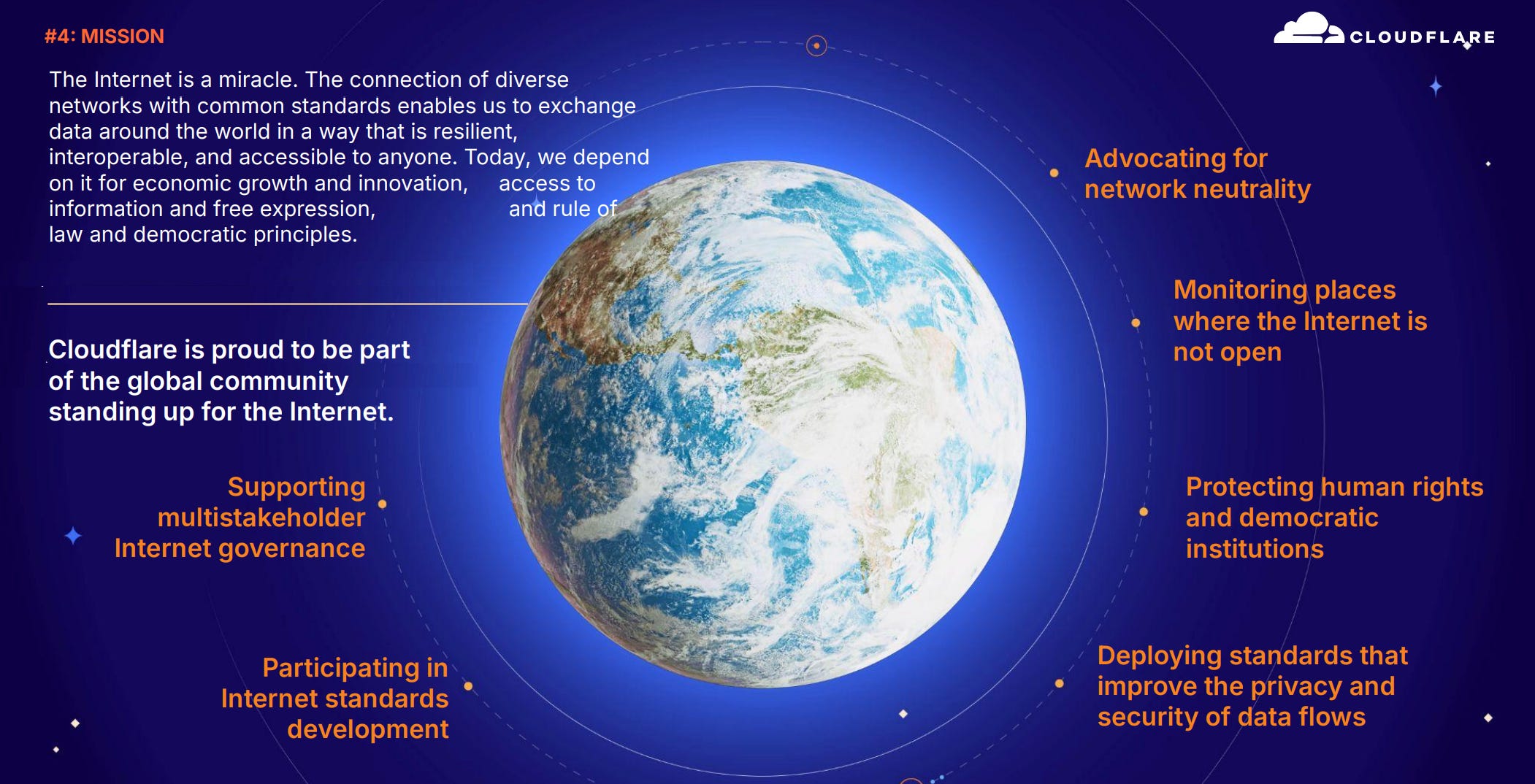
Building a better internet
Source: Cloudflare Investor Day 2025
Matthew Prince: If I’m at a party and someone asks me what I do and I don’t want to talk to them anymore. Yeah. I say that Cloudflare makes the Internet faster and protects it from bad guys.
Okay. And they say, Oh, that’s really nice.
Matthew Prince: And then they walk away. If I do want to talk to them more, I say, What we did at Cloudflare was we looked at what the Internet became. And it was never supposed to be this. The the Internet was the sort of academic side project. There was actually another project coming out of out of DARPA at the same time, which was the highly secure, you know, supposed to be the robust network.
Matthew Prince: Mhmm. Turns out like many of these things, the toy took off, the robust one died. But now we’re stuck with all the mistakes that we made where if you look at the original papers describing how the Internet worked, there’s often a section on security and it would say security is beyond the scope of this paper. Right? Or, you know, if they it would say, like, how how do we make sure these things are actually going to work together?
Matthew Prince: People didn’t really consider that from the beginning. And so what we think of as sort of the problem space that we’re working on at Cloudflare is if you could go back and reengineer the Internet to be how it should have been if we had known what it was going to become from the beginning, what would that look like? And that has kind of led us to all of the things that we’ve that we’ve that we’ve delivered at Cloudflare.
Most of us take for granted the idea of “the internet” as something that will keep working and somebody else can fix it for us. Most of my readers work for companies whose entire business model depends on the same level of access to the internet for both themselves and their customers.
The continued existence of the digital highways is not guaranteed. The biggest players in cloud infrastructure software (the hyperscalers and the frontier model labs) would actually benefit from consolidation within their own networks.
Source: Cloudflare Investor Day 2025
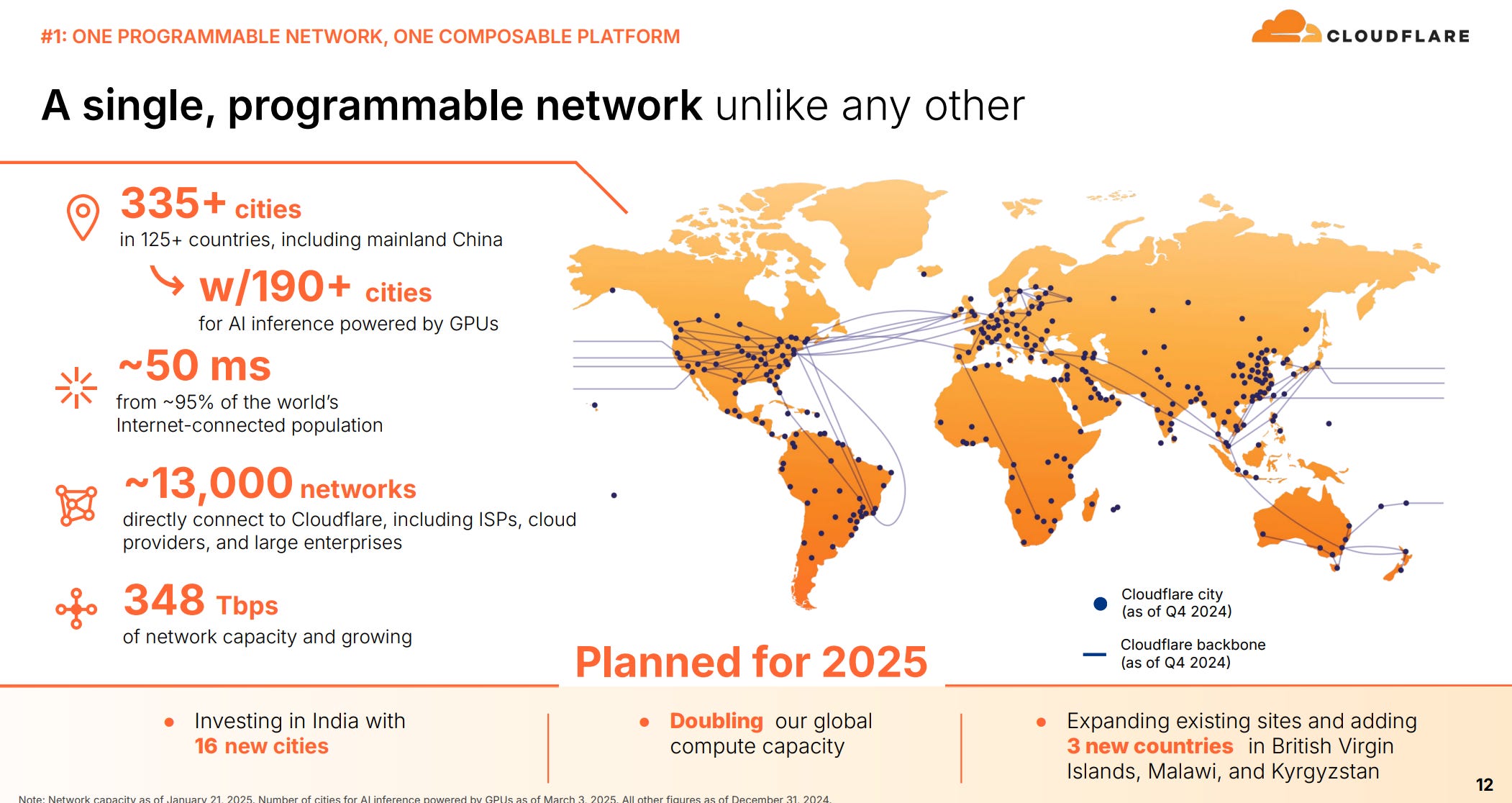
Matthew Prince: The reason we can have a free version of our service that doesn’t actually impose that much cost on us is there’s always somewhere on Earth where there’s a computer sitting, one of our servers sitting, not running at its top kind of capacity. And so that that just that’s like the space over the urinals in the bathroom.
Matthew Prince: It’s it’s an asset that you didn’t think that you could sell, but it turns out that someone once said, well, we can put ads there, and then and it and it became a resource. We’ve got that excess capacity, so we built the ability to move code around or move load around in order to take advantage of that. That’s why the utilization rates of our equipment are so much higher. It’s why we can get so much more out of every dollar of CapEx spend than you can if you’re one of the hyperscalers, which which are fundamentally in a different business.
They’re in the business of buying a server and then basically selling it back over time for fivetimes what they originally bought it for.
Matthew Prince: We we’re in the business of of running code super efficiently across across that. And so in the case of the hyperscalers, optimization is their client’s problem. In the case of us, optimization is our problem. And so that’s that’s that’s what we are doing. And to answer. your question, server is a I mean, it’s a pretty beefy these servers are pretty beefy.
Now the obvious question here is, does this mean Cloudflare is some sort of a cybersecurity hyperscaler for the open web? Interestingly enough, it’s a lot more nuanced than that.